Inflation has two lives in India. In the kitchen, it is the price of vegetables, milk and cooking oil. In the dealing room, it is a number shaped by consumer price data, crude oil, bond yields and expectations of the Reserve Bank of India’s next move. Both influence economic behaviour, but they tell very different stories.
Central banks influence the economy partly by shaping what households and businesses expect inflation to be. The work of Robert Hall and Michael Woodford, recognised by the 2026 Nobel Prize in Economic Sciences, has helped establish the theoretical foundations for understanding these expectations. Yet, real-world behaviour often departs from the assumptions underpinning economic models. India offers a revealing example: households and bond dealers observe the same economy but interpret inflation differently. The RBI needs to understand both.
Kitchen Economics
Every two months, the RBI surveys around 6,000 households across 19 cities about current inflation and their expectations for the year ahead. In September 2026, households put current inflation at a median 8.4% and expected it to reach 10% over the following year. Official September inflation, released on 12 October, was 5.54%, falling to 4.88% in urban India, where the survey is conducted.
The gap is persistent. In September 2025, households estimated inflation at 7.4% and expected 8.7% a year later. Actual inflation that month was just 1.5%, the lowest in eight years. By September 2026, it had risen to 5.54%, still well below what households had anticipated.
Households do not form expectations solely from official data. They rely on prices they encounter regularly, particularly food and fuel. Food inflation stood at 7.74% in September, considerably above the headline rate. A ₹20 increase in the price of tomatoes is immediately noticeable, while a cheaper phone or data plan may barely register. Price increases also tend to leave a stronger impression than equivalent reductions.
International research finds that people who shop for groceries report higher inflation expectations than those who do not, while experiences of high inflation can shape expectations for years. Indian studies identify similar patterns.
These perceptions are not necessarily irrational. Households care about frequently purchased essentials, but those prices can become a misleading guide to inflation across the economy. The result is a persistent tendency to overestimate the overall rate.
Dealing Room
Bond dealers approach inflation through CPI releases, crude oil prices, US Treasury yields and RBI communications. The RBI’s Survey of Professional Forecasters put inflation at 5.1% for 2026-27, close to the central bank’s own projection of 5.2%, revised on October 7. Neither comes close to the household survey’s 10%.
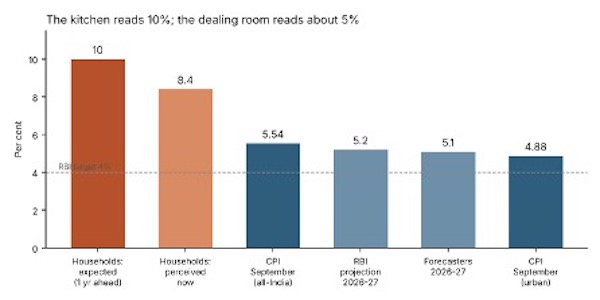
How far apart India's inflation readings are (percent). Source: RBI Households' Inflation Expectations Survey, September 2026 round (median); RBI Survey of Professional Forecasters, 102nd round; RBI Monetary Policy Statement, October 2026; MoSPI CPI release, 12 October 2026.
A dealer would hardly use the household median as a direct inflation forecast. But dismissing the survey altogether could be a mistake.
The direction of household expectations may matter more than their absolute level. Between July and September, one-year expectations rose from 9.4% to 10%, while two-thirds of households expected prices to rise faster. Crude oil remained above $100 a barrel and the rupee weakened. September inflation subsequently rose to 5.54% from 4.83% in August, exceeding market expectations for the July-September quarter.
Businesses were also signalling greater pricing pressure. In the RBI’s industrial outlook survey, the net share of manufacturers expecting to raise selling prices increased from 16.7% to 28.4% for October-December.
These signals matter because expectations can influence behaviour. Workers may seek higher wages when they anticipate rising prices, while businesses may increase selling prices in anticipation of higher costs. Such responses can make inflation more persistent.
The RBI raised the repo rate by 25 basis points on October 7, while the 10-year government bond yield climbed to around 7.4%. For dealers, rising household expectations may be less a forecast of inflation than a clue to the pressures facing the central bank and its likely response.
Two Biases
Households are not the only ones prone to misreading inflation. Markets can react sharply to crude oil spikes, surprise CPI figures or changes in central-bank language, sometimes adjusting rate expectations more than the underlying news warrants.
Both groups can place too much weight on recent and visible information. Households may overreact to food prices; dealers may overreact to the latest data release. Their methods differ, but neither is immune to short-term distortions.
For the RBI, the lesson is not to privilege household surveys over official data, but to recognise that expectations form differently across the economy. Publishing an inflation figure will not persuade households that prices are rising more slowly if their experience at the market or petrol pump suggests otherwise. Clear communication and credible policy can help explain the difference and prevent temporary shocks from becoming persistent pressures.
Financial markets, meanwhile, should watch changes in household expectations without treating their levels as reliable forecasts. A rise can signal growing public concern even when the absolute estimate is too high.
The survey has limitations: it covers 19 cities, excludes rural India and conceals differences between income groups in its median. Yet its persistent divergence from official inflation highlights the gap between statistical measures and lived experience.
The kitchen and the dealing room offer different perspectives on the same economy. One captures the prices people experience; the other interprets data and anticipates policy. Neither provides the complete picture.
The Nobel-winning framework places expectations at the heart of economic decision-making. India’s experience adds an important complication: expectations depend not only on economic information, but also on which prices people see and how they interpret recent events. For the RBI, understanding these differences is essential to keeping inflation expectations from becoming a source of lasting instability.
*Views are personal and not those of the authors' employers.
.png)