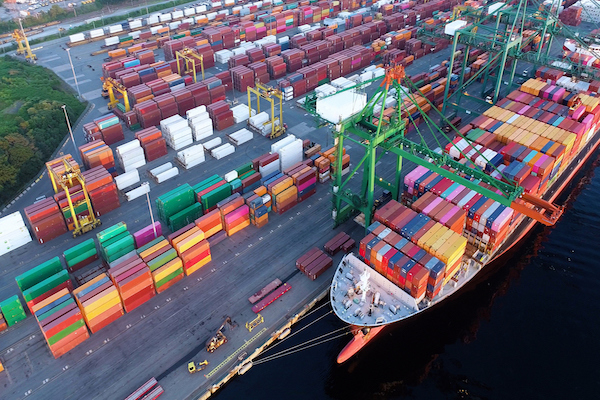






A Countercyclical Manufacturing Gambit: India bets ₹100 billion on container production amid global trade flux, eyeing niche value and logistics leverage over volume dominance.
Sharmila Chavaly
iStock.com
Debates about the impact of AI have centered on potential job losses, with far less attention paid to its implications for the business landscape. But corporate leaders should be thinking about how the technology can enhance their organisational capabilities and, in turn, increase economy-wide productivity.
Diane Coyle
India’s Finance Bill 2026 restores capital gains taxation on share buybacks while adding a promoter levy, raising fresh compliance and litigation risks.
Sangeeta Jain
Reskilling helps, but the real test lies in building sovereign compute, research depth, and new institutional responses to AI-led change.
Srinath Sridharan
Anand Venkatanarayanan
The India–EU FTA offers scale and promise, but strict standards, climate rules and structural gaps mean gains will be gradual, uneven and hard-earned.
G. Chandrashekhar
PMO
For the first time since 2011, Mamata Banerjee is going into an Assembly election without the cushion of certainty.
Amitabh Tiwari
Istock/com
Across the Global South, one of the biggest challenges is not just to build more infrastructure, but to build it right. Without institutional capacity and financial depth, the increasingly popular public-private-partnership model can backfire, creating a vicious spiral of debt, delays, and disillusionment.
Rakesh Mohan and Divya Srinivasan
National Highway Authority of India
AI sovereignty is not about apps or agents. It rests on GPUs, high-bandwidth memory, chip fabrication, political will, and the capital to fund long-term risk.
TK Arun
PIB
BasisPoint Insight
As AI tools grow more powerful, fears are mounting that they could disrupt India’s IT-led growth and threaten white-collar jobs. The real question is whether humans and AI will compete or collaborate, and whether India can turn disruption into opportunity.
Nilanjan Banik
India’s unique opportunity to transition from back-office IT servicing to AI-building offers a promising pathway to global trade leadership in a services-driven economy.
Ninupta Srinath
After years of public capex leading growth, tentative signs of private investment revival emerge. But capacity use, demand trends and sector skew keep the cycle uncertain.
Sharmila Kantha
India’s apple economy is at a crossroads. Imports, now equal to roughly one-fifth of domestic production, will likely expand further.
Ajay Srivastava
Revised weights, softer underlying inflation and corridor liquidity dynamics suggest room for calibrated action in April, subject to incoming data.
Barendra Kumar Bhoi
While anyone familiar with past technological hype cycles can see that today's predominantly young technologists are overly optimistic about AI's potential benefits, mainstream economists seem to suffer from tunnel vision of a different sort. If recent history is any guide, that should worry us all.
Charles Ferguson
Dragon Claws/iStock.com
The government has described the rise in women’s unemployment as a short-term phenomenon. But a 1.5 percentage point jump in joblessness for a group where unemployment is already persistently high is not easy to dismiss as routine variation.
Akshi Chawla
The next phase of the clean-energy revolution will be led not by those who build more solar panels, but by those who modernize their grids, markets, and institutions accordingly. In fact, AI-ready grids will be as crucial to the Global South’s development as traditional infrastructure like roads and ports.
Nandan Nilekani and Ashish Khanna
At Munich, Rubio sketched a new Western century rooted in Christian civilisational pride and economic sovereignty. This is bound to unsettle post-colonial nations.
Rajesh Ramachandran
Gage Skidmore/Via WikiCommons
With banks strong and inflation anchored, India’s risk is not fragility but comfort. Governing success will demand pre-emptive discipline.
Anupam Sonal
Michael Patra is an economist and former RBI Deputy Governor.
Arun is a seasoned writer on economic and policy matters.
Abheek is an Independent Economist and the Former Chief Economist at HDFC Bank.
Ajay Srivastava is the founder of the Global Trade Research Initiative.
Vijay Singh Chauhan, a former IRS official, is a Senior Visiting Fellow at ICPP, Ashoka University
Dhananjay, a D-School alum, is CEO and Co-Head of Equities at Systematix Group.
Kriti is a psychologist specialising in mental health, org behaviour, and brand strategy
Srinath is an author, corporate advisor, and independent director on corporate boards.
Ex-civil servant Chavaly held key Railways, Finance roles; specialises in infra & PPPs
Nilanjan Banik, Professor at Mahindra University, specialises in trade and development economics.
Sachin was till recently an MD with Standard Chartered Bank.
Rajesh Mahapatra is the former Editor of The Press Trust of India
Krishnadevan is Editorial Director at BasisPoint Insight.
Chandra advises companies on big-picture narratives on strategy and markets.
Kalyan Ram co-founded Cogencis. He now leads BasisPoint Insight.
Gurumurthy is an ex-central banker who handled markets, and later, financial stability for RBI.

Lt Gen Syed Ata Hasnain is a former Commander of India’s Kashmir Corps.
Arvind Mayaram, former Finance Secretary, is Chairman of the Institute of Development Studies, Jaipur.