Telangana has some good news on tax revenues. According to provisional data from the State Commercial Taxes Department, it collected ₹77.35 billion from goods and services tax, value-added tax, and professional tax in October, about 22% more than the ₹63.32 billion collected a year earlier. GST Network data point to a similar trend: domestic GST collections in Telangana grew by 13.8% between April and September, more than twice the national growth rate of 6.1%. The harder question is what the additional revenue will buy. Will it translate into a more reliable water supply, functioning drains and punctual buses, or disappear into the general Budget?
Gross GST collections across India touched ₹2.31 trillion in October, up 22.9% year-on-year, according to provisional data released by the finance ministry on November 1. GST collections from imports grew faster than those from domestic transactions, rising 42.2%, compared with growth of 15.8% in domestic GST collections. The comparison was flattered by a lower base: October 2025 collections had declined following the rate cuts that took effect on September 22 that year. For April–October as a whole, domestic GST collections grew 7.4%, according to the ministry’s data. The increase is respectable, but hardly spectacular.
Higher tax receipts do not automatically signal a stronger economy. Collections are influenced by prices, compliance, tax rates, import bills, and the timing of payments, as well as genuine economic growth. Telangana’s October figures illustrate the distinction: VAT collections from petrol and liquor rose 31%, compared with 17% growth in GST collections. Long-lived urban assets should not be planned around revenue from liquor sales. The state should publish comparable monthly series for GST, VAT, and professional tax, alongside data on refunds, settlements, and inflation-adjusted trends. Without such information, it is difficult to distinguish a broadening tax base from a temporary windfall.
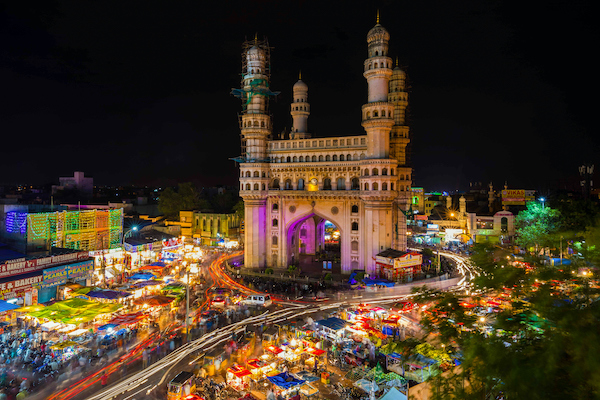
That uncertainty does not diminish the opportunity. Hyderabad has deep clusters in information technology, life sciences, pharmaceuticals, professional services, and real estate. The state government’s Socio-Economic Outlook 2026 puts Telangana’s IT and IT-enabled services exports at about ₹3.13 trillion in 2024–25 and its gross state domestic product at ₹17.82 trillion in 2025–26. Yet urban infrastructure has struggled to keep pace with economic growth. Anyone caught in traffic along the western corridor or forced to wait for a water tanker knows the cost. These are not merely inconveniences; they erode the productivity that helped generate the revenue in the first place.
In a concept note on Hyderabad’s urban development, I describe this as the city’s central paradox: a globally competitive metropolitan economy operating within a local infrastructure capacity that is increasingly stretched. Hyderabad’s built-up area expanded from about 183 square kilometres in 1975 to 527 square kilometres in 2024. Development along the western corridor has brought jobs and investment, but it has also increased demand for water, sewerage, electricity, transport, schools, and clinics. When planning approvals fail to account for these demands, the public exchequer and existing residents end up bearing part of the cost of new development.
Spreading the additional revenue thinly across unrelated projects would squander the opportunity. A better approach would be to earmark a published share of incremental, sustainable revenue for a metropolitan infrastructure renewal programme, with projects selected according to the size of the service gaps they address. Performance should be measured by outcomes: kilometres of stormwater drains that function effectively, hours of reliable water supply, volumes of treated wastewater reused, bus frequencies, the availability of safe walking routes, and reductions in flood exposure. A project’s value lies in what it delivers, not what it costs.
Institutional responsibilities also need to be clarified. GST revenue is shared between the Union and the states, but cities do not receive a direct share of these collections, even though they provide many of the services residents use every day. Without predictable transfers and credible sources of revenue of their own, urban local bodies will remain dependent on one-off grants. A rules-based metropolitan investment fund, with allocations published in advance and spending independently audited, could link the state’s fiscal gains to improvements in urban services. More effective property-tax collection, user charges designed to protect poorer households, land-value capture, and carefully structured municipal borrowing should complement state support, not substitute for it.
Equity must also guide spending. Hyderabad’s western growth corridors are generally better served than many older neighbourhoods, informal settlements, and peri-urban areas. If public investment simply follows land values and existing commercial activity, disparities in access to basic services will widen. Allocations should therefore include an explicit deprivation component based on ward-level indicators of water supply, sanitation, mobility, healthcare, open space, and climate risk. A city whose workers lose hours commuting or cannot rely on basic services is less productive than its headline economic indicators suggest.
To make these trade-offs more visible, I have proposed a Hyderabad Urban Carrying Capacity Index. Rather than counting approved buildings or kilometres of new roads, planners would assess whether a locality can accommodate more residents and businesses without compromising essential services. Large developments should undergo an Urban Infrastructure Impact Assessment and contribute towards the additional infrastructure they require. The test would no longer be simply whether a building complies with design rules, but whether the surrounding neighbourhood has the capacity to support it.
Telangana deserves credit for its revenue performance, but that is no reason to stop asking questions. Higher receipts give the state greater fiscal space; governance determines whether it translates into public value. The ultimate measure of success will not be the next record in tax collections. It will be a Hyderabad where economic growth comes with reliable water, affordable transport, safer neighbourhoods, and fairer access to the city’s opportunities.
.png)