.png)

Not Just Another Founder-CEO Exit: Why Jensen Huang’s Departure Is Different
Steve Jobs, Travis Kalanick, Jack Dorsey and Sam Altman all left companies that could absorb the shock. Nvidia’s situation is of a different order.
Rajesh Mahapatra, ex-Editor of PTI, has deep experience in political and economic journalism, shaping media coverage of key events.
November 17, 2026 at 7:12 AM IST
When Nvidia announced last Thursday that Jensen Huang had resigned as its CEO, media commentators were quick to draw parallels with similar exits of founder-CEOs in the past: the founder who was pushed out and may yet return, like Apple’s Steve Jobs in 1985; the founder undone by his own conduct – Travis Kalanick at Uber in 2017; the founder who chose to walk away, like Twitter’s Jack Dorsey in 2021; or the founder ousted and reinstated within days, like Sam Altman of OpenAI in 2023.
The comparisons are tempting. They are misleading, however.
Each of those exits was a result of a dispute over strategy, culture or governance inside a company. In contrast, Huang’s was precipitated by revelations about his “scandalous relationships”. More importantly, it is tied to the geopolitics of AI chips and a federal investigation into whether his personal conduct put national security at risk.
Also, Nvidia sits at the centre of multi-billion-dollar circular deals that are critical to the future growth of the AI industry and have been a key factor driving up its valuation. Uncertainties at Nvidia could unsettle the AI ecosystem in more ways than one. Lastly, Huang has left the company – he also quit the board – with no obvious heir. In short, just as the success of the business empire Huang built has had no parallel in the past, his exit too has none.
Not a Dispute Over Vision
On November 8, Huang admitted to having an extramarital affair. A day later, the board issued a statement saying it had no reason to believe Huang’s conduct would have affected the company’s interests, notwithstanding reports that US intelligence suspected the person in question, Alice Huang, of working for China.
Two days later, the board reversed its stance when media reports exposed affairs Huang had with two of his own executives. This time around, the board appeared to be addressing a governance issue that had become indefensible. Huang resigned on November 11 with immediate effect, as CEO, president and board member.
National Security
Nvidia’s board has not shared the official reason for Huang’s resignation. But the reasons are slowly coming to the fore. The Federal Bureau of Investigation has begun probing the matter.
Senator Elizabeth Warren has said Huang’s departure from Nvidia does not absolve the company of answering questions about export-control compliance. Resigning does not end the matter, and it exposes the company, not just the founder, to regulators.
The chairman of the US Senate Banking Committee, Republican Tim Scott, has summoned Huang and US Commerce Secretary Howard Lutnick to testify, in hearings likely to be held in early December.
Meanwhile, the Democrats, emboldened by their emphatic victory in the US midterms, see the Nvidia episode as yet another opportunity to tighten the noose around President Donald Trump. They have accused him of going slow on enforcing export controls against China and also raised questions about Huang’s growing proximity to the American President in recent times.
The disgraced Nvidia CEO is a tech adviser to Trump, accompanied him on his China visit earlier this year, and was an invited guest at an exclusive White House dinner for Chinese President Xi Jinping when he visited Washington this past September. Investment firms tied to Trump’s family are believed to have bought shares of Nvidia in bulk deals weeks before the US government partially relaxed curbs on exports of AI chips in December 2025.
Not just security, but domestic politics too have come to be part of the story. No exit of a founder-CEO in the past had such a spillover effect.
Also Read:
The Guarantor of Last Resort
When the Founder Becomes a National Security Question
The Stakes Are Systemic
Its share price rose nearly 15 times in the same period before sliding on growing concerns about inflated valuations in the AI industry. The slide got worse following Huang’s disclosure. Nvidia shares fell roughly 27% in the month ended Nov 12, and the first test is its earnings report scheduled for Tuesday.
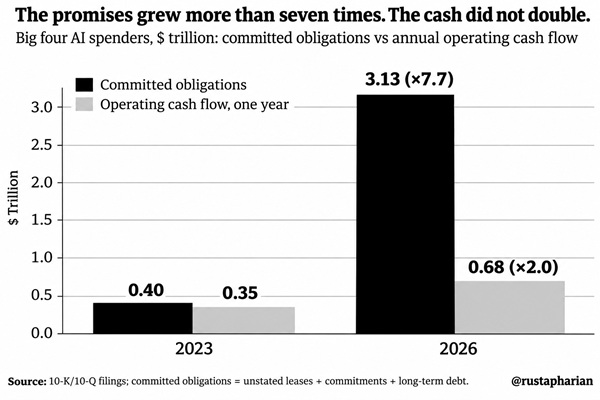
A weakened Nvidia matters to customers, competitors and governments alike. The risks are greater because of the web of circular deals Nvidia has spun over the past two years. It buys stakes in client firms against the chips it sells them, guarantees the debts of and rents capacity from the AI labs and “neocloud” firms that then spend the money on Nvidia chips. These deals have created a circular financing structure – of which Huang has been a key architect – running into hundreds of billions of dollars, if not more.
Sample this: In 2025, Nvidia agreed to invest up to $100 billion in OpenAI, and its latest filing shows roughly $164.5 billion of commitments, most of them contingent guarantees. In September, news reports said it was in talks to invest in Anthropic’s IPO that hit the market last week. It isn’t clear if the plan went through.
Nvidia-backed British cloud service provider Nscale was reported to be considering postponing its plans for a $35-billion listing on the New York Stock Exchange. Nvidia was expected to buy $2 billion worth of shares in Nscale.
Weeks before the scandal broke, Nvidia had announced an investment of $3 billion in Meta’s equity offering and was linked to a $40 billion GPU financing arrangement between Elon Musk’s SpaceX and Apollo involving Nvidia chips. Both are at risk now. In September, Nvidia signed a $13-billion agreement to buy Hugging Face, an open-source platform for machine learning, AI and data science. The deal is expected to close early next year, subject to regulatory approval.
Goldman Sachs expects it to be harder for Nvidia to arrange new multi-party investments at the same scale. With Huang gone, analysts expect the “creative deal-making and circular financing” in the AI industry to moderate. Investors are already uneasy about the debt funding AI infrastructure, and the International Monetary Fund has warned that rising leverage in the sector could amplify a downturn.
How the risks will play out depends on how Nvidia’s interim CEO, Colette Kress, and eventually a permanent CEO treat the guarantees that Huang made.
No Heir in Waiting
Apple had Tim Cook when Steve Jobs stepped down, Twitter had Parag Agrawal to take Dorsey’s place, and Uber’s board quickly found an outsider, Dara Khosrowshahi, who could successfully steer the company out of the crisis.
Nvidia has an interim CEO who is also its CFO, and a board that is only now getting its first chair – Harvey C. Jones, a long-time ally of Huang who has been on the board since its inception in 1993. Analysts have pointed to the company’s structure as a risk: Huang sat at the centre of dozens of direct reports and drove decisions through spontaneous, hands-on involvement. Every major deal was personally closed by him.
As CBS News quoted one analyst as saying, there is “no replacement for Jensen.” That was never the case with the past exits cited for comparison. Two of the four earlier founders, Jobs and Altman, returned to their companies or were reinstated, and Dorsey had already come back once before. Huang left amid such investigations and allegations that, if substantiated, would make it difficult for him to return.
US Treasury Secretary Scott Bessent on Sunday called for a “dramatic shakeup” at Nvidia and asked its board to look for an outsider as the next CEO. A Reuters report said the board has ruled out Huang returning, and that its newly appointed chair, Jones, would lead the search for a successor.
Nonetheless, the past few days have seen a growing clamour for Huang’s return. An online petition seeking Huang’s reinstatement has already drawn nearly 180,000 signatures, including hundreds of Nvidia’s current employees and prominent tech leaders such as Elon Musk. A Financial Times report said Huang has been in discussions with his confidants about a possible return. Even President Trump appears to be backing the idea.
More From BasisPoint