.png)


Rahul Ghosh is a banking and risk expert who advises banks, corporates, and central banks, and builds tech solutions for risk management. He authored two books on risk.
September 15, 2026 at 6:22 AM IST
The debate over India's surprisingly strong 7.8% GDP growth in the latest quarter may be missing the bigger story. Quarterly GDP prints fluctuate. Structural indicators do not. Two measures deserve far greater attention: bank credit deepening and economic efficiency.
These are the metrics that reveal whether an economy has the financial capacity to fund growth and the productive capacity to convert that funding into sustained expansion. Judged on both counts, India appears to be entering a phase that bears a striking resemblance to the take-off stages of East Asia's high-growth economies.
The Asian miracle economies did not merely grow rapidly; they sustained exceptional growth for well over a decade. A common feature across South Korea, China and Vietnam was deep bank-led financing. For years, India was the outlier. Its Bank Credit-to-GDP ratio remained stuck around 40%, even as several East Asian economies operated with ratios well above 100%. That financial shallowness was one reason India struggled to sustain the kind of long growth cycle witnessed elsewhere.
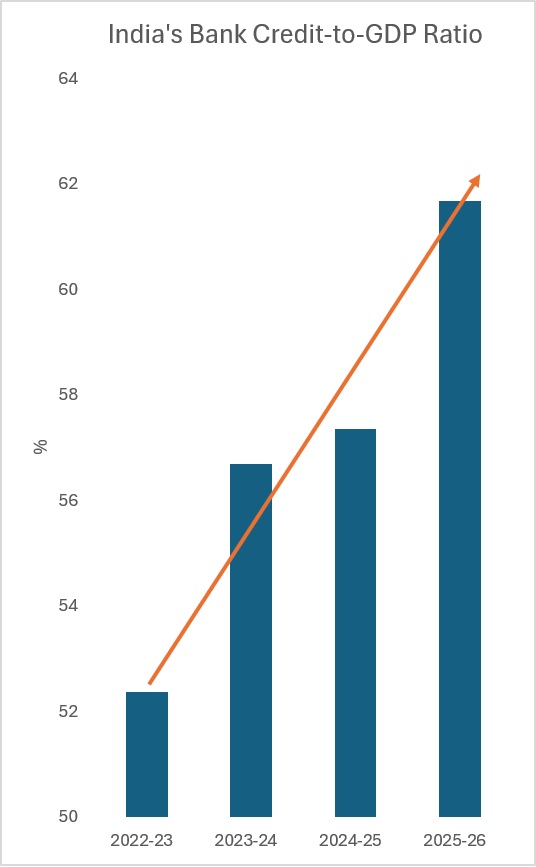
That picture has changed dramatically. After remaining stagnant near 52% for almost 15 years, India's Bank Credit-to-GDP ratio has climbed to about 62% in just three years. More interestingly, several East Asian economies entered prolonged high-growth phases after bank credit crossed roughly 60% of GDP, although the exact threshold differed across countries.
Credit alone, however, is never enough. The second ingredient is economic efficiency. Economists measure it through Total Factor Productivity, while labour productivity—output produced per worker—is one of its clearest visible outcomes. Rapid growth begins when rising credit is matched by an economy's increasing ability to deploy capital efficiently.
South Korea illustrates this combination well. By 2000, it had crossed the 60% Bank Credit-to-GDP threshold after decades of financial deepening. At the same time, its economic efficiency had improved sharply, producing labour productivity well above $10,000 per worker. The result was a remarkable 15-year expansion during which South Korea's economy nearly tripled, from about $560 billion in 2000 to roughly $1.5 trillion by 2015, before growth naturally moderated.
China followed a different path. It entered the 1990s with a relatively high Bank Credit-to-GDP ratio—around 75%—yet labour productivity remained well below $10,000 per worker until about 2003. High credit availability did not immediately translate into extraordinary growth because the economy's productive efficiency had not yet reached the same level. The late-1990s banking reforms, better capital allocation, WTO accession and a sharp improvement in economic efficiency changed that equation. Bank credit moved from around 75% in the 1990s to over 115% by 2010, while labour productivity quadrupled over the next 15 years to nearly $40,000 per worker. China's GDP expanded from $2.3 trillion in 2005 to nearly $15 trillion by 2020.
Vietnam offers perhaps the closest parallel to India today. In 2005, its Bank Credit-to-GDP ratio crossed 60% as labour productivity approached $10,000 per worker. Over the following 15 years, labour productivity doubled to around $20,000, while GDP expanded nearly sixfold—from about $60 billion to $350 billion. Financial deepening and rising economic efficiency moved together.
India's story is now becoming intriguing.
India had already achieved labour productivity of about $10,000 per worker by 2005. Yet Bank Credit-to-GDP remained near 40%, limiting the economy's ability to finance a prolonged investment cycle despite improving productive capacity. That disconnect may finally be disappearing.
Labour productivity has accelerated from below $20,000 before the pandemic to over $26,000 today. This improvement reflects more than a better-skilled workforce. It is also the outcome of sustained investment in infrastructure, technology, digital public infrastructure, institutional reforms and a banking system that is increasingly allocating credit more effectively across the economy.
India has now crossed the same broad credit threshold at which several East Asian economies began their long expansion cycles. Unlike earlier episodes, this credit deepening is occurring alongside visible gains in economic efficiency.
No historical analogy is perfect. South Korea, China and Vietnam each followed different development models and different credit trajectories. But the combination of deeper banking credit and improving economic efficiency has been a recurring feature of their sustained growth stories.
The evidence increasingly suggests that India may be entering a decade or more of structurally higher growth. If that is correct, the more important debate is no longer whether India can grow at 7.8% in one quarter, but whether it can become a $6.5 trillion–7 trillion economy by 2030.
More From BasisPoint