.png)



Deba Prasad Rath, Former Principal Adviser to the Reserve Bank of India, is RBI Chair Professor at Council for Social Development, Hyderabad.

Rewanth Raichooti is a Research Associate at Council for Social Development, Hyderabad.
November 25, 2026 at 7:19 AM IST
The quality of government spending is one of the most debated aspects of public finance. This is particularly true amid a steep global public debt trajectory, which is estimated to reach 102.3% of GDP by 2031 with advanced economies estimated at 114.8%.
In contrast, India’s public debt over the same period is estimated to decline to 77.7% from 84.1%. This has been enabled by the central government’s continued emphasis on debt sustainability and fiscal discipline. However, concerns often emerge regarding excessive cuts to social spending when such consolidation measures are undertaken. In this context, the excessive reliance on usual quality measures such as the RECO ratio (Revenue Expenditure to Capital Outlay) becomes a point of concern.
Recent research estimates overall revenue expenditure and social spending multipliers at 0.67 and 1.67, implying that a unit increase in revenue expenditure and social spending in particular will result in 0.67 and 1.67 units increase in GDP, respectively (Goyal & Sharma, 2018; Bose & Banerjee, 2025).
Therefore, a better measure of expenditure quality can be obtained by clubbing capital outlay and social sector spending together. Such a measure can be termed ‘Effective RECO’, which measures revenue expenditure (less social spending) for each rupee of expenditure on capital outlay and social spending. While such an adjustment would mechanically lower the effective RECO, its temporal movement would provide an insight on the quality of spending including social sector spending. Furthermore, spending on capital outlay includes defence expenditure. While it does have real effects on output, it has minimal first-order effects on the productive capacity or human capital in the economy, especially when a large share of our defence equipment is imported. Thus, a ‘defence-adjusted’ Effective RECO (DA - Effective RECO hereafter) must also be looked at parallelly.
|
RECO = Revenue Expenditure / Capital Outlay Effective RECO = (Revenue Expenditure − Social Spending) / (Capital Outlay + Social Spending) DA - Effective RECO = (Revenue Expenditure − Social Spending) / (Capital Outlay − Defence Expenditure + Social Spending) |
Estimating Alternative Measures
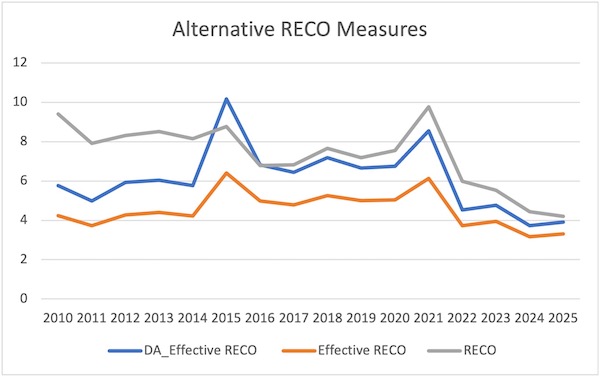
The Effective RECO, DA - Effective RECO and the conventional RECO are estimated for the central government finances from FY 2009-10 to FY 2024-25 and presented in Figure 1. During this period, the DA - Effective RECO stays right below the conventional RECO and Effective RECO stays at the bottom among the three. All the measures improved significantly after the COVID pandemic, where a steep decline can be seen towards levels close to 4. This is largely due a sustained improvement in expenditure quality in the post-COVID period. Applying the RECO logic to these trends, the expenditure quality was far superior to what a conventional RECO would suggest. So, how we define expenditure quality has a significant bearing on our assessment of it.
Enabled by higher expenditure quality, the simultaneous fall in fiscal deficit and rising GDP growth has become a feature of the post-COVID growth story. Also, it has allowed for greater coordination between fiscal and monetary authorities, leading to better growth outcome. As our recent research shows, a unit increase in policy coordination is seen leading to about 0.7-0.8 percentage points increase in the gross state domestic product (GSDP) (Raichooti & Rath, 2026).
This does not mean that the conventional RECO is useless. But its purpose must be redefined. Instead of being a benchmark metric for quality, it can serve as an indicator for spending that enhances the productive capacity in the economy. Also, capital spending tends to be non-inflationary in the medium term as it augments the aggregate supply directly, unlike the revenue expenditure.
More From BasisPoint