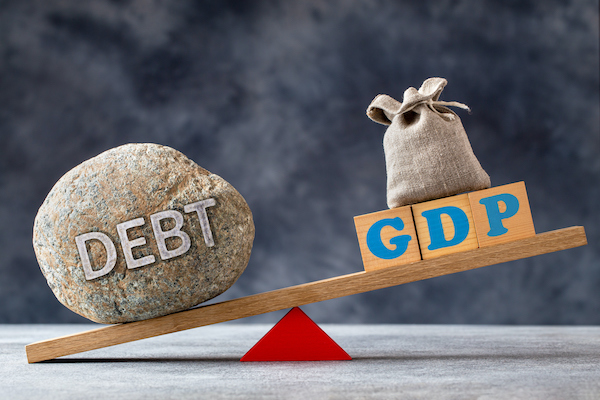
There has been much debate about the sustainability of the US Government’s debt burden that recently surpassed $40 trillion. This has spilled over to spirited discussion about the Indian government’s debt as well, with academia and political spokesmen engaging in the inevitable public thrust and parry of public debate. The former worry about interest payments, while the latter point to robust growth in GDP and tax collection numbers. A worthy middle ground is assessing the trajectory of public finances in the context of assessing how to sustain GDP growth rates in the future.
That the economy has been resilient in the face of multiple recent assaults in the form of terror attacks leading to Operation Sindoor, US tariffs, and the West Asia crisis seems beyond doubt, though clarity is still missing on the precision of measured output. This is creditable, but one cannot drive while looking in the rear view mirror.
The fact is that the absolute numbers of interest payments on government debt are large, as this author has recently pointed out (“Are Interest Rates in India Too Low?”). In all, 80% of new borrowing now finds its way into the pockets of creditors to the government. This is an alarming statistic, yet, other statistics like debt-to-GDP at approximately 55% do not seem extreme. Corresponding numbers for the US, on the other hand, are 50% of new borrowing is used for interest payments, and the debt to GDP ratio stands at 120%.
The contrast - India seems to have a manageable debt-to-GDP ratio, but a rather large proportion of new borrowing is used for interest payments compared to the US (stated alternatively, a larger proportion of GDP is spent on debt servicing in India), which has a large debt-to-GDP ratio, but much a much smaller proportion of new borrowing is utilised for interest payment - really boils down to two key differences.
First, the US government accumulated much of its $40 trillion debt after the global financial crisis when its domestic interest rates had been slashed to near zero. COVID related support held them there for longer. The 10-Year US Treasury yield during that time has averaged a mere 2.6%. Additionally, during this time, the US Treasury relied heavily on raising money via treasury bills that were issued at an average of 1.3% over the last 15 years or so, rather than on coupon bonds. This has been seen by many as quasi quantitative easing, as reduced supply of long term bonds takes duration out of the market and suppresses long term yields, something that the present US Secretary is attempting to emulate, in addition to direct intervention.
India, on the other hand, did not see such a drastic fall in interest rates. The 10-year in India has averaged about 7.5% over the same period and T-Bills at 6.5%. Neither has the Indian government relied excessively on T-Bills, which have averaged only about 7% of net issuance compared to 25% for the US Government. India’s debt burden, though smaller as a percentage of GDP has therefore been built up at much higher interest rates.
Second, tax collection for the US government is of the order of 15% of GDP while the corresponding number for the Indian Central government is approximately 7.5% of GDP. This effectively means borrowing more at these higher rates to fund operating expenses and social expenditures that do not have a large impact on GDP like infrastructure spending generally does. With a narrow tax base, less than 50% of tax receipts comprise income tax in India, while these taxes make up about 80% of US taxes.
Thus, both countries have built up unsustainable debt, but for different reasons. In India the cost of the debt is the issue. In the US the size of the debt is the issue. Arguably, many other developed countries in the world, notably Japan, France and the UK also have similar unsustainable debt for one of these two reasons. With enormous additional demand from hyperscalers borrowing to fund AI infrastructure investments, interest rates are now rising everywhere, the global debt problem is becoming quite acute requiring some form of action to reduce spending or increase taxes, rather than the interventionist path adopted by the US Treasury in trying, unsuccessfully, to hold yields down.
The implications of this global buildup of debt for the global economy are immense, and the path forward is not clear. Should interest rates be raised to tame inflation at the risk of precipitating an interest burden doom loop? Or should they be left stable or lowered? Proponents of the former are traditional economists who likely swear by Volckeresque responses to rising inflation. Supporters of the latter cite the inability of interest rates to deal with supply shock-led inflation, and the idea that increasing the debt burden only creates more instability, not just for governments, but also for the AI boom where debt financing, and hence interest payment, is an embedded cost.
This is where policy in India and the US is likely to diverge, as each economy responds to a different underlying source of the debt problem.
In India, where inflation is largely driven by the oil supply shock, the most likely course of action will be moderate increases in interest rates but at the cost of further currency depreciation, consistent with our penchant for “calibrated responses”. The need for further reforms should find acceptance and further sops to hard currency investors, such as capital gains tax exemptions are likely.
In the US, where demand from the AI boom has at least as much of a role in high inflation as the oil shock, an interest rate hiking cycle seems likely, absent a climbdown from the Trump administration on Iran, tariffs and increased spending. Markets should also prepare for significant intervention, in interest rates, commodities and currencies.
.png)