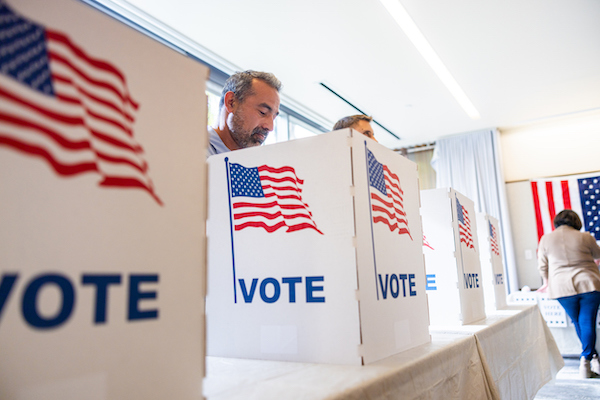
The outcome of the November 3 midterm elections may not favour Donald Trump. Current indications suggest Republicans are likely to lose the House of Representatives, while control of the Senate remains uncertain. For India, however, the outcome may make little difference to the direction of US economic policy. A Democratic-controlled House would not necessarily reverse the Trump administration’s agenda. Instead, it could create a more complicated form of continuity: tariffs would largely remain in place, fiscal negotiations would become more confrontational, and the courts and the Federal Reserve would matter more than Congress in shaping policy. A divided Congress may constrain the White House procedurally without fundamentally changing its economic direction.
A Democratic House could pass bills seeking to repeal tariffs, demand information from the administration and investigate the costs of trade restrictions. But with Republicans retaining the Senate and the president holding veto power, such initiatives are unlikely to become law. Tariffs imposed under Section 232 of the Trade Expansion Act of 1962 and Section 301 of the Trade Act of 1974 can sustain much of Trump’s tariff regime without new congressional legislation. India should therefore not assume that a change in the House will bring a swift return to predictable, rules-based US trade policy.
Tariff Risks
Trump has moved from a relatively identifiable tariff regime to a layered system involving national-security tariffs, trade-remedy investigations and country- and sector-specific measures. The US Supreme Court’s rejection of tariffs imposed under the International Emergency Economic Powers Act did not end protectionism. Instead, it encouraged the administration to rely on alternative legal provisions, including Sections 232 and 301.
This matters for India because its expanding manufacturing capacity, subsidies and industrial-policy programmes could attract greater scrutiny in Washington. What India regards as development policy could be interpreted by US agencies as market distortion or excess capacity. Nor is there reason to assume that a Democratic return to the House would necessarily benefit India. Much of the protectionism introduced under Trump’s first administration continued under Joe Biden.
Trade Pressures
Over the past century, global trade has generally grown faster than global GDP. Since 2008, however, that relationship has reversed. Trade has grown more slowly, reflecting not only weaker global economic growth but also external shocks, including wars in Europe and West Asia. Recent estimates suggest global growth will slow to 2.6% in 2026, down from 2.9% in 2025.
The slowdown is worrying. On the demand side, sluggish import growth limits export opportunities and can weigh on national growth. On the supply side, slower trade restricts productivity gains from specialisation and technology diffusion. When productivity and economic opportunities weaken, protectionism becomes easier to sell politically, particularly when workers fear that immigration and imports threaten their livelihoods. Trump’s return to office draws on this sentiment, promising that tighter immigration controls and a more protectionist domestic market will help Make America Great Again (MAGA).
The economic evidence, however, complicates this narrative. Consider immigration. The US has long relied on migrant labour, both skilled and unskilled, to support its economy. Without immigration, population ageing would have reduced the labour force by about 1.2 million between 2019 and 2023. An ageing population also puts pressure on the tax base that supports Social Security and Medicare.
Maine, the oldest US state, with a median age of 45.1, illustrates the challenge. Its $1 billion lobster industry increasingly relies on foreign-born workers as the domestic workforce becomes harder to recruit. Politically, it may be easier to claim that immigrants take jobs than to explain how they help sustain industries facing labour shortages. The tightening of H-1B visa rules is therefore likely to continue alongside other restrictive immigration measures.
Artificial intelligence is adding another source of disruption. In an economy increasingly shaped by algorithms and start-ups, wealth is becoming concentrated in the hands of a relatively small group. Although the US economy is growing, with GDP growth of 2.5% cited in the source, many households remain economically insecure because wage gains have not kept pace with living costs.
Investment in AI has become an important driver of US growth. Its contribution reportedly reached 1.4% of GDP in the first quarter of 2026, compared with an average of 0.5% between 2015 and 2023. AI workers earn, on average, 60% to 120% more than other skilled workers, but those gains are not shared equally across the economy.
Even amid strong headline growth, households remain anxious about everyday expenses, including food, housing, transport and services. The Bureau of Labor Statistics’ Employment Cost Index showed inflation-adjusted wages and salaries falling by 0.4% year on year through June, according to the figures cited. Inflation is also squeezing household budgets: the headline rate has crossed 3%, petrol prices are up more than 40%, and mortgage rates exceed 7%.
Currency Effects
With US inflation hovering around 3%, above the Federal Reserve’s 2% target, the possibility of another rate increase this year cannot be ruled out. Such a move would have implications for India.
First, higher US bond yields could trigger another round of foreign institutional investor (FII) outflows, putting pressure on Indian equities. FIIs have already withdrawn more than $40 billion from the Indian stock market in 2026, according to the figures cited. A US rate increase could also strengthen the dollar, raising the rupee cost of imported crude oil, machinery, electronics and intermediate goods and worsening India’s current account deficit.
A stronger dollar could also feed imported inflation, complicating the Reserve Bank of India’s policy choices. Even if domestic growth weakens, the RBI may have less room to ease monetary policy if rupee depreciation threatens to push inflation higher.
India’s Strategy
US tariffs are encouraging multinational companies to diversify production across countries offering more attractive investment prospects. India is a natural candidate, given its market size, labour force and strategic importance in the Indo-Pacific.
The expansion of global capability centres illustrates this opportunity. India produces about 2.5 million STEM graduates each year, providing a substantial talent pool for these centres. Around $100 billion has reportedly been committed to the sector, making India the world’s second-largest destination for GCC investment. GCCs have benefited from India’s ability to supply high-skilled services, which face fewer of the physical infrastructure and logistics constraints that often hamper manufacturing.
Becoming a manufacturing hub of choice, however, will require more than attracting companies seeking alternatives to China. Investors will compare India with Vietnam, Mexico and Indonesia, weighing the costs and reliability of operating in each market.
India must therefore move beyond incentive-led industrial policy. Production-linked incentives can help manufacturers achieve scale, but they cannot substitute for efficient ports, predictable taxation, flexible logistics, reliable power, skilled labour and faster dispute resolution. The opportunity is real, but converting trade disruption into sustained manufacturing investment will depend on India’s ability to improve the underlying conditions for doing business.
.png)