.png)

The Iran War Is Far From Over
The unresolved battle for Hormuz threatens prolonged conflict, global economic disruption and mounting costs for India.

Dr. Srinath Sridharan is a Corporate Advisor & Independent Director on Corporate Boards. He is the author of ‘Family and Dhanda’.

Anand Venkatanarayanan is a strategic security and digital policy researcher.
November 11, 2026 at 3:14 AM IST
The Iran war tests how much pain a superpower can impose and how much disruption the world must absorb. Washington entered seeking to dismantle Iran’s missile capabilities and bring about regime change. Neither objective has been achieved.
The war has also exposed the limits of military superiority against an adversary able to threaten a global artery. Iran’s missile arsenal proved larger and more sophisticated than expected. Its payloads, range and accuracy, alongside terminally manoeuvring hypersonic systems, challenged assumptions about the military balance. Washington underestimated Iran’s capabilities and its willingness to absorb punishment. Ahmadinejad was floated as an unlikely successor. The regime has survived, while Iranian civilians bear the destruction and hardship.
Washington shifted to economic warfare and a naval siege, using escorted oil movements and pressure on Iranian exports to prise open Strait of Hormuz. Escorted passages cannot restore commercial confidence. After tanker attacks, shipping slowed sharply in early November. Kpler recorded five commodity-vessel transits on Saturday and none on Sunday, against more than 130 daily before the war. The Houthi campaign in the Red Sea against the internationally recognised government in Aden has opened a second maritime front. Iranian attacks on tankers and commercial vessels have pushed risk premiums into oil, gas and downstream products.
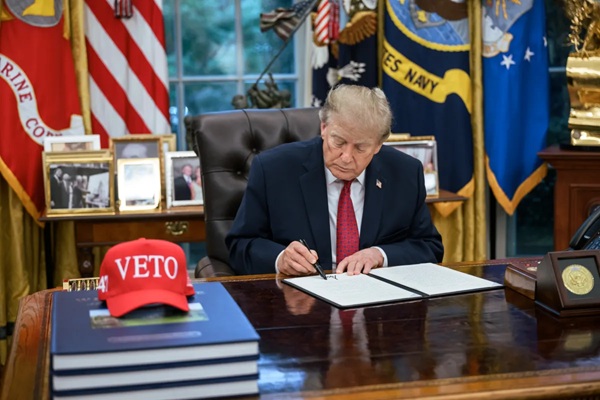
The shock is political too. Higher energy prices feed into transport, food and manufacturing, deepening living costs. Households are anxious about employment as AI changes skill demand. Dearer essentials and uncertain work are combustible pressures. Democrats captured both chambers of Congress in the US midterm elections. Vice-President JD Vance said: “The reason we lost is the war.” Trump has said military action is not necessary at “this point”.
Tehran’s resistance has helped change power in Washington, while Iran’s regime remains in place. The war mattered, though the result also reflected wider discontent.
The question is Hormuz. There is no durable exit without settling control of the strait. If Washington accepts Iranian sovereignty or effective control over passage, Tehran acquires extraordinary regional leverage. Yet Iran, after extensive destruction and years of sanctions, cannot easily relinquish its claim without undermining the legitimacy of its resistance.
Neither side can secure decisive victory at acceptable cost. Researcher Anusar Farooqui calls this a “game of mercy”: each side inflicts pain hoping the other yields first. With two years remaining in his term, Trump has little political incentive to concede. This is endurance, with the world paying for every day of this war.
Tankers remain vulnerable to attack and sinking. US supercarriers are too few to secure every theatre. Meanwhile, Ukrainian drone attacks on Russian refining capacity constrain refined-product supply. Gulf disruption threatens crude and gas, while damage to Russian refineries tightens diesel availability. Fuel and freight costs pass through supply chains, adding to inflation. Governments will struggle if opposition parties connect persistent hardship to decisions and miscalculations in office.
The irony is that this war may produce political change elsewhere while leaving Iran’s regime intact. The “game of mercy” is also being played between Washington and countries absorbing the consequences of its choices. In 1971, as Bretton Woods unravelled and the US ended the dollar’s convertibility into gold, the then US Treasury Secretary John Connally told European finance ministers: “Our dollar, your problem.” Trump’s intervention carries a harsher equivalent: “Our imperialism, your problem.” Washington’s apparent success in pursuing regime change in Venezuela may have encouraged the belief that Iran could be handled similarly.
For India, the shock compounds existing vulnerabilities. A failed monsoon associated with El Niño has left several states facing drought. Higher energy prices strain the current account, the rupee and inflation. At the same time, greater reliance on US AI models could raise dollar-denominated token and computing costs even as AI compresses traditional IT services earnings. India risks paying more for technology inputs while earning less from a sector that has generated foreign exchange.
The rupee is also being supported through FCNR dollar mobilisation, with deposits carrying three-to-five-year tenors under the RBI’s 2026 swap facility. The effect depends on banks’ deployment of the funds. If dollar resources are converted into rupee lending, added liquidity could complicate inflation management as energy costs pass through. The RBI faces competing demands: containing currency pressure, anchoring inflation expectations and supporting the government through dividends. Higher rates would make credit costlier and could suppress industrial activity. Weaker tax receipts and higher subsidy demands may leave the government less room for production-linked incentives and development expenditure.
India’s exposure is strategic as well as financial. A prolonged conflict will test its energy security, external resilience, industrial competitiveness and fiscal capacity.
The danger is that the world mistakes the political setback suffered by Washington in the US midterm elections, or a temporary military pause, for the end of the conflict. Hormuz remains the unresolved question, and neither Washington nor Tehran has demonstrated a willingness to accept the other’s terms. Until that changes, this war will continue to exact an economic and political price well beyond West Asia. Its next chapter may be fought through markets, currencies, trade and domestic politics, but the confrontation itself will remain alive for the foreseeable future.
More From BasisPoint