.png)

Seeing the Human in the Crowd
A French mayor intervened to protect protesting students, saying they could have been his own children. His words make one wonder: Is our empathy limited by our ability to recognise ourselves in another person? And when those in power struggle to see the humanity of people who disagree with them what happens to the trust on which their authority rests?

Kirti Tarang Pande is a psychologist, researcher, and brand strategist specialising in the intersection of mental health, societal resilience, and organisational behaviour.
October 10, 2026 at 5:02 AM IST
Imagine your child standing among hundreds of protesting students. You may disagree with their demands, question their methods or worry about the disruption they are causing. But as the police begin moving towards the crowd, your eyes would instinctively search for one face. Your child's.
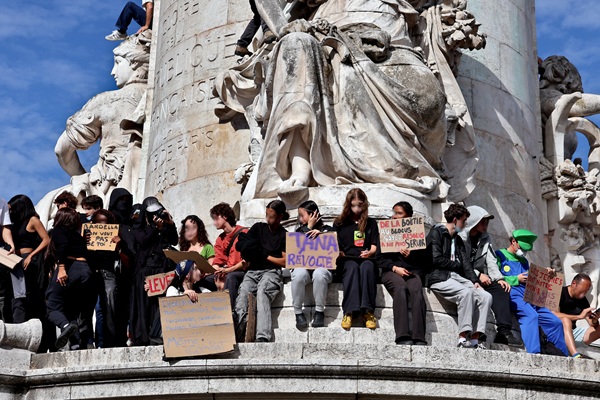
On October 6, in Paris, Bally Bagayoko, the mayor of Saint-Denis, stood facing police officers advancing towards protesting students. In a video that has since gone viral, he can be seen extending his arms, shielding the students and shouting for the police to stop. Later, explaining his intervention to Reuters, the father of four said the students on the street could have been his own children. He felt responsible for standing beside them.
His response is deeply human, perhaps because almost any parent can imagine making the same choice. Yet it also reveals something unsettling about the way empathy works. We often recognise another person's vulnerability most readily when their life resembles our own. What happens, then, when the person before us is someone whose anger we do not share, whose demands we disagree with, or whose actions challenge our authority? This is where emotional discipline becomes essential to leadership: the ability to uphold the law, maintain boundaries and exercise judgement without allowing disagreement to diminish another person's dignity. How leaders navigate this tension can determine whether a confrontation leaves room for dialogue or deepens the mistrust that survives long after the crowd has dispersed.
The students were protesting overcrowded classrooms, teacher shortages and deteriorating school infrastructure. What began in the working-class suburbs of Paris had grown into a nationwide movement. More than 6,000 people have been arrested since the demonstrations began, with injuries reported among students and police officers. Rights groups have criticised police tactics, while authorities have pointed to attacks on officers and damage to schools.
Closer home, students in India are also confronting institutions over questions that shape their futures. At Delhi's Ambedkar University, students have protested inadequate facilities, faculty shortages, access restrictions and changes affecting research scholars. Students alleged that security personnel prevented food from reaching protesters; the university disputed allegations of misconduct and maintained that security procedures were necessary and dialogue was continuing.
Meanwhile, youth-led demonstrations over electoral-roll revisions have brought students and other protesters into confrontation with authorities. Delhi Police have cited prohibitory orders, public safety concerns and alleged violations during demonstrations. Protesters have questioned restrictions and detentions. The Election Commission maintains that its revision process is intended to remove ineligible and duplicate entries, while critics have challenged its implementation.
The grievances, circumstances and legal questions differ. Yet they invite the same psychological inquiry: What happens to our perception of another human being when that person becomes part of a crowd challenging our authority?
Imagine a student walking into a university administrator's office with a grievance. She has a name, a face and a story. The administrator may listen sympathetically, disagree with her or offer little by way of a solution. Now place that same student among hundreds outside the university gates, shouting slogans and demanding change. Her grievance may remain exactly the same, but to those inside the building, she may suddenly appear as part of a crowd that needs to be controlled. What changed? The student, the circumstances, or the way authority sees her?
Our brains simplify the social world by organising people into groups. The mind simplifies a complicated situation into categories that are easier to manage, particularly under pressure. This process can have consequences far beyond perception. Instead of seeing hundreds of individuals with different experiences, motivations and concerns, we may begin to see one collective identity: the protesters. Individual stories become less visible, and assumptions about the group begin to colour our interpretation of each person's behaviour.
And then comes the perception of threat. When our authority is publicly challenged, it can stir fears about losing control, status or legitimacy. Under such pressure, attention may narrow. Restoring order can begin to feel more urgent than understanding what brought people onto the streets in the first place. Sometimes there are genuine threats to public safety that demand intervention. But the psychological challenge for those in authority is to distinguish those threats from the discomfort of being challenged.
This is where emotional discipline becomes crucial to leadership. When anger, fear or defensiveness arises, does the leader treat that emotion as information to be examined or an instruction to be obeyed? The feeling of being threatened is real, but what that feeling tells us about another person's intentions still requires judgement. An emotionally disciplined leader can recognise their own reaction without allowing it to determine the humanity they are willing to see in others. They can maintain boundaries, uphold the law and respond to disruptive behaviour while remembering that the people standing before them have lives, fears and aspirations extending far beyond that moment of confrontation.
Because treating everyone in a crowd as a threat can create a shared opposition that was not there initially.
Imagine joining a protest because your child’s school has too few teachers. A few people nearby begin throwing objects. You move away. You came to demand better classrooms, and you want nothing to do with them. Then the police move towards you too.
Until that moment, the distinction seemed obvious: you were protesting peacefully; someone else was causing trouble. But the response of the police makes you wonder whether that distinction matters to those facing you. Your attention shifts from what separates you from the other protesters to what you now share.
A 1998 study by psychologists Clifford Stott and Steve Reicher reveals how that distinction can disappear. In interviews with 26 British public-order police officers, they found that officers recognised the different kinds of people within a crowd. Yet they also believed that a disruptive minority could draw ordinary people into disorder. Once conflict began, everyone could be seen as dangerous, while police tactics made it difficult to distinguish between them.
So, people who initially reject confrontation may begin identifying with more confrontational participants when they experience the same treatment as unjust. “I have nothing to do with them” can become “This is happening to all of us.”
Not everyone becomes violent. But the boundaries of belonging can shift. People who arrived with different intentions may leave with a common grievance against the authority confronting them.
The unsettling possibility is that an authority can help produce the unity it assumed was already there. A crowd's behaviour is shaped partly by how the crowd is treated.
This is a particularly important insight for leadership. Every act of dissent contains information, although that information may arrive wrapped in anger, slogans, disruption or demands that institutions cannot immediately meet. When leaders interpret disagreement primarily as a challenge to their authority, they risk losing access to the concerns that produced it.
Psychology offers another way to understand what is at stake.
A systematic review and meta-analysis published in the Journal of Experimental Criminology, drawing on 123 studies involving more than 200,000 participants, found significant associations between procedural justice, social identity and perceived police legitimacy.
Procedural justice concerns something deceptively simple: whether people believe they have been heard, treated with dignity and subjected to fair, understandable decisions. Research suggests that the manner in which authority is exercised influences its perceived legitimacy, even when people dislike the outcome.
When we are talking about protests, authorities may have legitimate responsibilities to maintain public order, protect other citizens and respond to unlawful behaviour. Yet how they distinguish peaceful participants from those engaging in violence, explain restrictions, communicate decisions and provide avenues for grievances can influence whether people experience that authority as protective or hostile.
Because public trust is more than approval of a particular decision. It is the willingness to recognise an institution's authority even when its decisions disappoint us. Once that willingness deteriorates, securing cooperation becomes considerably harder.
The same psychology operates inside organisations. An employee questioning a policy can be perceived as troublesome or as someone providing information about an emerging problem. A manager's response influences whether others speak honestly the next time something goes wrong. An institution that makes disagreement psychologically costly may eventually hear less of it, while the underlying problems continue accumulating.
This brings us back to Bagayoko and his children.
His words illustrate the extraordinary power of personal identification. Imagining someone as part of our own family can make their vulnerability immediate, tangible and impossible to overlook. Yet empathy that depends entirely on recognising ourselves in another person has an inherent limitation. What happens to those whose circumstances, beliefs or identities make them difficult to imagine as our own?
Responsible leadership asks us to extend that recognition beyond familiarity. It requires the emotional discipline to remain curious about people who disagree with us, without abandoning judgement, institutional responsibility or the need to maintain order.
The most enduring forms of authority are built through repeated experiences of fairness. People remember whether someone listened when listening was inconvenient, whether rules were applied consistently and whether their dignity survived a disagreement.
In Paris, a mayor saw children where others may have seen protesters. His intervention leaves us with a possibility worth considering in every institution, from governments to corporate boardrooms.
Imagine what might change if leaders could recognise the human being in the crowd before having to imagine their own child standing there.
More From BasisPoint