.png)

India's Foreign Policy: From Non-Alignment to Multi-Alignment
India's multiple international partnerships reflect a pragmatic pursuit of strategic autonomy. But balancing competing interests is not the same as having the capacity to shape the world.
Gurumurthy, ex-central banker and a Wharton alum, managed the rupee and forex reserves, government debt and played a key role in drafting India's Financial Stability Reports.
November 20, 2026 at 9:09 AM IST
India's foreign policy once had a recognisable identity: Non-alignment. Today, its vocabulary is strategic autonomy and multi-alignment. Take a few affiliations: India belongs to BRICS, the Quad and the Shanghai Cooperation Organisation, or SCO. It deepens ties with the United States and Russia, cultivates friendship with Israel and supports Palestinian statehood. Is this diplomatic dexterity or overextension?
The comparison with the Nehru era is instructive. Non-alignment emerged in a bipolar world dominated by two superpowers. Newly independent countries resisted becoming pawns in their rivalry. India's refusal to join either military bloc reflected the need to concentrate on nation-building. It also challenged colonialism and racial discrimination, giving developing countries a collective voice.
Yet non-alignment never meant absolute neutrality. India's 1971 Treaty of Peace, Friendship and Cooperation with the Soviet Union demonstrated that strategic interests could take precedence over equidistance. The difference today is that India actively cultivates relationships across competing power centres rather than maintaining distance from rival blocs.
Multi-alignment is a response to a more complex world shaped by economic interdependence, technological competition and multiple centres of power. India seeks American technology and investment, Russian defence and energy cooperation, Japanese capital and infrastructure, and economic and diplomatic opportunities through BRICS. The objective is to optimise options.
The apparent contradictions are striking. BRICS seeks greater representation for emerging economies in global institutions and has explored more efficient cross-border payments and local-currency settlements. Donald Trump has threatened tariffs against countries pursuing alternatives to the dollar and against those aligning with what he calls BRICS' anti-American policies.
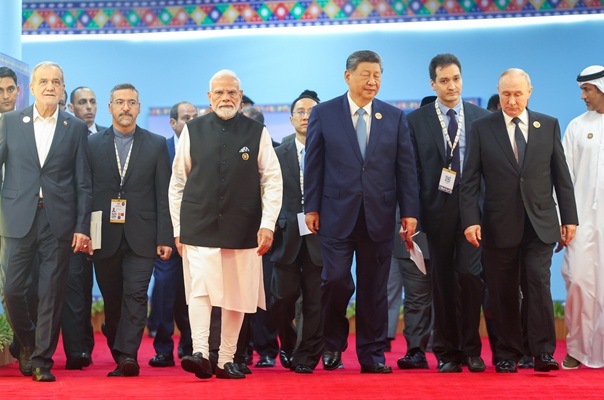
Yet India chaired BRICS in 2026 and hosted its New Delhi summit. India has clarified that BRICS has no common-currency proposal; local-currency settlement is being discussed as a practical complement to existing payment systems. Simultaneously, India participates in the Quad with the United States, Japan and Australia, a partnership committed to a free and open Indo-Pacific.
The SCO brings India together with China, Russia and Pakistan, despite serious bilateral differences. Neither the Quad nor the SCO is a conventional military alliance: their overlapping agendas allow India to cooperate selectively without automatically accepting identical obligations or strategic priorities.
Israel-Palestine presents another dimension. India was the first non-Arab country to recognise the Palestine Liberation Organisation in 1974 and recognised the State of Palestine in 1988. Yet it recognised Israel in 1950 and established full diplomatic relations in 1992. Recently in February 2026, the relationship was elevated to a Special Strategic Partnership, encompassing defence, security, emerging technologies, agriculture and other fields. India supports Palestinian self-determination and a negotiated two-state solution, while recognising Israel's security concerns.
Israel is an important technological and defence partner; Palestine represents a longstanding political commitment and India's historical engagement with the Arab world. But the test is whether India's commitment to Palestinian statehood retains substance as its strategic engagement with Israel deepens. In September 2026, India reiterated its support for a sovereign, viable and independent Palestinian state living in peace and security alongside Israel. Principles are measured by conduct, not declarations alone.
But this balancing act has limits. Competing partners may not indefinitely accommodate India's independent positions. Washington may accept India's relationship with Moscow today, but geopolitical and economic disagreements can impose costs tomorrow. Strategic autonomy also depends on capabilities. Dependence on external technology, energy and defence equipment limits India's bargaining power. Membership of international groupings should not be mistaken for influence. BRICS has divergent interests among its members, while the SCO has not resolved their underlying strategic differences.
India aspires to leadership of the Global South, a permanent seat on the UN Security Council and a greater role in shaping global governance. These ambitions require coalition-building, influence over international rules and a willingness to take costly positions.
India need not choose a permanent geopolitical camp or maintain equal distance from every power. Nor should multi-alignment become an excuse for avoiding difficult choices. India must know what it seeks from each relationship, what it will concede and where its non-negotiable interests lie.
Foreign policy should be judged by its results. Does engagement with the United States improve access to technology and investment? Does its relationship with Russia strengthen defence and energy security without creating excessive dependence? Does BRICS give India greater influence over global economic governance? Does the Quad strengthen regional security? Can India sustain its relationships with Israel and Palestine without compromising its strategic interests or stated principles?
Strategic autonomy is not an end in itself; it is an instrument for advancing national interests. A successful foreign policy need not keep every partner equally happy. It must ensure that India emerges economically, technologically, militarily and diplomatically stronger from the relationships it chooses to cultivate.
More From BasisPoint