.png)


Carla Norrlöf, Professor of Political Science at the University of Toronto, is a non-resident senior fellow at the Atlantic Council.
November 26, 2026 at 8:08 AM IST
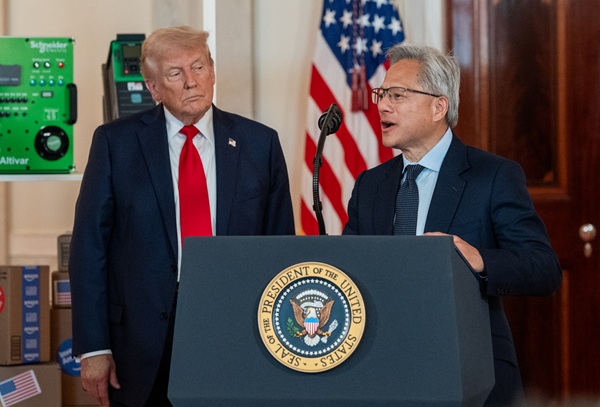
On November 23, Nvidia reinstated Jensen Huang as chief executive, less than two weeks after his resignation amid a controversy stoked by national-security concerns. Huang admitted to having had multiple affairs, including with a suspected Chinese intelligence asset. Nonetheless, US President Donald Trump personally intervened with the company’s board to secure his return.
The US political establishment’s response was swift. Former Secretary of State Hillary Clinton is calling the scandal “Supergate,” owing to the potent mix of national-security concerns, corruption, insider trading, and market manipulation. House Democratic leader Hakeem Jeffries sees Huang’s reinstatement as “indefensible” and is promising a congressional investigation. On the Republican side, former House Speaker Newt Gingrich has called for an investigation, and Senator Tom Cotton is pushing for stronger export controls on chips. Senator Kevin Cramer has warned that while Nvidia’s board has assumed the legal and reputational risks of reinstating Huang, the national-security risks fall on the American military and public.
The episode exposes a paradox at the heart of American technological hegemony. American AI dominance gives the US leverage over China, but the US economy’s dependence on Nvidia has created a second, domestic chokepoint. Owing to Nvidia’s strategic importance, the US has a powerful incentive to protect the company’s leadership and commercial success, even though it also has a duty to regulate Nvidia and safeguard national security. Put another way, Nvidia gives the US leverage over China; but the geopolitical power that Nvidia makes possible gives it leverage over the US government.
Nvidia’s power rests on its chips and software, which are essential to AI. The US has the power to restrict foreign access to American technology, but such restrictions obviously affect Nvidia’s bottom line.
In April 2025, the US restricted exports of Nvidia’s H20 chips to China on national-security grounds, resulting in a $4.5 billion write-off in unsold chips and associated commitments. Three months later, the Trump administration reversed course, with Commerce Secretary Howard Lutnick arguing that keeping Chinese companies dependent on American technology served US strategic interests. The US was now defending some chip sales to China as a way to preserve American technological dominance, despite having restricted them on security grounds.
The H20 reversal was not the only decision to draw scrutiny. On November 19, the House Foreign Affairs Committee revealed that, by May 11, 2026, the Commerce Department had approved licenses for roughly 880,000 advanced Nvidia and AMD chips destined for Chinese companies, some of which were later flagged by the Defense Department for alleged military ties.
But even when the US prohibits sales, chips can reach China through third countries. US authorities are now investigating whether the Singapore-based compute provider Megaspeed illegally diverted Nvidia chips to China. This is the company at the center of the current scandal. Huang had an extramarital affair with one of its top executives, Alice Huang (no relation), who is alleged to have ties to Chinese intelligence.
Some US lawmakers are also questioning whether Nvidia’s close contacts with US Commerce Department officials influenced its investigation into Megaspeed, which was added to the US export blacklist only on November 23. Taken together, these controversies raise questions about whether the US government can independently regulate a company it considers indispensable to American technological leadership.
Nvidia’s influence is not simply a matter of corporate lobbying or political access. American technological hegemony rests on far-reaching international networks of customers, developers, manufacturers, and commercial partners. These intangible assets are what generate profits for Nvidia and geopolitical leverage for the US. Yet restricting access arguably can encourage the development of alternatives. In an August 2026 securities filing, Nvidia claimed that its exclusion from much of China’s compute market had helped competitors expand their customer bases and networks of software developers.
Nvidia’s strongest argument against export controls is not simply that they cost the company money. It is that shutting Chinese customers out of American technology may strengthen Chinese competitors and eventually erode America’s leverage over China. Yet allowing those sales also gives China access to the computing power that US restrictions are meant to deny.
Preserving American technological hegemony requires distinguishing between the national interest and the commercial interests of the corporations on which American power depends. Export controls should be imposed when national-security concerns warrant them, without privileged political access influencing those decisions. Investigations into possible violations must remain free from corporate influence. And Congress should scrutinize these decisions even when doing so threatens the interests of firms that the US government considers indispensable.
This is the deeper paradox of America’s AI chokepoint. We have just witnessed how private corporate power can constrain and influence what should be independent national-security decisions. The two forms of power reinforce one another, but they do not necessarily serve the same interests. The more indispensable American technology becomes to the world, the more politically indispensable its corporate owners become to the US economy and government. American technological hegemony strengthens the private corporations on which it depends, even as they become harder for the US to govern.
Project Syndicate
More From BasisPoint