.png)


Datametricx is a veteran journalist tallying the macro game, keeping score of the numbers that shape India’s economy and policy.
October 17, 2026 at 12:20 PM IST
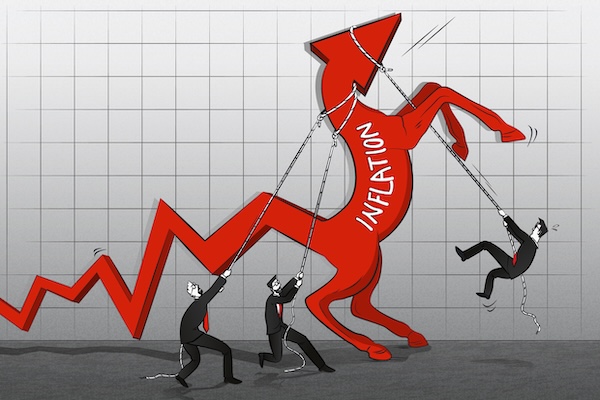
India’s retail inflation, measured by the Consumer Price Index (Combined), rose to a 23-month high of 5.54% in September, driven primarily by higher food prices, particularly vegetables and sugar. Retail inflation was 4.82% in August and 1.41% a year earlier.
The overall CPI rose 0.7% month-on-month, driven by a 1.3% increase in food prices. Food inflation accelerated to 7.74% in September from 5.97% a month earlier. The increase was led by vegetables and sugar, whose prices rose 4.3% and 2.9%, respectively, over the month.
Inflation in the personal care, social protection and miscellaneous goods and services division of the CPI basket was 13.75%, driven by an 87.80% year-on-year increase in silver jewellery prices and a 30.92% rise in gold jewellery prices.
Core inflation edged up to 4.3% in September from 4.2% a month earlier, pointing to broadening price pressures. With the war in West Asia showing no signs of abating and deficient monsoon rainfall posing risks to food prices, inflationary pressures are likely to persist.
The Reserve Bank of India has projected inflation to rise to 6.0% in the October-December quarter before easing in subsequent quarters. This is the first time since December 2023 that the RBI has projected quarterly inflation to reach 6.0%, the upper bound of its tolerance band.
The RBI’s Monetary Policy Committee, which raised the policy repo rate for the first time in three-and-a-half years, said there was some evidence that elevated inflation expectations were becoming generalised.
India’s annual inflation rate, based on the Wholesale Price Index, rose to a record 11.39% in September from 9.92% a month earlier, mainly driven by higher prices of crude oil, coal, and basic metals as the conflict in West Asia escalated during the month. This was the first time inflation had entered double digits in the current WPI series, which has history dating back to April 2024.
Among the three broad groups, annual inflation stood at 8.7% for primary articles, 25.9% for fuel and power, and 9.8% for manufactured products. Food price inflation rose to a 23-month high of 8.7% in September from 7.0% a month earlier, while WPI core inflation rose to a record 9.9%, suggesting underlying price pressures. Crude oil prices rose 27.0% month-on-month in September, while non-coking coal and basic metal prices increased 5.6% and 5.3%, respectively.
WPI inflation remains significantly higher than CPI inflation, partly because increases in petroleum product prices have not been fully passed on to consumers. Lower retail inflation also reflects manufacturers’ inability to pass on higher commodity costs to consumers.
India’s annual inflation rate, based on the newly introduced Output Producer Price Index, rose to a record 11.39% in September from 9.81% in August. Inflation based on the output PPI inflation has closely tracked WPI inflation in recent months.
Growth in automobile dispatches edged up to 14.8% year-on-year in September, with total dispatches rising to 3.02 million units. Growth remained in double digits for the 11th consecutive month and was marginally higher than the 14.6% recorded in August.
Growth in passenger vehicle dispatches slowed to 21.8% in September from a multi-year high of 36.5% in August. Dispatches rose to 454,574 units from 439,309 units in August and 373,347 units a year earlier.
Growth in two-wheeler dispatches accelerated to 13.5% in September from 10.5% a month earlier, with dispatches reaching 2.46 million units. Motorcycle dispatches remained subdued, rising just 2.8% year-on-year to 1.41 million units. Scooter dispatches, however, continued to grow strongly, increasing 34.1% to 995,576 units.
Among passenger vehicles, utility vehicle dispatches rose 25.3% year-on-year to 257,112 units, while car dispatches increased 19.6% to 117,612 units.
The Society of Indian Automobile Manufacturers expects positive growth momentum to continue in the second half of 2026–27, although growth rates may moderate as the industry faces a higher base. Automobile sales had risen sharply in the second half of the previous year following steep cuts in goods and services tax rates.
India’s merchandise exports continued to grow strongly despite the war in West Asia and disruptions to shipping routes in the region. The merchandise trade deficit narrowed 8.4% year-on-year to $30.21 billion in September, as exports grew nearly three times as fast as imports. However, the deficit widened from $26.86 billion in August. Exports rose 23.0% year-on-year to $44.40 billion during the month, marking their second-fastest growth in over four years. Imports increased 8.0% to $74.61 billion.
Among exports, electronic goods rose 70.4% to $5.31 billion, while petroleum products increased 31.9% to $6.22 billion. Engineering goods, the largest component of India’s export basket, rose 20.9% to $12.17 billion in September.
Import growth, meanwhile, moderated, largely due to a sharp contraction in precious metal imports. Imports of gold and silver fell 77.4% year-on-year to $2.47 billion in September. However, imports of petroleum products and crude oil rose 30.8% to $18.34 billion, while imports of electronic goods increased 51.5% to $14.86 billion.
India’s current account deficit narrowed to $5.2 billion in August from $7.0 billion a month earlier, mainly on account of a decline in the merchandise trade deficit. The current account deficit was $6.1 billion in August last year. The merchandise trade deficit fell to $26.6 billion in August from $31.7 billion a month earlier, while the services trade surplus fell to $16.5 billion from $17.6 billion in July.
The capital account recorded a surplus of $50.6 billion in August, up sharply from $27.7 billion a month earlier, primarily due to a substantial increase in banking capital to $64.7 billion from $18.4 billion. The increase was driven by strong inflows under the special deposit schemes for non-resident Indians announced by the RBI to attract foreign exchange. The capital account recorded a surplus of $0.5 billion in August last year. Net foreign direct investment inflows of $3.3 billion and foreign portfolio investment inflows of $1.7 billion also boosted the capital account.
The current account recorded a deficit of $18.3 billion in April-August, up from $12.8 billion a year earlier. The capital account recorded a surplus of $76.3 billion in the first five months of 2026-27, up sharply from $12.0 billion a year earlier.
The country’s unemployment rate remained unchanged at 5.0% in September, despite an increase in joblessness among urban youth. The rural unemployment rate rose to 4.2% from 4.1% a month earlier, while the urban rate increased to 6.9% from 6.8%.
The unemployment rate among youth rose to 15.2% in September from 15.1% in August, driven by an increase in urban youth unemployment, which climbed to 19.0% from 18.7%. Unemployment among young urban men rose to 16.4% from 16.2%, while that among young urban women increased to 26.6% from 26.4%.
The overall labour force participation rate — the share of the working-age population that is employed or actively seeking work — eased to 55.5% in September from 55.6% a month earlier.
Open-ended mutual fund schemes saw net outflows of ₹1.331 trillion in September against net inflows of ₹425 billion in August, driven by sharp outflows from debt schemes. The schemes saw net outflows of ₹428 billion in September last year. Open-ended debt schemes typically see large outflows around corporate advance tax payment dates. Debt schemes recorded net outflows of ₹1.832 trillion in September, compared with ₹81 billion a month earlier and ₹1.020 trillion a year earlier.
Net inflows into open-ended equity schemes increased to ₹383 billion in September from ₹293 billion a month earlier and ₹304 billion a year earlier, despite the sharp decline in equity indices. The Nifty 50 declined 6.1% month-on-month to 22,620.45 points in September. Equity schemes have now recorded net inflows for more than five-and-a-half years. Inflows into gold exchange-traded funds increased to ₹45 billion in September from ₹26 billion a month earlier.
Despite stock market volatility, systematic investment plan inflows remained robust. SIP inflows edged up to a record ₹325 billion in September from ₹323 billion a month earlier.
The mutual fund industry’s net assets under management fell to ₹82.64 trillion at the end of September, down from ₹87.08 trillion a month earlier, primarily due to mark-to-market losses and outflows from debt funds.
Domestic tractor sales contracted year-on-year for the first time in 22 months in September as the base effect turned extremely unfavourable. Domestic tractor sales declined 18.1% year-on-year to 119,667 units. Domestic tractor sales had risen 45.4% year-on-year in September last year following goods and services tax rate cuts. The tractor industry is among the biggest beneficiaries of the GST rate cuts introduced in September 2025. The industry had recorded double-digit growth in domestic sales every month from August 2025 to July 2026. Total sales, including exports, declined 15.5% to 130,551 units.
Tractor production grew just 1.0% to 115,630 units in September. Despite the modest increase, production in September was the third-highest on record.
Growth in India’s coal production accelerated to a 13-month high of 10.6% year-on-year in September, compared with a contraction of 3.8% in August. Production rose to 75.37 million tonnes from 68.14 million tonnes a year earlier and 66.87 million tonnes in August.
Coal dispatches rose 13.2% year-on-year to 83.90 million tonnes in September. Reports said coal stocks at nearly 40% of the country’s thermal power plants were at “critical levels” as of mid-September amid a surge in power demand due to hotter-than-usual summer conditions. Thermal power generation rose 15.6% year-on-year to 117.91 billion kWh in September. Coal dispatches to the power sector, which accounts for about 80% of total coal dispatches, increased 10.4% year-on-year to 67.18 million tonnes during the month.
Petroleum product consumption grew year-on-year for the first time in seven months in September, as disruptions following the war in West Asia eased. Petroleum product consumption rose 3.4% year-on-year to 19.26 million tonnes in September, primarily on account of an increase in petrol and diesel consumption. Consumption of petrol rose 7.9% to 3.67 million tonnes, while that of diesel increased 5.6% to 7.16 million tonnes. Consumption of LPG declined for the seventh consecutive month, falling 8.9% to 2.54 million tonnes in September.
India’s foreign exchange reserves continued to decline amid pressure on the rupee from higher crude oil prices and elevated US Treasury yields, prompting the Reserve Bank of India to intervene in the foreign exchange market to support the currency. Reserves fell by $8.58 billion over the week to $726.03 billion as of October 9, marking the fifth consecutive weekly decline. They fell by a cumulative $59.68 billion over this period. Foreign currency assets declined by $7.14 billion to $597.61 billion, while gold reserves fell by $1.32 billion to $105.09 billion.
Water storage in key reservoirs continued to fall, remaining well below normal levels. As of October 15, live storage in the country’s 178 reservoirs stood at 126.72 billion cubic metres, or 69% of their total capacity. Storage was 25% below the year-ago level and 16% below the 10-year average. Deficient southwest monsoon rainfall and lower storage levels in reservoirs are likely to affect rabi crops, which typically depend on irrigation. Normally, reservoir storage falls to around 126 billion cubic metres by mid-January.
The northeast monsoon has got off to a slow start, with rainfall deficient in most parts of the country so far. Cumulative rainfall across the country stood at 18.5 millimetres as of October 16, equivalent to 38% of the long-period average. Rainfall in the core region, where the northeast monsoon is most active, was just 49% of the long-period average. The core region comprises Coastal Andhra Pradesh, Rayalaseema, Tamil Nadu and Puducherry, South Interior Karnataka and Kerala.
Coming up
- October 21: Index of Nine Core Industries for September
- October 23: HSBC India Flash PMI for October
- October 28: Index of Industrial Production for September
Tailpiece
The government has announced the premature redemption of sovereign gold bonds issued in October 2020. The bonds will be redeemed at ₹14,614 per unit, representing capital appreciation of 192.2% over the issue price of ₹5,001 per gram over six years. Bondholders will also receive fixed interest of 2.5% per annum on the initial investment.
More From BasisPoint