.png)


Minari Shah is a strategic communications leader who has helped Fortune 500 brands, such as Amazon, Tata Motors and Dell, build trust through storytelling.
September 17, 2026 at 12:37 PM IST
For the last five years, as quick commerce scaled up, “dark store” entered the urban Indian lexicon but remained a nebulous presence, often just a number in a quick-commerce presentation where more stores meant more pin codes, shorter delivery times, higher order frequency, a stronger claim on the market.
But it found its way to major headlines when, on August 13, Maharashtra's Food and Drug Administration inspected 86 premises. Inspectors reported cockroaches, rodent droppings, rotten vegetables, dirty racks and poor food handling. The regulator issued 60 improvement notices and suspended the licences of 12 warehouses linked to Blinkit, Zepto and Swiggy Instamart. At Zepto's Nashik warehouse, delivery workers were walking into food storage areas in their street footwear.
None of this is new to Indian food retail nor unique to quick commerce. Dirty premises, broken refrigeration and expired stock have unfortunately been with us far longer than ten-minute delivery. Quick commerce inherited these problems, and the fast growth has only scaled the problem. Nor is it confined to the quick-commerce specialists. In September, Karnataka inspectors reported incorrectly labelled and expired food at two Amazon food-storage and supply facilities in Bengaluru; Amazon said it was reviewing the findings and would take the necessary steps.
This brings us to the hard question: why is India the only large market where a ten-minute grocery business has become a food safety story of this scale?
Cause one: The leapfrog problem, the visible kirana store
In most large markets, the roughly fifty years between the corner shop and the app was the golden era of traditional suburban supermarkets. Tesco, Carrefour, Kroger and Ahold grew with explicit promises of price, parking and convenience. But there was another key impact from their growth which was really the infrastructure they built. They built the cold chains, first-expired-first-out habits, food-safety processes, store audits and supplier standards, that helped regulators, manufacturers and landlords build a robust food-safety ecosystem.
India largely bypassed this supermarket stage. The kirana’s vast network meant almost everyone could walk across for essentials, and due to multiple socio-economic-political reasons, India was among the last major economies to build supermarkets. But before these supermarkets could actually scale up, e-commerce arrived, and quick on its heels came quick commerce. We got to dark stores era without either the infrastructure or the habits of food safety.
The kirana could have, and often did, the same problems as the dark store. But the fact that when the customer entered the place, she could see whether the floor was dirty, if the vegetables were fresh, check the expiry date or reject a dented tin made a difference. It was easy to return a damaged packet to the store owner who likely knew her name and address. Small shops were not necessarily more compliant than large platforms but this visibility acted as its own check. When quick commerce replaced the “send it home” kirana economy, the trust that once had a human face shifted to Blinkit, Zepto or Instamart without any checks in place.
Cause two: The arithmetic of enforcement
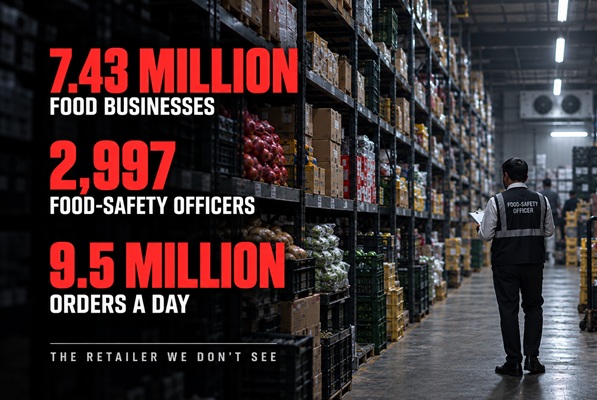
There was of course the legal necessity - Indian law covers licenses, cleanliness, pest control, refrigeration, segregation and employee hygiene. FSSAI’s late-2024 directions also require online food businesses to maintain minimum remaining shelf life. The problem however is enforcement. India has about 7.3 million licensed and registered food businesses and roughly 3,000 food-safety officers: that is, about one for every 2,400 businesses. In reality, the ratio is even more skewed give how many sanctioned posts continue to lie vacant. There were just 26,000 risk-based inspections across the entire food economy in 2024-25. Meanwhile, the top five quick-commerce players have approximately 6,500 dark stores and the sector crossed 9.5 million orders a day in August. Blinkit alone reported 2,443 stores as of 30 June and wants 3,000 by March 2027. It’s clear the under-resourced regulator is chasing a network that’s growing much faster.
And penalties, unchanged since 2006, do not carry significant constraint. Failure to comply with an FSSAI direction carries a maximum fine of Rs 2 lakh and unsanitary manufacture or processing draws Rs 1 lakh. For a business running millions of orders a day, these are rounding errors in a week’s discounting budget.
The China example
China also somewhat leapfrogged to the app, with just a thin supermarket layer earlier. In March 2022, an undercover investigation found re-labelled expired vegetables, dead fish sold as fresh and products with tampered shelf life at a Dingdong Maicai front warehouse. Dingdong’s chief executive confirmed the report, suspended the warehouse and accepted that management bore major responsibility. The regulator ordered self-examination across 124 fulfilment stations and inspected competing platforms. Today, Chinese enforcement has escalated dramatically. In April 2026, the investigation ran for nearly ten months across all 31 provinces and the regulator, SAMR, imposed total fines and confiscations of RMB 3.597 billion (around $500 million), on seven platforms in the “ghost takeout” cases, including personal fines on legal representatives and food-safety directors.
Compare this with India’s Rs 1-2 lakh ceilings. This when China has more than 80,000 dark stores and a daily order volume roughly twenty times that of India. Scale has clearly not prevented enforcement in China from acquiring teeth.
Cause three: The business model of condensed space
The dark store’s business model is focused on fitting the most products into the smallest viable area. The average Indian dark store carried about 6,000 products in 2023; by the following year, many platforms crossed 20,000. But food handling requires space: separation between categories, temperature zones, space for damaged and expired stock to go, and room for a picker to move at speed without contaminating what she passes. The business logic of the 10-minutes delivery thus has an inherent tension vis-a-vis safe food handling.
Other countries have grappled with this problem and were finally compelled to move to larger premises. Meituan closed most of its first-generation Chinese warehouses of about 2,200 sq ft and now operates facilities averaging about 6,500 to 16,000 sq ft. In the US, Gopuff’s centres average 5,000 to 8,000 sq ft for roughly 2,500 to 4,000 products. Britain and US also leverage the existing supermarket structure. In Britain, early forms of the rapid grocery delivery models have mostly been absorbed into the supermarket structure: Tesco’s Whoosh, for instance, delivers from its own stores, meaning that the fulfilment nodes are already licensed, inspected and staffed by people trained in grocery handling. In the US too, Instacart shoppers pick from supermarket aisles; DoorDash and Uber Eats partner with grocers; Kroger and Walmart deliver from their own networks. Dark-store exceptions such as Gopuff and DashMart primarily handle convenience products rather than the full fresh basket as seen in India. India, lacking this supermarket network, built a parallel invisible network. The distributors’ federation has now proposed a minimum floor-area formula, similar to global direction.
What’s changing
Indian brands are quickly waking up to the reputational risk from dark store’s problem. By FY26 quick commerce accounted for 60 to 75 per cent of online sales at ITC, Tata Consumer, Parle and AWL Agri Business. In the largest cities, quick commerce and modern trade together account for roughly 40 per cent of ice-cream sales and close to three-quarters of frozen-food sales.
Nearly a dozen large food companies, including Britannia, ITC, PepsiCo, Amul, Parle and Mother Dairy, have written to platforms about storage and handling lapses. Marico, ITC, Godrej Consumer and Dabur have begun adding clauses on FSSAI compliance, expiry discipline and indemnity against reputational damage. BigBasket’s cofounder Vipul Parekh has said customers may visit any of its dark stores and obtain the location from customer service; ironical for a business built around removing the need to visit a store. Platforms have increased surprise audits, are redesigning storage areas and giving manufacturers greater inspection access. But while manufacturers are writing audits into commercial contracts, the bargaining power is uneven. Many new-age brands derive a fifth of sales or more from quick commerce and are hardly in a position to negotiate audit rights.
And where does the solution lie?
A system dependent on periodic government raids cannot compete with a fast-growing network, commercially incentivized, and with access to capital, for expansion. The only real substitute for walking into the shop is therefore a public record, in plain language, dated, attached to the listings visible to the customers.
In August 2026, a Gopuff facility in Chicago was cited for, among other things, more than 500 rat droppings and nearly 50 large flies; not very different from the Malad and Nashik findings. But the difference is that the citation sits on the Chicago Data Portal, searchable by anyone. American inspection results are commonly public records, while Britain publishes per-premises hygiene ratings in plain language. FSSAI’s FoSCoS portal lets an Indian customer verify that a license exists, but not what the last inspection found.
The platforms now have a choice: to wait for FSSAI to build public records; or build it themselves. If the consumer cannot walk into the store, the least the platform can do is let her read its file. The first platform to provide that visibility may build a kind of trust its rivals cannot discount their way past.
* This piece first appeared on Minari Shah’s Substack page, The Long View
More From BasisPoint