.png)

The Importance of Being A R Rahman
He changed the sound of Indian film music. But perhaps his greater achievement was changing how a song could tell its story.

Minari Shah is a strategic communications leader who has helped Fortune 500 brands, such as Amazon, Tata Motors and Dell, build trust through storytelling.
November 4, 2026 at 4:12 AM IST
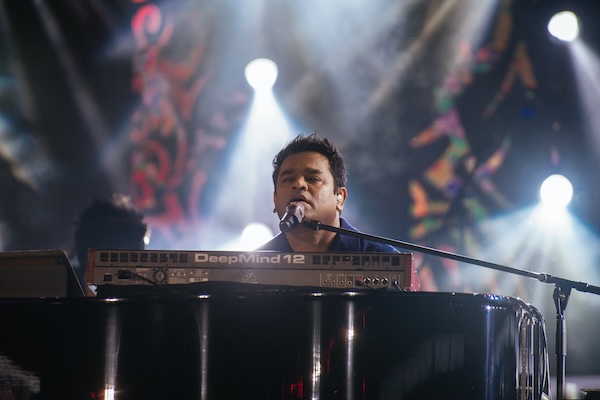
Sunday evening, I sat for three hours at A R Rahman’s Wonderment concert in Mumbai, spanning three decades of compositions, songs so familiar the opening notes brought back entire films and memories and moments from our own lives. The production was superb and you could pick out the sounds of guitar, flute, sitar or tabla separately.
Much has been written about how this one man changed Indian film music and the startling sound Rahman brought with Roja in 1992: the electronics, the orchestration, the meeting of Indian and Western traditions. But what struck me, listening to them live, was not just how different they were, but how they changed the very template of Indian film songs.
Through much of Hindi film music, melody and lyrics were at the centre of the song. The familiar mukhda-and-antara structure, connected by instrumental interludes, lay at the heart of most pre-Rahman film songs, even those by the finest composers. The interludes could be magnificent: R D Burman’s O Haseena Zulfonwali, with its exhilarating drums and brass, is a fine example. Salil Chowdhury had his Western harmonies and Ilaiyaraaja his Carnatic-Western counterpoint. But with Rahman, something shifted more fundamentally, as instrumental passages were no longer merely introductions or bridges between the sung portions. Rhythm, voices, orchestration, pauses and tempo all became part of one seamless musical narrative, the divisions between mukhda, antara and interlude sometimes irrelevant.
Take Dil Se Re. Gulzar’s lyrics could easily have been composed as a tender, even sombre expression of love. But Rahman turned them into something far more evocative, something restless, almost primal, the music moving from meditative quiet into sudden surges of percussion and vocal intensity. There is tenderness and anguish and urgency as the music itself throbs under one’s skin; the words tell you what to feel while the music makes you live it.
In Satrangi Re, from the same film, Gulzar explores the seven stages of love, but the insistent rhythmic pulse, shifting textures and mounting intensity make the junoon or the obsession physically palpable even without the words, the gravelly hoarse whisper of (the usually mellifluous) Kavita Krishnamurthy’s voice bringing alive the stark dunes even when you aren’t watching the song. The voice became an instrument in itself, a part of the orchestration: sometimes a rhythmic element, sometimes an expression of emotion or at times the prelude before a single intelligible word had been sung, like Sonu Nigam at start of this song.
If Chandralekha in Thiruda Thiruda is a riot of rhythm, voices and unexpected turns, a composition that keeps reinventing itself, the exuberant aiyya ya yo announces the mood of Mangta Hai Kya of Rangeela from the start and then the rhythm takes over such that it’s almost impossible to listen without moving your body. Yet the yearning baat meri samjho na finds its place amid the mischief and the playful, teasing mood.
On the other hand, Hai Rama begins delicately, with classically inflected voices, but then the beat enters to turn the whole atmosphere charged and pulsating with desire. It grows increasingly sensuous, carried as much by texture, rhythm and the interplay of voices as by the words. By the time Taal arrived, Rahman seemed capable of making the rhythm itself the protagonist. In Taal Se Taal Mila, the music ebbs and builds around a deceptively accessible melody. If percussion, vocal energy and shifting intensity create a momentum far beyond the lyrics in Ramta Jogi, melody leads arrangement in Ishq Bina.
Then there are compositions like Tu Hi Re from Bombay, Dheemi Dheemi from 1947: Earth, Tu Bin Bataye from Rang De Basanti that show extraordinary restraint despite being complex and layered. The composer of Muqabla and Urvashi Urvashi also wrote Luka Chuppi and O Paalanhaare where his classical, folk and devotional influences lay the foundation of the music itself rather than just decorate an international sound.
Masakali in Delhi-6 is playful, buoyant and wonderfully unpredictable, the instruments and rhythm skipping around to give it a lightness the lyrics alone couldn’t achieve. Rehna Tu, on the other hand, creates jazz-infused hypnotic intimacy, opening into a rich, unexpected instrumental passage. Two utterly different songs but both capture the imagination much beyond the sung words.
Or take Rockstar. Nadaan Parindey makes longing and homecoming feel like an emotional struggle unfolding in real time with its rock instrumentation, the vocal urgency and the shifts between reflective passages and explosive intensity (not uncommon in his compositions as seen in some previous examples). If Kun Faya Kun achieves serenity and the spirit of surrender, Sadda Haq is perhaps the truest rock anthem Hindi film music has produced. The anger, defiance and sheer rebelliousness aren’t just in the lyrics but in the distorted guitars, the relentless drums, Mohit Chauhan’s almost furious vocals. Tamasha’s Agar Tum Saath Ho uses the contrast between voices and the pace to build the emotional distance between the two people.
The choice of singers has been as adventurous as his instrumentation; opening up film music to voices that might not have fitted the conventional playback mould. The earthy power of Sukhwinder, the silken smoothness of Naresh Iyer, the crystalline purity of Chinmayi; Rahman seems to have cared as much for the character of a voice as its technical accomplishment, a breathy or raw quality sometimes doing more than conventional vocal perfection, bringing diverse voices into our soundscape.
When younger, I mainly listened for the melody, for the hooks that I could hum but now I hear the architecture underneath it all where the orchestration breathes and has space between the notes. This well-integrated music-words structure is perhaps why it is so hard to sing Rahman songs on a casual evening with friends!
A question I have found myself asking in recent times is: has Rahman stopped surprising us post-2015 even if he has not stopped making good music. Ponniyin Selvan has wonderful compositions and Amar Singh Chamkila is an accomplished soundtrack. In Main Vaapas Aaunga, Tere Paas Main is beautifully melodic, Maskara vivacious and foot-tapping, Ishq Mastana a masterful retro mix of Indian styles with rock and jazz-inflected rhythms. But how many recent Rahman songs have made us stop and wonder where on earth that musical idea came from?
Perhaps the musical language Rahman spent two decades building has now been so thoroughly absorbed not just in his work but also in our own hearing experience that it sounds less distinctive. Layered production, electronic textures, unusual voices, folk-classical-western fusion have now been adopted by others such as Shankar-Ehsaan-Loy, Pritam and other younger music directors. In his more recent work, Ponniyin Selvan or Chamkila, the western influences are also more subtly integrated while the Indian classical or regional traditions sit more upfront. It’s interesting that Rahman often seems to be the first port of call for some of the biggest period or mythology films, from Lagaan and Jodhaa Akbar right down to Ponniyin and now Ramayana.
Perhaps it is an unfair test whether a new Rahman song sounds as novel as Roja did back in 1992, an impossible standard to set for the man who changed the industry’s music vocabulary. Moreover, there is an unfair advantage that older music has over anything new because it’s sepia-tinted. While Bollywood music has always been wired into our emotional lives, with songs for every crush and every heartbreak; Roja, Bombay, Rangeela, Dil Se were the actual soundtrack of our younger lives, reflecting how exhilarating or painful or consuming love could be. No matter how lovely Tere Paas Main is, it cannot make me feel 23 or even 32 again.
And that was the experience of Wonderment. The sexy laughter and thump of Humma Humma had the entire arena grooving while Tu Hi Re could make one sway with damp eyes. A notable surprise of the evening (for me) was the generosity of Rahman as a performer. He shared the stage with his young singers, letting them take the lead, often stepping back into the ensemble. Besides Jonita Gandhi who was the most consistent voice, there was Heer, (who records as Nilanjana Ghosh Dastidar), so impressive with her acoustic guitar slung over her bright green silk saree, singing Maskara with impressive gusto. Pooja Tiwari confidently led the multi-layered Ishq Mastana, not easy to sing live. And violinist Haritha Raj’s accomplished set pieces gave me goosebumps. The man whose name had brought everyone there seemed content to let the music, and the musicians, occupy centre stage without gimmicks. When the evening closed with Maa Tujhe Salaam, the entire ground was on its feet, singing Vande Mataram with him.
So perhaps the questions of whether Rahman is still at his peak or whether he has changed are too small beside the sheer audacity of what he made possible. What made his greatest compositions extraordinary wasn’t their novelty, or the memories we attached to them. It was how he changed how completely the music could inhabit an emotion, giving it a force and complexity beyond what the lyrics could express. Hindi film songs have always been an integral part of moving the story forward; he made the instruments, voices, rhythms and silences as much a part of the storytelling as the lyrics. He could make love sound tender, feverish, joyful, anguished or almost frightening, sometimes within the same composition.
And perhaps that is the peculiar burden of being A.R. Rahman. Having taught us to expect the unexpected, he is now measured against the extraordinary standard he created himself.
But what an extraordinary standard it is.
* This piece first appeared on Minari Shah’s Substack page, Off Duty
More From BasisPoint