.png)


Prakash Nanda is a veteran editor, author and strategic-affairs commentator with over three decades in media, academia and policy consulting.
October 23, 2026 at 4:46 AM IST
Strategic experts have often debated whether or not the Indian Navy should shift its doctrine from a traditional “sea control” strategy, to a “sea denial” strategy.
While the former aims at dominating large areas of the sea by using carrier battle groups and their associated aircraft, missiles, and surface ships, sea denial relies on submarines and other anti-access/area-denial (A2/AD) capabilities to prevent an adversary from using the sea.
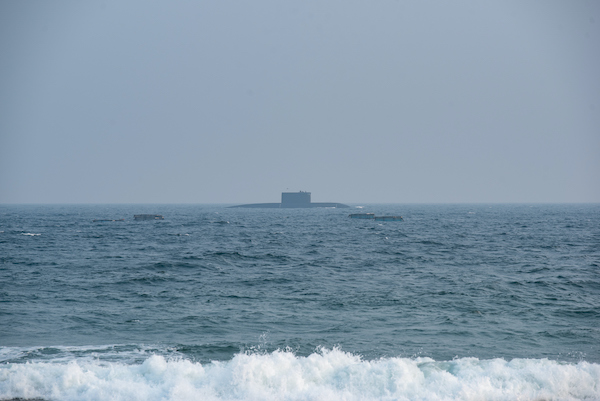
Submarines are among the most effective instruments of sea denial. They threaten surface combatants, complicate protection of merchant shipping, force adversaries to divert resources towards anti-submarine warfare, and can remain concealed until an opportunity to strike emerges.
India also lacks an operational nuclear-powered attack submarine, or SSN. Unlike conventional diesel-electric submarines, which must periodically surface to recharge their batteries unless equipped with suitable air-independent propulsion, SSNs can remain submerged for extended periods and sustain high speeds over long distances. They make their own oxygen and water, and can sustain 25+ knots submerged for months. With more manoeuvrability than a diesel-powered submarine, an SSN can better track, survive, and hold against an adversary’s boats.
In short, SSNs’ endurance and mobility make them particularly valuable for tracking enemy submarines, protecting strategic naval formations, and operating across the vast distances of the Indian Ocean. They also escort Carrier Strike Groups (CSGs) or aircraft carriers like the INS Vikrant and INS Vikramaditya for sea control missions.
SSNs add to the formidability of the nuclear-powered ballistic-missile submarines, or SSBNs like INS Arihant, INS Arrighat and INS Aridhaman, which constitute India’s sea-based nuclear deterrence by assuring a survivable second-strike capability to maintain credible nuclear deterrence.
While SSBNS’ capabilities depend upon the range of the missiles (India’s K-15 submarine-launched ballistic missile has a publicly assessed range of approximately 700 km, the longer-range K-4 can cover targets at around 3,500 km), they need bodyguards, where an SSN escort comes in.
At the moment, India does not have any SSNs in service. It had earlier leased two from Russia - INS Chakra I and INS Chakra II. INS Chakra I was leased for three years – from 1988 to 1991. In 2012, India leased INS Chakra II, a far more advanced Akula-II class (Project 971) multi-purpose attack submarine. It returned to Russia after a lease period of 10 years.
While India has signed an agreement with Russia for another leased SSN for a period of 10 years, there have been delays and it is likely to come only by 2028 due to the Russia-Ukraine war and subsequent sanctions.
The Indian Navy has requisitioned six indigenous SSNs.
The Chinese Side of the Story
This move comes at a time when China, widely recognised to be India’s principal adversary, is investing in nuclear-powered attack submarines, ballistic-missile submarines and conventional attack submarines, backed by a shipbuilding ecosystem capable of producing increasingly sophisticated platforms at scale.
An analysis published by the International Institute for Strategic Studies in February 2026 reported that China’s nuclear-submarine production between 2021 and 2025 had exceeded its output during the preceding decade. China also launched more nuclear-powered submarines, both by number and combined tonnage, than the United States.
Incidentally, in March this year, the US Navy’s intelligence chief, Rear Admiral Mike Brookes, testified before the US-China Economic and Security Review Commission (USCC) that China is undertaking a major shift toward building an all-nuclear submarine fleet as part of a broader effort to strengthen its undersea warfare capabilities.
According to Brookes, the People’s Liberation Army Navy (PLAN), which operates more than 60 submarines in total, including roughly 50 conventional diesel-electric boats (SSK) and a smaller number of SSNs and SSBNs, is transitioning away from conventional submarines toward a predominantly nuclear construction programme to support sustained operations, strategic deterrence, and sea-lane interdiction.
The Indo-Pacific will remain the PLA Navy’s primary focus, but by 2040 routine submarine deployments to the Indian Ocean, Arctic approaches, and possibly the Atlantic are likely, Brookes cautioned.
The China Threat
Chinese submarines operating in the Indian Ocean could threaten Indian surface formations, complicate the defence of maritime approaches and force the Indian Navy to devote greater resources to surveillance and anti-submarine warfare.
But geographical advantage does not automatically translate into maritime supremacy. Nor does the ability to deploy ships across a large area guarantee the ability to control it during a high-intensity conflict.
On closer scrutiny, China's advantage is not simply that it has more warships and submarines. It is that its expanding industrial capacity gives it the potential to replace losses, rotate platforms, and maintain operational pressure more effectively over time. In other words, China’s expansion of naval power rests not only on the platforms already in service but also on the capacity to construct, maintain, modernise and replace them.
It is not that India has to replicate China’s entire naval expansion fully. But what is needed is an industrial ecosystem that could produce enough modern, deployable submarines and the supporting capabilities to ensure that China cannot challenge its maritime interests at an acceptable cost.
More From BasisPoint