.png)

Spoiler or Spark? What the Azad–Owaisi Alliance means for UP 2027
The new Dalit–Muslim front is unlikely to win many seats. But in a state where the 2024 election was decided by razor-thin margins, it could determine who does.
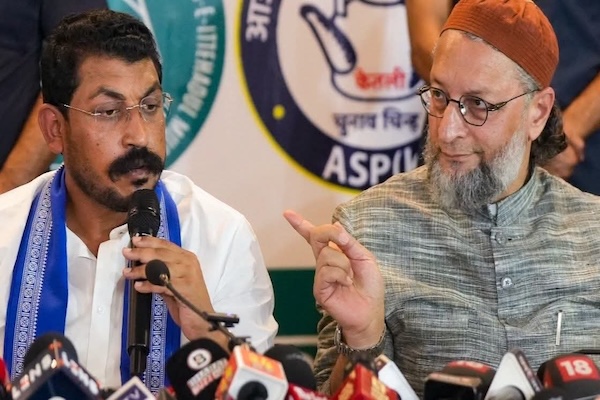
Amitabh Tiwari, formerly a corporate and investment banker, now follows his passion for politics and elections, startups and education. He is Founding Partner at VoteVibe.
November 17, 2026 at 6:34 AM IST
On November 12, the Azad Samaj Party (Kanshi Ram) and Asaduddin Owaisi’s AIMIM announced an alliance, the Samajik Parivartan Morcha, for the 2027 Uttar Pradesh Assembly elections. The front says it will contest all 403 seats and has named Chandrashekhar Azad as its chief ministerial face. It is targeting the Dalit–Muslim bloc, which makes up around 40% of the state’s population.
The ambition is large. The track record is not.
A Thin Electoral Record
In 2022, AIMIM contested 95 seats, won none and polled about 0.49% of the statewide vote. The Azad Samaj Party fielded candidates on more than 100 seats, polled roughly 0.13% and also drew a blank. Neither party has ever opened its account in an Assembly election in UP.
In the Lok Sabha election, Chandrashekhar Azad won from Nagina, giving the ASP one seat and a 0.69% vote share. The two parties, contesting separately, polled a combined vote share of around 1%.
Both say they are fighting to win. Realistically, they are unlikely to. The more consequential question is how much they could take away from others.
Why a Marginal Player Can Matter
The 2024 Lok Sabha election showed how narrow the margins are in UP. The gap between the two big alliances in vote share was only around 0.3 percentage points. In a contest that close, even a party polling 2–4% can shift the balance.
A simple scenario model shows how the numbers could work. It assumes SC voters are roughly 22% of the electorate, Muslims about 18% and everyone else about 60%.
VOTE SHARE OF ASP-AIMIM ALLIANCE IN UP: SCENARIOS
|
SUPPORT FROM |
Scenario 1 |
Scenario 2 |
Scenario 3 |
|
SC |
5% |
10% |
15% |
|
Muslim |
5% |
10% |
15% |
|
Others |
3% |
5% |
7% |
|
VOTE SHARE |
Scenario 1 |
Scenario 2 |
Scenario 3 |
|
SC |
1.1% |
2.1% |
3.2% |
|
Muslim |
0.9% |
1.8% |
2.7% |
|
Others |
1.8% |
3.1% |
4.3% |
|
Vote Share |
3.8% |
7.0% |
10.1% |
|
DAMAGE TO |
Scenario 1 |
Scenario 2 |
Scenario 3 |
|
SP+ |
2.3% |
4.4% |
6.4% |
|
BJP+ |
0.9% |
1.5% |
2.1% |
|
BSP |
0.5% |
1.1% |
1.6% |
|
Vote Share |
3.8% |
7.0% |
10.1% |
|
PROPORTIONAL DAMAGE |
Scenario 1 |
Scenario 2 |
Scenario 3 |
|
SP+ |
62% |
63% |
63% |
|
BJP+ |
24% |
22% |
21% |
|
BSP |
14% |
15% |
16% |
|
Vote Share |
100% |
100% |
100% |
-
Scenario 1: If the alliance gets 5% of SC voters, 5% of Muslims and 3% of others behind it, its statewide vote share would be about 3.8%.
-
Scenario 2: Support of 10%, 10% and 5%, respectively, would translate into about 7.0%.
-
Scenario 3: Support of 15%, 15% and 7% would yield about 10.1%.
Even the modest first scenario, with 5% support among Dalits and Muslims and 3% among others, delivers nearly 4% of the statewide vote. These are assumptions, not forecasts, but they show how a relatively small shift in voter loyalty could matter.
The model also estimates where those votes would come from. In every scenario, the SP and its allies lose about 62–63% of the alliance's vote, the BJP and its allies 21–24%, and the BSP 14–16%. In Scenario 3, that translates into losses of about 6.4 percentage points for SP+, 2.1 for BJP+ and 1.6 for the BSP. The SP would take roughly three times the hit suffered by the BJP. These splits are assumed; actual seat outcomes will depend on constituency-level voter concentration, not statewide averages.
The Politics of Representation
Owaisi’s pitch rests on representation. He accuses secular parties of taking Muslim votes while denying Muslims tickets and failing to build Muslim leaders. The numbers give him material. Muslims account for only about 5% of Lok Sabha MPs. In UP, there are just 34 Muslim MLAs, compared with an estimated 70–80 that their population share would suggest.
The argument is gaining traction among minorities, and AIMIM’s five seats in Bihar’s 2025 election have strengthened its claim to political relevance. In UP, however, converting resentment into votes has proved difficult. In 2022, around 79% of Muslim voters backed the SP, according to a Lokniti-CSDS survey. In 2024, that share rose to 92%.
The Dalit Question
The alliance is not only about Muslims. The BSP’s vote share has fallen from 22.2% in 2017 to 12.9% in 2022 and 9.4% in the 2024 Lok Sabha polls. Some Dalit voters appear to be looking for an alternative leader.
Azad, who won Nagina in 2024, is positioned to appeal to younger Dalit voters, especially Jatavs, the BSP’s core base. He could also challenge Akash Anand, whose uncertain positioning within the BSP has complicated Mayawati’s efforts to consolidate the party.
The risk to the INDIA bloc is just as real. In 2024, non-Jatav SC voters moved towards the SP and Congress, with 56% backing the alliance. The Azad Samaj Party could now erode those gains.
The SP’s Ticket Dilemma
The alliance arrives at an awkward moment for Akhilesh Yadav. The SP did well in 2024 partly because it neutralised the “MY” (Muslim–Yadav) tag. It gave only 5 of its 62 tickets to Muslims, whereas their population share would suggest roughly 12 seats. The freed-up tickets went to non-Yadav OBCs and SCs, including some candidates from general seats. The result was a reported gain of about 9 and 11 percentage points among Kurmi–Koeri and other OBC voters, respectively, and a 20–30% increase among non-Jatav SCs.
Repeating that formula in 2027 will be harder. If the SP again gives few tickets to Muslims, Owaisi’s narrative of denial gains ground. If it gives more, it risks polarisation and could play into the BJP’s “80–20” narrative, long used by Yogi Adityanath.
The SP has responded calmly. Akhilesh Yadav welcomed the alliance and called for a broader “political change” front, while the Congress has called the new front the BJP’s team. Senior advocate Kapil Sibal said the front will certainly not form a government but can hurt the SP–Congress alliance.
Where the Damage Could be Done
The alliance may not win many seats, but it does not need to. In tight contests, particularly in the 100–120 constituencies with Muslim populations above 20%, a loss of even a few thousand Muslim votes could tilt the result against the SP+. The Dalit leg adds a second risk, nibbling at the non-Jatav and Jatav SC votes that both the BSP and the INDIA bloc depend on. Dalit populations exceed 20% in around 150 constituencies.
The BJP and its allies, meanwhile, stand to lose the least in absolute terms. That asymmetry is precisely why opponents call the front a vote-splitter. The alliance’s leaders reject the label, arguing that other parties have failed to stop the BJP and that they are offering a genuine alternative.
The Question for Muslim Voters
The central question is whether Muslim voters will respond to Owaisi’s call for political representation or prioritise the larger goal of defeating the BJP. Many have backed whichever party appeared best placed to win. But Bihar’s 2020 and 2025 elections offer a different picture, with AIMIM hurting the RJD-led alliance.
If Muslims prioritise the broader anti-BJP contest, the alliance will remain a marginal player. If a meaningful share of Dalit and Muslim voters shifts towards it, the consequences could be significant. In 2024, 107 Assembly segments were decided by fewer than 10,000 votes. In such a close contest, the front could change the outcome without winning much itself.
Only time will tell.
More From BasisPoint