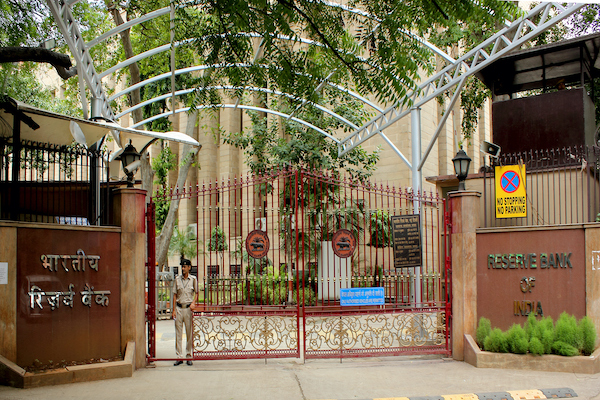
The Reserve Bank of India is extending reserve-style regulation to currency derivatives, requiring banks to lock up funds when they provide certain dollar hedges. Its Foreign Exchange Risk Reserve, or FERR, seeks to influence the cost of forward dollar buying rather than rely only on selling reserves to absorb market pressure.
Authorised dealer banks must deposit 20% of the rupee notional of qualifying over-the-counter dollar/rupee derivative contracts with the RBI, without interest, for the contract’s duration. The requirement covers contracts above $2 million in which a corporate customer buys foreign currency against rupees.
Exporters selling dollars forward are excluded, making the measure deliberately asymmetric. Announced on October 10, the requirement takes effect on October 12, leaving banks and customers to adjust.
The obligation falls on the bank, but its cost is expected to reach importers through derivative pricing. Dollar cover remains available; what changes is the amount of rupee funding immobilised when banks provide it, and therefore the price at which they can offer that protection.
Unlike trading limits or exchange margins, FERR applies a reserve obligation directly to banks’ over-the-counter derivatives business. It is a regulatory deposit rather than a transaction tax: funds are immobilised with the central bank for the contract’s duration, not paid away as a levy.
The measure follows a $43.42 billion fall in reported foreign exchange reserves over four weeks to October 2 to $734.61 billion, amid rising oil prices and Treasury yields. Its rationale is to affect demand before it creates pressure for further intervention. That does not mean every import hedge is speculative, or that raising its cost necessarily reduces the underlying need for dollars.
Reserve Pricing
Consider a $10 million hedge at ₹97 per dollar. The rupee notional is ₹970 million, requiring a FERR deposit of ₹194 million. Using the standing deposit facility rate of 5.25% as an opportunity-cost benchmark, the deposit costs approximately ₹2.55 million over three months, equivalent to about ₹0.255 paise per dollar.
Pricing the same deposit at 10–12% instead would produce a three-month charge of ₹4.85 million–₹5.82 million, or ₹0.485–0.582 per dollar. These calculations illustrate the sensitivity to the rate banks use; the reserve percentage alone does not determine the importer’s final bill. These figures capture the incremental reserve cost, not the full forward premium or every charge attached to the transaction. A transparent quote should make that difference clear, rather than bundle unlike costs into an unexplained price increase.
The RBI deposit does not carry the corporate borrower’s credit risk. The relevant pricing distinction is therefore between the cost of immobilising funds and the risk associated with the customer’s underlying transaction. Treating the reserve component automatically as an ordinary corporate loan would obscure that distinction.
Pricing guidance would help treasurers assess the resulting quotes. Banks should identify the FERR component separately and explain the funding cost being recovered. The standing deposit facility provides a benchmark for comparing charges, not a substitute for examining the actual financing arrangement.
The difference matters particularly for importers undertaking transactions of $2 million–$5 million, where higher charges could alter the decision to hedge. Passing the reserve cost through to customers is part of the policy’s transmission, but an excessive charge can change the response from accepting more expensive cover to abandoning cover altogether.
Hedging Response
Higher hedging costs do not extinguish an existing import payment. An importer can continue buying goods while leaving the currency exposure open, postponing its dollar purchase rather than eliminating it. If the rupee subsequently weakens, urgent spot purchases could concentrate demand when the market is already under pressure.
The policy must therefore distinguish between reducing dollar demand and reducing the willingness to hedge it. A decline in forward bookings may look like successful restraint while leaving a larger stock of unprotected obligations to be met later.
Cross-market pricing adds another complication. Higher onshore hedge costs may narrow the advantage of buying dollars forward domestically against offshore non-deliverable forwards. But a charge on an importer’s contract is not necessarily a market-wide change in tradable forward points. A reverse trade, selling dollars forward onshore while buying them offshore, would depend on executable prices on both legs. The RBI would need to track that spread alongside offshore positioning, rather than assume that arbitrage has disappeared.
FERR could impound an estimated ₹600 billion–₹1 trillion, against durable surplus liquidity of approximately ₹13.94 trillion on September 15. The range remains provisional because public derivative data do not fully separate customer and interbank activity by purpose, limiting the precision of estimates.
Actual deposits will consequently need to be read alongside hedge volumes, pricing and unhedged exposures. A smaller reserve pool cannot, by itself, establish that underlying dollar demand has fallen.
The test is whether FERR contains destabilising demand while preserving corporate protection against depreciation, rather than replacing pressure on official reserves with risk on company balance sheets.
.png)