.png)

RBI’s Rate Cut Shows Rupee is No Obstacle to Easing
The MPC cut rates despite the rupee’s wobble, signalling what policy has long implied. The currency is simply not a factor in the RBI’s rate calculus.

Groupthink is the House View of BasisPoint’s in-house columnists.
December 5, 2025 at 2:12 PM IST
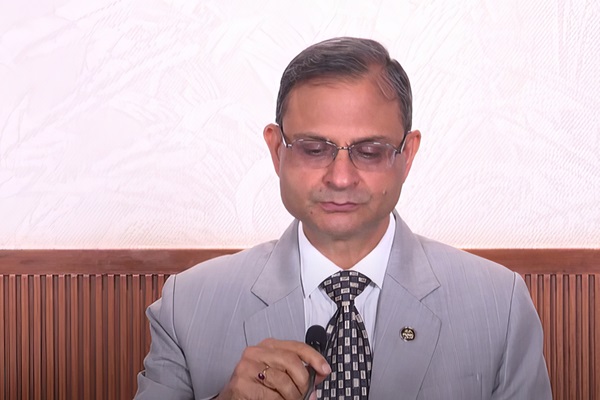
Not just Chief Economic Adviser Anantha Nageswaran, even Governor Sanjay Malhotra does not seem to be losing sleep over the rupee’s exchange rate. The message from both North Block and Mint Street landed with remarkable clarity today.
The rupee may be soft, but it has not been a barrier to monetary easing. Markets that expected the currency’s wobble to restrain the Monetary Policy Committee were proven wrong as the committee delivered a 25-basis-point cut and the Governor emphasised that there was space for more.
The notion that the rupee would act as a handbrake on policy always overstated its role in the RBI’s framework. The exchange rate has rarely featured in the committee’s reaction function, beyond the broad ambition of ensuring orderly movements. Today’s cut, delivered in the face of a currency that has probed weaker levels for weeks, merely confirmed what the RBI’s behaviour has long signalled.
Domestic growth and inflation dynamics anchor the stance, and nothing in recent weeks suggested they were moving in the wrong direction.
Liquidity Tools
He reiterated that the RBI does not target the currency and allows the market to find the correct position within an orderly band. This is fully consistent with the central bank’s recent playbook, where liquidity instruments are deployed to shape money market conditions, while the exchange rate is left to adjust to broader global impulses.
Interpreting the swap as evidence of FX defence would misread the intent.
The operation adds to reserves and injects interbank liquidity, giving the RBI more tactical space to intervene if volatility spikes, but it does not represent a shift in strategy. If anything, the decision to ease policy on the same day underscores the point. The RBI is not treating the rupee as a constraint on its easing path, nor is it concerned about any marginal increase in carry that speculators may exploit.
The central bank appears comfortable with the buffers at its disposal and confident that liquidity engineering can counter disorderly moves without altering macro priorities.
A softer rupee, in this context, works as a modest stabiliser. Exporters gain a sliver of competitiveness at a time when global demand remains uneven, and the currency’s adjustment provides a shock absorber rather than a shock amplifier.
To view the rupee as a policy deterrent is to overlook this stabilising role. Easing financial conditions can continue even if the exchange rate drifts, as long as inflation remains aligned with the projected path and domestic momentum holds.
Domestic Signals
The Governor left little ambiguity about what would guide future rate decisions.
Domestic factors, particularly the growth trajectory and the improving inflation outlook, will remain the core determinants. This reinforces the structural reality that currency movements do not dictate the MPC’s tolerance for easier policy. A central bank that feels compelled to defend a level typically tightens or halts cuts.
The RBI did the opposite today.
Comfort on the external front only strengthens this stance.
The current account deficit has narrowed meaningfully, services exports and remittances remain strong, foreign direct investment has picked up in the first half of the year, and reserves provide more than eleven months of import cover. If a US–India trade agreement revives capital and trade flows, the RBI will have further opportunity to rebuild buffers. Nothing in this configuration suggests vulnerability that would force a defensive monetary posture.
Policymakers are not losing sleep over the rupee, and markets should not build rate expectations around it. India’s easing cycle will be shaped by domestic conditions, not currency swings. The rupee is simply not the centrepiece of this story, and today made that unmistakably clear.
More From BasisPoint