.png)

Nine-Tailed Diplomacy: Can India and China Learn to Coexist at Last?
India and China are bound by trade, divided by suspicion and shaped by history. As Modi and Xi test a fragile reset, can coexistence beat confrontation?
Phynix is a seasoned journalist who revels in playful, unconventional narration, blending quirky storytelling with measured, precise editing. Her work embodies a dual mastery of creative flair and steadfast rigor.
September 14, 2026 at 4:08 AM IST
Dear Insighter,
In Chinese mythology, the nine-tailed fox, or húlijīng, is neither hero nor villain. It shapeshifts, deceives, illuminates and sometimes destroys. Across centuries, it has embodied a paradox: something can be wise and dangerous, bring fortune and calamity, and still survive by learning when not to destroy the other.
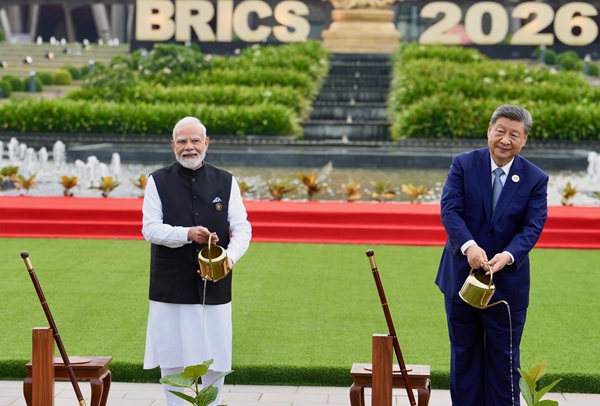
That was the image that came to mind watching Prime Minister Narendra Modi ask Chinese President Xi Jinping, on camera at the BRICS Summit, “Is it okay?” He asked twice, paused and waited for Xi to nod before proceedings continued. It was a tiny moment, but it captured something essential about India-China relations: two ancient civilisations, carrying the weight of history and the immediate tension of a $155 billion trading relationship, navigating even the symbolism of a microphone, translation and protocol.
The exchange may have been mundane. But at the highest levels of diplomacy, logistics can signal respect. Modi was not being deferential. He was being practical. The larger question was unmistakable: can two powers with competing visions of prosperity and power, a disputed border and a huge trade imbalance learn to coexist? Not necessarily as friends, but as neighbours that recognise the cost of confrontation.
The economics explain why that question matters. Nilanjan Banik notes that bilateral merchandise trade reached a record $155.6 billion in 2025. India imported $132 billion from China while exporting less than $20 billion, buying roughly six to seven dollars of goods for every dollar it sells. Yet this is not simply a story of loss. Chinese semiconductors, solar cells, battery components and pharmaceutical ingredients are productive inputs on which Indian industry depends.
What makes the current moment more interesting is that both countries can draw on a much older tradition of engagement. Rakesh Kumar and Xie Zhibin document how India and China exchanged ideas, knowledge and culture for thousands of years. Xuanzang travelled to India for Buddhist teachings, while Tagore and Tan Yunshan helped establish the China Academy. This was not merely cultural tourism. It was a practice of mutual learning that allowed each civilisation to absorb ideas while retaining its own identity. The challenge now is turning that tradition into practical capacity to manage contemporary differences.
The stakes extend beyond the bilateral relationship. Lt Gen Syed Ata Hasnain argues that India’s engagement with BRICS remains vital even as it works with the US through the Quad, maintains its strategic relationship with Russia, competes with China, engages Iran and maintains close ties with Israel and the Arab Gulf states. What looks contradictory is, in his view, strategic autonomy: relationships across geopolitical divides without allowing any one of them to dictate all others.
That strategy, however, depends on credibility. Arvind Mayaram argues that gaps in India’s economic data have damaged confidence in the growth narrative. Lapsed employment surveys, missing consumption data and the disappearance of unorganised enterprise surveys for years have made official numbers harder to trust. Credibility is not a public relations problem to fix after a crisis. It is a policy asset built over time and spent quickly when trust is lost.
Yet Michael Debabrata Patra, former RBI Deputy Governor, points to internal consistency in the data as evidence of genuine growth acceleration. Consumption, supported by tax cuts, higher subsidies, minimum wage increases and expansionary monetary conditions, contributes 51% of overall GDP growth. Patra argues that revised data weakens the case for a gloomier reading of RBI policy.
But the debate over GDP is itself evolving. The UN’s Beyond GDP initiative, championed by António Guterres, seeks complementary measures that capture inequality, wellbeing, sustainability and planetary health. For India’s Viksit Bharat@2047 ambition, the question is not only how much wealth is created, but whether growth delivers liveable cities, skilled employment and environmental resilience.
External strength presents another test. India’s foreign exchange reserves have crossed $700 billion, placing it among the world’s five largest holders. But, as KS Sujit and Nandini M point out, reserves are a buffer, not a permanent solution. The deeper test is whether India can earn foreign exchange fast enough to finance its growth.
That is the context for Rakesh Khar’s analysis of Modi’s appeal for Indians to moderate gold purchases. The concern is not economic paranoia but the foreign-exchange cost of a deeply rooted preference. Some households may defer purchases, but the larger lesson is harder: India cannot strengthen its external position simply by asking people to buy less or travel less. It must earn more from the world.
That means building competitive manufacturing, moving up the value chain in technology and pharmaceuticals, expanding knowledge-intensive services and reducing dependence on imported energy. Srinath Sridharan argues that India’s industrial future cannot be rented. Billions may be invested in battery gigafactories, but if critical technology remains elsewhere, Indian factories can become large assets built around somebody else’s strategic leverage. Industrial power ultimately requires ownership of the capabilities beneath manufacturing scale.
India’s domestic economy has its own vulnerabilities. Abhiman Das and Smita Roy Trivedi show that household debt reached 45.5% of GDP by September 2025, driven mainly by non-housing retail loans, with consumption accounting for half of household borrowing.
Markets, meanwhile, have offered little consolation. Vivek Kaul notes that the Sensex has remained below its September 2024 peak for more than 700 days. Newer investors are learning a lesson markets eventually teach everyone: prices rise, fall and sometimes go nowhere for a very long time.
Regulation is also being tested. Indra Chourasia argues that SEBI has delivered stability and deeper, more resilient markets, but needs a stronger framework for measuring its own effectiveness. Rahul Ghosh makes a related case for banking supervision: the focus must move beyond procedural compliance towards enforcement of risk governance, including accountability for weak oversight and ineffective risk appetite frameworks.
The same balancing act is visible across industry. Krishnadevan V finds India’s carmakers preparing for a fragmented fuel future: CNG accounts for 25% of registrations, hybrids 9%, EVs 7.6% and petrol 40%. Tata, Maruti and Hyundai are building flexibility into platforms and supply chains so they can serve multiple fuel types without allowing complexity to erode returns.
In fisheries, Badri Narayanan Gopalakrishnan and Himanshu Jaiswal chronicle India’s national deep-sea fishing programme, including Letters of Authorisation for Fish Farmers Producer Organisations to operate on the high seas. India is the world’s second-largest fish producer, accounting for 17% of global output, and exported more than ₹620 billion of marine products in 2024-25. Yet three-fourths of production remains inland, leaving substantial room to expand marine capacity.
Food security faces another external pressure. G. Chandrashekhar notes that Indonesia’s biodiesel programme is moving from B50 to B60 blending by 2027, with implications for India’s palm oil imports. Palm oil typically accounts for 60% of India’s vegetable oil basket, making Indonesian policy an issue for domestic supply as well as global energy markets.
Corporate strategy, too, is moving from scale to ownership. Krishnadevan V writes that Varun Beverages, having exhausted the upside of its PepsiCo bottling contract, is entering alcohol through KIVA Spirits. The bet is that owning a brand offers what bottling cannot: a direct relationship with consumer habit. For Varun, the strategic question is whether execution can become ownership.
Politics has economic consequences as well. Amitrajeet A. Batabyal finds that political alignment affects not only fiscal transfers but security. In resource-rich areas, electing a legislator aligned with the state government significantly reduces insurgency-related violence, suggesting that the provision of security is deeply political.
Which brings us back to the nine-tailed fox. Each tail, legend says, marks accumulated learning, greater power and greater vulnerability. India and China have accumulated their own versions of all three.
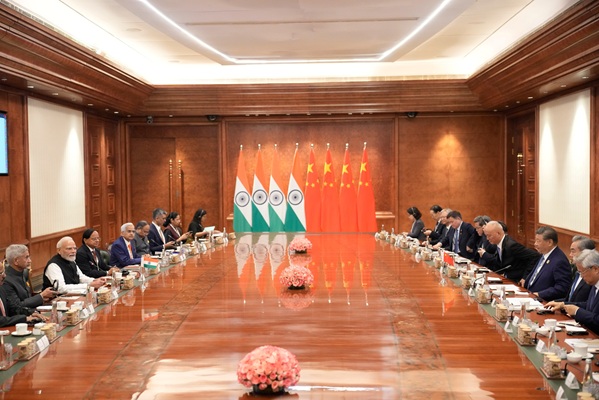
As Rajesh Mahapatra writes, the BRICS summit’s success hinges partly on an India-China reset. Their bilateral meeting reaffirmed steady progress since Tianjin in August 2025 and stressed that differences should not become disputes. Both sides invoked three mutuals: mutual respect, mutual sensitivity and mutual interest.
These are hardly revolutionary commitments. They are, however, the sort of incremental confidence-building measures required when one country faces a $100 billion-plus trade deficit and the other carries strategic vulnerabilities in critical supply chains.
The real measure of success will not be the trade deficit alone. It will be whether India can export more high-value goods, control more critical supply chains and reduce exposure to decisions made in geopolitical contests it did not start. More importantly, it will be whether the world’s two most populous nations can prove that coexistence is not weakness, but strategy.
Until next time, watching where the world moves.
Phynix
Also Read:
- The Fight for UP's Jatland: The RLD Factor and SP's Bid for a Dalit-Muslim Bloc by Amitabh Tiwari: As 2027 looms, former allies RLD and SP battle for political space in western UP’s Jatland.
- Why Intelligent People Keep Moving Toward Outcomes They Know Are Dangerous by Kirti Tarang Pande: Coxon’s resignation exposes the gap between knowing and doing—and the systems that keep it open.
- The Customer Is King, Just Don't Ask Him for Anything by Kalyani Srinath: A hunt for ordinary dark brown socks becomes a wry lesson in contemporary Indian retail.
- Sarci Sense: Why Do We Photograph Food Before Eating It? by Srinath Sridharan: We once ate, remembered and moved on; now a meal feels incomplete until someone absent has seen it.
- The Serious Business of Being Funny by R. Gurumurthy: Humour is not an escape from serious matters but one of the sharpest ways to puncture power and expose hypocrisy.
- Trump Wants Lower Rates, but US Borrowing and Inflation Stand in the Way by Sanjay Mansabdar: Trump wants rate cuts, but heavy borrowing and persistent inflation are pulling US policy in the opposite direction.
- Twenty-Five Years After 9/11: Is the Age of Global Terrorism Over? by Lt Gen Syed Ata Hasnain: Terrorism has lost territory but not its ecosystems, as weak states, new technologies and dispersed networks keep the threat alive.
- What Makes a Nation Difficult to Coerce? by Lt Gen Syed Ata Hasnain: National resilience—absorbing shocks, recovering quickly and retaining freedom to act—is the real test when deterrence fails.
More From BasisPoint