When Prime Minister Narendra Modi launched the Make in India campaign on September 25, 2014, the ambition was unmistakable: turn the country into a global manufacturing hub, lift the sector's share of GDP from around 16% to 25%, and create 100 million new factory jobs by 2022. Eleven years and several revised deadlines later, the scheme has become one of independent India's longest-running industrial experiments. As it enters its second decade, the honest question for policymakers, industry and citizens alike is no longer whether the idea was well-intentioned — it clearly was — but whether the instrument in its current form is still fit for purpose, or whether it needs a serious rethink.
The Promise and the Numbers
The original targets were bold by design. Manufacturing's contribution to GDP was to rise to 25%, first by 2022 and later pushed to 2025, and then again extended, with newer government mission documents now speaking of 2035 as the horizon for that same 25% goal. That repeated slippage is itself telling.
On the ground, manufacturing's share of gross value added has stayed remarkably flat. Various official and independent assessments place it somewhere between 15% and 17.7% through 2023-24 and 2024-25 — barely above where it stood when the campaign began, and in some calculations, marginally lower than the 2013-14 baseline. Measured against the original 25% ambition, this is the single most uncomfortable statistic for the scheme's champions to explain away.
Where the picture brightens considerably is investment and specific product categories. Foreign direct investment into manufacturing has grown substantially since 2014, India has climbed global ease-of-doing-business and investor-confidence rankings, and sectors such as mobile phone manufacturing, electronics assembly and automobile components have genuinely transformed. Mobile phone exports alone have crossed roughly ₹1.29 trillion cumulatively since 2014, electronics production is reported to have grown roughly sixfold in recent years, and domestic value addition in segments like auto components has climbed above 80%. India's total exports also touched a record of around $720 billion in the April-January period of 2025-26, a sign that domestic manufacturing capacity is beginning to feed outward as well as inward demand.
Employment data tells a more contested story. Government surveys such as the Periodic Labour Force Survey and the RBI's KLEMS database point to rising manufacturing employment in recent years, with several million new jobs recorded in FY23 and FY24. Yet independent economists have flagged that much of the broader employment growth is concentrated in informal work, self-employment and services rather than the large-scale, well-paid factory jobs the scheme originally promised, and some analyses note that formal manufacturing job growth has periodically stagnated or contracted even as headline employment numbers rose. The 100-million-jobs target, in particular, remains a long way off by most credible estimates.
A Decade Before, A Decade After
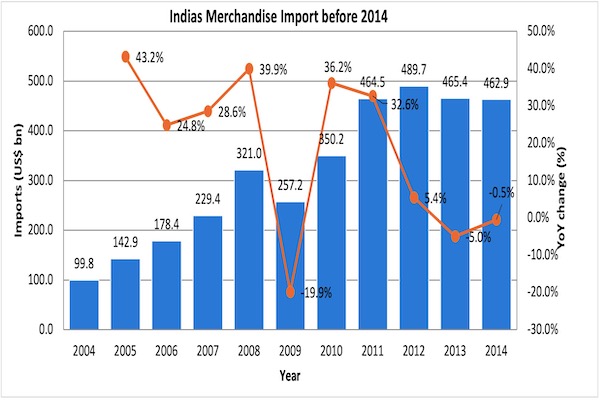
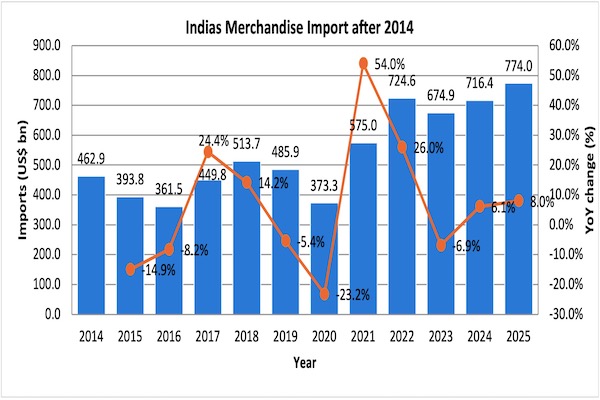
Sector-level indigenisation tells only part of the story. India's total merchandise imports stood at roughly $100 billion in 2004 and ballooned to around $463 billion by 2013-14. Since then, the pace has changed noticeably. From about $463 billion in 2013-14, India's merchandise import bill rose to roughly $721 billion in 2024-25 (Directorate General of Commercial Intelligence and Statistics data) — an increase of a little over 55% across the Make in India decade, a much slower rate of growth than in the ten years before it. Part of this slowdown reflects genuine import substitution in electronics assembly and defence, as noted earlier; part of it also reflects global factors such as the 2015-16 commodity price crash, the pandemic-year contraction, and slower world trade growth overall that had nothing to do with domestic policy. Even so, the headline trade deficit has not shrunk — it widened from roughly $135 billion in 2013-14 to over $260 billion in 2024, as exports have not kept pace with the economy's still-considerable appetite for imported energy, gold, electronics components and capital goods.
China highlights the challenge further. India’s trade deficit with China rose from $1.48 billion in 2004-05 to $36.21 billion in 2013-14 and continued widening after 2014. Chinese imports reached $113 billion–$127 billion in 2024-25, leaving a bilateral deficit of more than $99 billion. Electronics, machinery and chemicals remain major import categories. India has made gains in defence and mobile-device assembly, but its dependence on Chinese intermediate and capital goods remains substantial — showing that self-reliance is still a work in progress.
Where Import Substitution Worked
The clearest, most measurable success of the broader self-reliance push sits in defence. India was the world's largest arms importer in 2010, accounting for roughly 11% of global defence imports. By 2024, industry analysis built on Stockholm International Peace Research Institute (SIPRI) data shows that share has fallen to around 4%, with India slipping to fourth place globally among importing nations. Separate assessments record an 11% decline in India's major arms import volumes between the 2015-19 and 2020-24 periods, and government indigenisation portals report tens of thousands of defence components successfully localised, saving billions in what would otherwise have been import spending. Defence exports, meanwhile, have risen more than twenty-fold over the past decade, though still from a small base.
Electronics tells a similar, if less dramatic, story: local assembly of smartphones and consumer electronics has expanded sharply, reducing India's dependence on finished-device imports even as the country remains reliant on imported chips, specialised components and capital equipment used to build those very factories.
But this progress is uneven and sector-specific rather than economy-wide. India's overall merchandise trade deficit has not narrowed in any structural sense; the country still imports the overwhelming majority of its crude oil, a large share of electronic components and semiconductors, and increasing volumes of capital goods needed to run the new factories built under these schemes. Analysts tracking the government's newer ₹510 billion crore import-substitution push have cautioned that import substitution does not automatically translate into globally competitive, cost-efficient production, and that India's research and development spending — at roughly 0.64% of GDP against China's 2.41% — remains a structural constraint on climbing the value chain rather than simply assembling foreign-designed products domestically.
The Case for Reform
The headline, economy-wide target of 25% manufacturing share in GDP has been missed for over a decade and repeatedly pushed further into the future, infrastructure and logistics costs remain high relative to competing manufacturing destinations, labour law reform has been partial and unevenly implemented across states, and the domestic ecosystem for components, capital goods and deep-tier suppliers remains thin — meaning "Made in India" products in several sectors are still substantially "Assembled in India" from imported parts.
This gap between sector-level success stories and the missed macro target suggests the difficulty is not the underlying goal but the design of the instrument used to chase it. A single umbrella brand covering dozens of disparate sectors, with one distant target, risks masking the sectors that are genuinely transforming while providing political cover for those that are not.
A Way Forward, Not a Verdict
None of this argues that ‘Make in India’ should be abandoned. Where it has been paired with sustained, sector-specific incentives and firm procurement commitments — as in defence and electronics — the results are measurable and real. The argument, rather, is for a more honest and more targeted second phase.
Policymakers would do well to move away from a single, sweeping GDP-share target that has already been missed and re-extended multiple times, and instead set sector-specific, time-bound and independently audited benchmarks — in components manufacturing, semiconductors, capital goods and skilling — where progress can be tracked transparently rather than folded into one broad, difficult-to-verify number. Equally, sustained investment in R&D, deeper reform of land and labour markets at the state level, and a stronger push into the mid-tier component and capital-goods supply chain deserve at least as much attention as headline assembly and export figures.
Eleven years is long enough to know what has worked and what has not. Rather than treating ‘Make in India’ as a fixed slogan to be defended or dismissed wholesale, the moment calls for policymakers to rethink its architecture — sharpening the parts that deliver, redesigning or retiring the parts that don't, and being willing to consider genuine alternatives where the current approach has plainly run its course. A decade-old policy that refuses to evolve risks becoming a brand rather than a strategy; India's manufacturing ambitions deserve better than that.
*Views are personal.
.png)