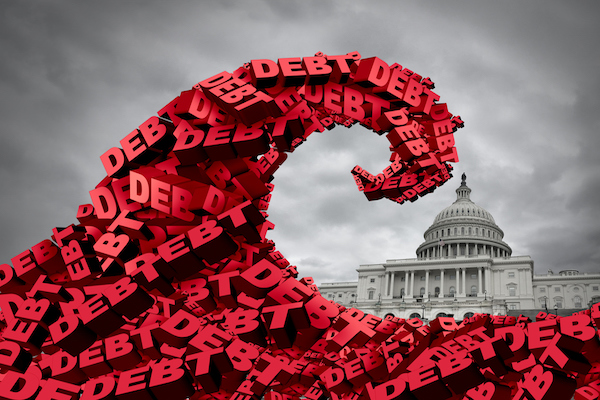
The strong rally in prices of US Treasuries last week notwithstanding, debt concerns now occupy centre stage globally. In the US, the problem of a $40 trillion debt load raised at an average cost of about 2.8% means that of the $2 trillion raised per year, about half is used in interest payments, with refinancing at the margin occurring at almost twice the existing average cost. The US debt burden increases at the rate of $8 billion a day. This is exacerbated by competition for debt capital from AI infrastructure-related capex.
At the same time, US inflation continues to tick up and has now been at uncomfortable levels of over 2% for 66 months. While a determined, albeit delayed, attempt to tame inflation was evident in the Biden administration from 2022 until 2023 in the form of one of the fastest rate hike cycles that raised the Fed Funds rate by 525 basis points in 16 months, the policies of the Trump administration have appeared to be anything but inflation-suppressive.
The tariffs bazooka launched early on had the direct effect of raising prices and inflation for US consumers.
Immigration restrictions and deportations, another centrepiece of the present administration, are also clearly inflationary, as they remove swathes of workers from agriculture and construction, raising wages and output costs.
The Big Beautiful Bill made the tax cuts of 2017 permanent and added several other tax deductions, while increasing spending on defence and immigration, both of which provide a growth and inflationary impulse.
The administration has taken stakes in several private companies, which, though small in relation to the monetary impact of some of the other policies, remain growth- and inflation-supportive at the margin.
The pièce de résistance, however, has to be the extended conflict in Iran, which has caused an enormous global spike in energy prices, which feed into everything from AI tokens to food, raising inflation through first- and second-round effects.
At the same time, the pressure exerted by the administration on the Fed to keep rates low has been, if anything, intense. The vitriolic and often personal assaults on Jerome Powell, conducted publicly via social media, and the accusations regarding mismanagement of the Fed building renovation were poorly disguised attempts at pressuring the Fed to reduce rates in the face of higher inflation.
There have been public pronouncements by Trump himself on how stronger growth in the US should automatically imply lower interest rates, going so far as to suggest that a 1% rate is an appropriate borrowing rate for the US Treasury.
All candidates considered by the administration to replace Powell, including Kevin Hassett, Christopher Waller, Michelle Bowman and Rick Rieder, are publicly dovish on interest rate policy, and Kevin Warsh, who won the nomination, did so on the strength of his views that the AI productivity boom should result in lower interest rates.
While Warsh, to his credit, has increased interest rates, presumably in opposition to the administration’s wishes, pressure on him has started to increase from the US Treasury Secretary to “keep an open mind” on lowering rates, and the real Fed Funds rate remains close to zero.
The US Treasury has resorted to interventionist policies to force interest rates lower and reduce funding costs through increased buybacks, increased Treasury bill issuance and attempts to restrict the sale of US Treasuries by large holders like the BoJ, which need to sell to raise dollars for intervention in USD/JPY.
Taken together, all of these seemingly disparate events point uncomfortably to a possible common underlying thread. Is the administration deliberately following a policy of inflating away debt as the solution to the mounting debt problems?
Compare the anecdotal evidence presented above with the choices that such a policy demands. Inflationary policies, check. Growth-supportive policies, check. Near-zero real rates, check. Accelerating money supply growth, check.
At first glance, a deliberate policy of inflating away debt seems unthinkable and even a conspiracy theory of sorts. When one looks at this administration’s record, however, many previously unthinkable events have indeed come to pass. By way of example, there are the assaults on global trade, the Iran War, the withdrawal of support for Ukraine, the obvious conflicts of interest that the administration is rife with and the hollowing out of NATO and international organisations. Each new unthinkable action is now greeted by the world with numb impassivity.
Trump himself knows a thing or two about debt. His “heads I win, tails you lose” approach towards debt holders has resulted in several corporate bankruptcies and debt defaults in his real estate empire. His own statement recently that “certain levels of inflation will pay off the debt very rapidly” clearly points at least to active consideration of such a policy. Many mandarins and policy wonks in his administration are undoubtedly well aware of the availability of the option of aggressively inflating away debt as a policy alternative to solving the debt problem.
Who would pay the price of such a policy? The obvious ones are investors in US bonds. These are largely constituents the administration cares little for — foreign governments and hedge funds. The other domestic private investors who have Treasury holdings also have significant stock holdings that would be expected to derive benefits enormously from a growth- and inflation-supportive environment and can be argued to be at least neutral, if not outright beneficiaries of such policies.
Who would benefit from such a policy? Firstly, investors in US equities, which Trump anyway sees as a barometer of his performance. Secondly, the US government in more ways than one. First, via the dissipation of the debt problem that such policies would target, and secondly, via the impact of such policies on gold prices, with the US government being the largest holder by a wide margin.
Finally, administration officials are certainly aware that such a policy is politically the easiest way out, as tackling the debt problem with spending cuts and tax hikes is likely to cause political and social trouble – witness the mayhem in France where such policies have been mooted.
Clearly, then, there is a possibility, even a probability, that the chaotic, disparate events that we have witnessed since the new Trump administration came to power are in fact fronts in the implementation of a policy to inflate away the debt burden, one of the biggest issues facing the US. If this is indeed true, then the ramifications for assets and markets globally are enormous, and the Fed, the bond vigilantes and the American voters remain the last bulwarks against such a ruinous policy.
.png)