In the aftermath of World War II, when the world engaged in reconstruction and development, monetary policy acquired a distinct domestic orientation and assumed goals like sustained high growth, full employment and price stability.
Yet, its antecedents in the preceding era of over three centuries were shaped by an outward alignment. In today’s world, the evolution of monetary policy has come full circle. Global economic integration and its fracturing more recently, exchange rates, and cross-border capital flows significantly influence a central bank's ability to manage domestic inflation and output.
The Exchange Rate Revisited
The exchange rate is a crucial variable for the conduct of monetary policy. In the pre-War period and even after, it performed the role of a nominal anchor for monetary policy. The exchange rate is also a channel of transmission of monetary policy, irrespective of whether or not it is chosen as the nominal anchor.
Hence, all monetary policy authorities care deeply about the exchange rate and monitor its behaviour closely. When they feel that it is misaligned or not reflecting what its true value is in their view, they express their discomfort and even take corrective steps to align it. In this context, the concept of ‘fair value’ is often used as an elusive lodestar.
These remedial steps may take various forms, such as direct interventions in the market to influence supply and demand, capital controls, macroprudential measures and also through monetary policy itself via changes in instruments like the interest rate.
A Quick Trip Through History
From 1944, the world agreed under the aegis of the Bretton Woods agreement to adopt a system of fixed exchange rates pegged to the US dollar or rather the gold content of the US dollar. Implicitly, US inflation and growth would determine inflation and growth in all other countries.
So, the task for monetary policy in all countries was to follow the US monetary policy and maintain the parity with the US dollar. The IMF had oversight of the system, and it allowed movements of +/- 1% around the parity.
Countries were responsible for maintaining their exchange rate parities by buying or selling US dollars in foreign exchange markets. If, for some reason, a country performed much better than the US in terms of higher growth and inflation, this would cause interest rates to rise higher than US interest rates and hence capital would flow out of the US and into the higher interest rate country. As a consequence, capital controls were an important part of the system.
Countries could, however, negotiate with the IMF and revise their parities in a one-step manner. These one-shot revisions were called revaluations or devaluations. The IMF also provided temporary balance of payments support in case a country experienced persistent pressures on its currency to devalue.
By the 1960s, a surplus of US dollars built up outside the US, caused by persistent balance of payments deficits due to foreign aid, military spending, and foreign investment.
This meant that the US dollar was overvalued. Despite several interventions by the US in the form of restrictions on foreign investment and lending, and cooperation with other countries, traders in foreign exchange markets, believing that the dollar’s overvaluation would one day compel the US government to devalue it, proved increasingly inclined to sell dollars. This resulted in periodic runs on the dollar. Eventually, it led to the suspension of the dollar’s gold convertibility, the floating of currencies against the dollar and the abandonment of the Bretton Woods fixed exchange rate system.
The Role of the IMF Today
Following the collapse of the Bretton Woods system, the IMF lost its main role of maintaining the parities. Since then, however, up to the present day, all countries that are members of the IMF are required to report to it the type of exchange rate arrangement they adopt. Apart from these reported positions that are known as de jure exchange rate arrangements, the IMF staff analyses the movements of exchange rates and puts out a de facto classification.
De Facto Exchange Rate Classification
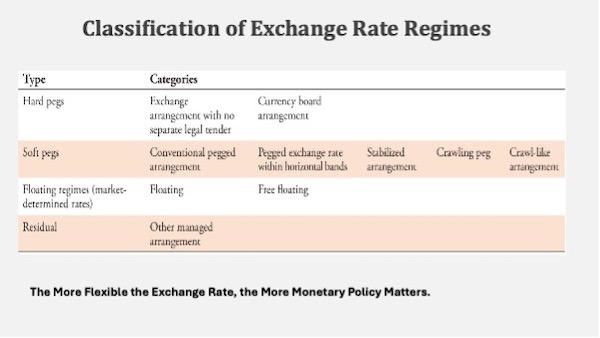
Under hard pegs, whereby a national currency's value is locked to a specific anchor like the US dollar or a basket of currencies, classification as an exchange rate arrangement with no separate legal tender indicates that the currency of another country circulates as the sole legal tender (formal dollarisation).
Adopting such an arrangement implies the complete surrender by the monetary authorities of control over domestic monetary policy. Another hard peg relates to exchange arrangements of countries that belong to a monetary or currency union like the European Union, in which the same legal tender is shared by the members of the union. This classification is based on the behaviour of the common currency, and typically, these countries also conduct a common monetary policy.
A currency board is a monetary arrangement based on an explicit legislative commitment to exchange domestic currency for a specified foreign currency at a fixed exchange rate, combined with restrictions on the issuing authority to ensure the fulfilment of its legal obligation. This implies that domestic currency is usually fully backed by foreign assets, eliminating traditional central bank functions such as regulation and supervision and leaving little scope for discretionary monetary policy.
In a conventional peg, the country formally (de jure) pegs its currency at a fixed rate to another currency or basket of currencies of major trading or financial partners, and weights reflect the geographic distribution of trade, services, or capital flows.
The country authorities stand ready to maintain the fixed parity through direct intervention via sale or purchase of foreign exchange in the market, or indirect intervention via exchange rate-related use of interest rate policy, imposition of foreign exchange regulations, exercise of moral suasion that constrains foreign exchange activity, or intervention by other public institutions.
There is no commitment to irrevocably keep the parity, but the formal arrangement must be confirmed empirically: the exchange rate may fluctuate within narrow margins of less than ±1% around a central rate, or the maximum and minimum value of the spot market exchange rate must remain within a narrow margin of 2% for at least six months.
Classification as a stabilised arrangement entails a spot market exchange rate that remains within a margin of 2% for six months or more (with the exception of a specified number of outliers or step adjustments) and is not floating. This classification requires that the statistical criteria are met and that the exchange rate remains stable as a result of official action.
In a crawling peg, the exchange rate is adjusted in small amounts at a fixed rate or in response to changes in selected quantitative indicators, such as past inflation differentials vis-à-vis major trading partners or differentials between the inflation target and expected inflation in major trading partners. The rate of crawl can be set to generate inflation-adjusted changes in the exchange rate (backwards-looking) or set at a predetermined fixed rate and/or below the projected inflation differentials (forward-looking).
In a crawl-like arrangement, the exchange rate must remain within a narrow margin of 2% relative to a statistically identified trend for six months or more (with the exception of a specified number of outliers).
Normally, a minimum rate of change greater than that allowed under a stabilised (peg-like) arrangement is required. However, an arrangement will be considered crawl-like with an annualised rate of change of at least 1%, provided that the exchange rate appreciates or depreciates in a sufficiently monotonic and continuous manner.
A pegged exchange rate with horizontal bands involves the value of the currency being maintained within certain margins of fluctuation of at least ±1% around a fixed central rate, or the margin between the maximum and minimum value of the exchange rate exceeds 2%. It includes arrangements of countries in the European Monetary System (EMS).
The ‘other managed’ category is a residual for an exchange rate arrangement that does not meet the criteria for any of the other categories. Arrangements characterised by frequent shifts in policies may fall into this category.
A floating exchange rate is largely market-determined, without an ascertainable or predictable path for the rate. Floating arrangements may exhibit more or less exchange rate volatility, depending on the size of the shocks affecting the economy. A freely floating exchange rate is one in which intervention occurs only exceptionally and aims to address disorderly market conditions. Intervention has been limited to at most three instances in the previous six months, each lasting no more than three business days.
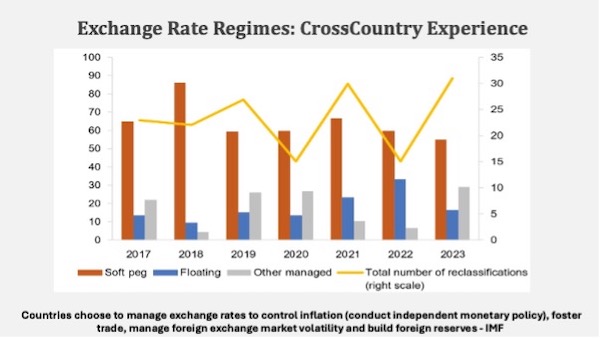
In its most recently published report, the IMF has observed that there has been a significant rise in “other managed” arrangements, indicating a response to heightened uncertainty in the economic environment, mainly in the soft peg categories.
The IMF has also observed that inflation targeting has the largest share in terms of the adoption of a nominal anchor, followed by anchoring to the US dollar. More than 90% of the IMF’s member countries have done away with current account restrictions and adopted Article VIII of the IMF’s Articles of Agreement.
On the other hand, the share of emerging market and developing economies adopting or intensifying capital account restrictions is on the rise. Three countries reported that a domestic CBDC was launched in their jurisdiction.
A majority of countries reported that they had no controls or had no regulations in place to control the use of CBDCs launched by another jurisdiction. About half of the countries reported that they have no controls or no regulations restricting the use of various types of tokens and stablecoins.
The Play between the Exchange Rate and Monetary Policy
To sum up, how the exchange rate is determined shapes in a fundamental way the manner in which monetary policy is conducted. When the exchange rate is fixed or managed to ensure some degree of fixity, the role of monetary policy is to maintain the exchange rate at the fixed level. Other objectives like inflation and growth become subservient to the exchange rate objective. Implicitly, domestic inflation and growth become tied to global inflation and growth.
On the other hand, if the exchange rate is freely floating and determined by market forces of demand and supply, monetary policy is freed from the exchange rate parity goal to serve the objectives of domestic price stability and growth that may be different from global inflation and growth. In the parlance of policymakers, this is termed independent monetary policy – the freedom to choose an inflation rate and a growth rate for the domestic economy that may be different from global conditions.
Over the years, therefore, the attitude of policymakers towards the exchange rate has had strong implications for the choice of the regime for monetary policy and how it is conducted. In fact, the exchange rate implicitly determines and reflects the monetary policy stance.
This is Part 13 of the Masterclass with Michael Patra.
Masterclass with Michael Patra: Previous Sessions
Part 1
Origins, Ideas and Institutions
Michael Patra begins the masterclass by tracing how central banks evolved from fragile monetary experiments into institutions entrusted with preserving trust, stability and confidence.
Part 2
RBI and the Safeguarding of Confidence
The series then turns to the RBI’s evolution, its expanding institutional role, and the balance between autonomy, growth and price stability.
Part 3
The Rise and Fall of Monetary Policy Regimes
From Bretton Woods to monetary targeting, the masterclass examines how central banks repeatedly reinvented monetary policy frameworks when old anchors collapsed.
Part 4
When Monetary Anchors Collapse
As monetary targeting broke down globally, central banks were pushed again into uncertainty, instability and regime change.
Part 5
Central Banking and Monetary Policy Regimes: The Indian Experience
How India’s trysts with crises, policy responses and changing gears in the development strategy imposed monetary policy regime shifts upon the RBI.
Part 6
Inflation Targeting and the Contract of Trust
From time inconsistency to flexible mandates, Michael Patra explains how inflation targeting became the world’s most durable monetary policy regime.
Part 7
India: Survival of the FITtest
From the Urjit Patel committee to the first MPC, Michael Patra traces how India designed, legislated and launched flexible inflation targeting.
Part 8
Lessons From India’s Inflation Targeting Decade
After a decade tested by a pandemic and war, Michael Patra distils four lessons from India’s flexible inflation-targeting framework.
Part 9
The Plumbing in the Monetary Policy Architecture
Patra explains the plumbing of monetary policy, tracing how RBI liquidity management transmits the MPC’s repo rate through banks and money markets.
Part 10
How the RBI Manages Liquidity, From the LAF Corridor to Sterilisation and Beyond
Michael Patra explains how the RBI manages liquidity, from sterilisation and CRR operations to forecasting and the LAF corridor’s role in transmission.
Part 11
The Pipes: Monetary Policy Transmission
Setting the repo rate is only the start. Michael Patra explains how monetary policy reaches the economy and what gets lost along the way.
Part 12
Operational Realities in Monetary Policy Transmission
Monetary policy transmission begins instantly in money markets, but frictions across rates, bonds and bank credit weaken its speed and strength.
.png)