.png)

India and Europe Are Courting Again, but Still Misreading the Signals
Whether in India or Europe, the fear is real. The gap between fear and action is where diplomacy dies.

Kirti Tarang Pande is a psychologist, researcher, and brand strategist specialising in the intersection of mental health, societal resilience, and organisational behaviour.
June 27, 2026 at 6:53 AM IST
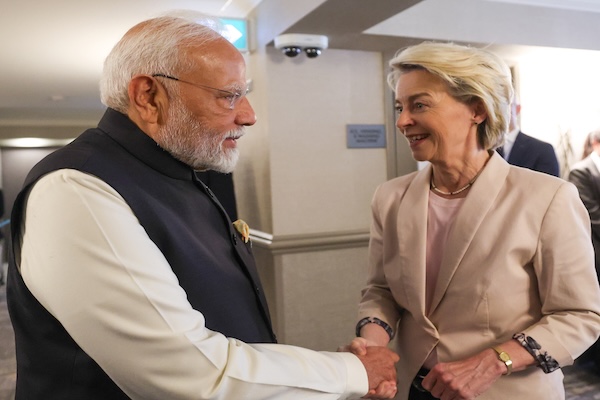
Last week, on the sidelines of the G7 summit, Narendra Modi and Ursula von der Leyen shook hands over what she has called “the mother of all trade deals”: the India-EU free trade agreement, nearly two decades in the making and now moving toward formal signing by year’s end. Commentary has treated it as a conclusion. But is it? Or is it only a recognition scene?
There is a moment in Homer’s Odyssey when Odysseus, after twenty years away, finally returns to Ithaca. His dog, Argos, recognises him immediately and dies of joy. His old nurse recognises him through the scar on his leg. But Penelope, the one person whose recognition matters most, does not. She refuses to be rushed and tests him instead.
Argos’s recognition is instantaneous and relational; it asks no proof beyond presence. Penelope’s is procedural and evidential; it demands verification. Neither is superior. They are simply different love languages: one speaks in presence, the other in proof. Trouble begins when each expects to hear its own dialect.
India and Europe are at just that stage. The signs are piling up fast: the trade deal, security, and defence cooperation, and a connectivity corridor through the Middle East. But the signs accumulating are not the same as the signs being read correctly. Strip away the summit photographs, and what remains is a relationship misfiring on its own signals: Europe looks at India’s ties with Moscow and reads inconsistency; India looks at Europe’s democratic report cards and reads an old colonial reflex.
Diplomacy usually treats misperception as an information problem. Psychologist Albert Ellis would have treated it first as an interpretation problem. Ellis argued that distress is not caused by events, but by what we decide they mean. “The best years of your life,” he wrote, “are the ones in which you decide your problems are your own.”
Recognition, in Ellis’s terms, is an inside job before it is an outside one. His point was never that problems are unreal; only that events and our beliefs about them are two different things.
Europe’s anxiety is real: China dwarfs it, the US is unreliable, and the order is fragmenting. India’s colonial wound is real, too: Western powers still issue democracy reports and moral lectures in a register that can sound less like concern than supervision. Both fears are legitimate; the trouble is what each side does with them.
Rather than ask why it is so anxious about losing its grip on the rules, Europe calls India “chaotic.” Rather than ask why it is still so sensitive to being lectured, India calls Europe “paralysed.” This refusal to own one’s part is mirror-reading: two anxious actors mistaking their own unease for a read on someone else’s character, dressed up as “strategic intelligence.”
Beliefs shape behaviour: Europe’s belief that India is unpredictable produces more rigid commitments, which India reads as condescension; India’s belief that Europe is paralysed produces leader-to-leader shortcuts, which Europe reads as unpredictability. Each side’s projection becomes the other’s evidence.
It is like two anxious people in a room, each mistaking the other’s nervousness for unreliability, and neither noticing that the anxiety began inside themselves.
This misreading is structural. The anthropologist Edward T. Hall argued that culture is a form of communication. Europe, in his framework, tends toward low-context diplomacy: codified, textual, explicit. India tends toward high-context diplomacy: relational, historical, situational. Europe sends a treaty; India reads it as a lack of trust. India sends a personal commitment; Europe reads it as a lack of seriousness.
Europe’s diplomatic love language is Words of Affirmation, written down: show me the text, and I’ll believe you mean it. India's Quality Time, built through relational investment: show up consistently, build history with me, and I’ll believe you mean it. When Europe sends a draft annex, it believes it is saying, “I respect you enough to be precise.” India hears, “You are cold and legalistic.” When India offers a leader-to-leader handshake, it believes it is saying, “I trust you enough not to need the paperwork.” Europe hears, “You are unserious.”
Europe has been offering Penelope’s method in treaties, sub-clauses, proof stacked on proof. India has been offering Argos’s instant recognition in trust extended through presence, ahead of paperwork. Neither approach is wrong. They are built to read different scars.
Rabindranath Tagore wrestled with Europe more than almost any Indian thinker of his generation. He saw the Western nation-state as a dehumanising machine and warned that absorbing that “nation-idea” would flatten something older and more human. He wanted neither India out-arguing Europe, nor retreating from it, but each side showing up as its full, contradictory self, not as a flattering translation for the other’s comfort.
That is exactly what India and Europe need and still have not learned to do. Europe’s machinery — the Commission, the working groups, the annexes — can look to Indian eyes like Tagore’s nation-machine: all process, no pulse. India’s leader-centric flexibility can look to European eyes like dangerous chaos. Each side sees the other through its own deepest fear. Recognition, in Tagore’s sense and Homer’s, was never about becoming legible to the other’s machinery. It was about being seen as what one actually is.
The FTA may well be signed by year’s end, ratified, footnoted, and absorbed into the machinery of economic statecraft. The harder negotiation will not appear in any communiqué: whether Europe can stop reading India’s caution as chaos, and India can stop reading Europe’s process as condescension. Penelope recognised Odysseus only once she stopped testing him against her fears and let herself see the man in front of her. The best years of a partnership, like the best years of a life, begin the same way: when each side decides its discomfort is its own to solve.
More From BasisPoint