.png)


Krishnadevan is Editorial Director at BasisPoint Insight. He has worked in the equity markets, and been a journalist at ET, AFX News, Reuters TV and Cogencis.
July 27, 2026 at 9:25 AM IST
The automobile world is busy arguing over which engine wins. Petrol, diesel, hybrid, pure EV. Motherson Sumi Wiring India is quietly doing something different. It is building a business that is quite happy to let that uncertainty run and still get paid for whichever way the powertrain dice rolls.
In 2025–26, revenue from operations for Motherson Sumi Wiring India rose about 23% to roughly ₹11.5 billion, while net profit rose to about ₹6.25 billion. January-March revenue rose 33% year on year to about ₹3.3 billion, but profit rose a meagre 1% and margins narrowed. Commodity costs surged, new plants weighed on earnings, and yet the company generated 39% return on capital and net external debt stayed close to zero.
The company is a spin‑off from Samvardhana Motherson’s domestic wiring business, backed by Samvardhana on manufacturing and by Japan’s Sumitomo on high‑voltage technology and connectors, enabling the company to talk credibly about being “powertrain agnostic.”
The company supplies harnesses to nine of India’s 10 best‑selling passenger‑vehicle models. Low‑ and high‑voltage harnesses are being built that feed power and data to internal‑combustion engines, hybrids, battery electric and CNG platforms.
High‑voltage EV harnesses contribute about 6.6% of full‑year revenue and 8.6% of fourth‑quarter revenue. Passenger cars still account for roughly two-thirds of the top line, but electrification and electronics are steadily lifting wiring content per vehicle.
The product mix ensures that sales keep moving even when the long‑term outlook for engines is turning noisy. Wiring is staying in place, quietly carrying more and more work. Whatever the fuel, every extra motor and every extra module needs a wire harness to talk to everything else.
Most investors are assuming that a straightforward story is being seen here, a solid wiring business that is continuing to grow faster than car production, with copper prices treated as a manageable nuisance and EV exposure viewed as an icing.
A more engaging view is that a different problem is being tackled. Suppliers everywhere are facing the same constraint. Capacity is having to be added for lines that may swing between internal‑combustion, hybrid and EV over the next decade.
A wrong call will result in stranded assets. But when a supplier hesitates to commit, the carmaker could give that business to someone else. And once the design is set, chosen suppliers get locked in and latecomers have no way into that model for years.
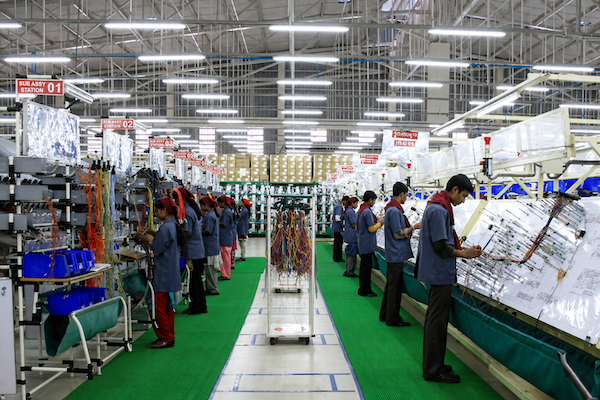
Motherson Sumi Wiring is choosing to build flexible capacity and to live with ugly start‑up costs. Legacy plants are running near 80% utilisation. Three newer facilities at Navagam, Pune and Kharkhoda are at roughly 50-80% utilisation and delivering about ₹5 billion of quarterly revenue, with a target of around ₹20 billion annually once fully ramped. Launch delays, particularly in Pune, left capacity under‑used and generated about ₹1.3 billion in start‑up costs over two years.
The company is paying with margins for that choice. Operating margin fell from 8.8% to 7.4% and net margin from 6.5% to 5.4%, as raw materials and wages are rising and greenfields are pulling down profitability. Even so, roughly ₹2 billion of capital expenditure is being funded from operating cash, net external debt is being kept negligible, and about 62% of profits are being paid out as dividend.
The management wants investors to look at return on capital, not to plant‑by‑plant margin, to drive the message that reported margins are being allowed to sag for a while in to keep options open across different engine and EV paths.
Copper is the joker in this pack, sitting at roughly 25% of the cost of goods sold. When prices jumped, as they did in 2025–26, material costs rose more than 27% and the company estimated a 200 to 250 basis-point hit to the bottom line in January-March from copper alone.
Motherson Sumi Wiring has a pass‑through arrangement for copper prices with OEMs, typically with a three‑month lag and, for some customers, six months. The absolute increase is being billed into revenue and cost, rather than negotiated as a percentage uplift. Smaller suppliers selling into the same vehicles often see copper inflation eating their margin until the next price reset.
In a labour‑heavy, seemingly commoditised segment, the company’s earnings are holding up less because of any clever view on commodities and more because buying and billing are being structured in its favour.
So, what should investors or suppliers be watching next?
First, whether utilisation at the new plants is converging toward legacy levels without further erosion in margin. If greenfield earnings are catching up as promised, today’s drag really is just the cost of growth. If not, the business may be settling into a structurally lower profitability band.
Second, whether copper and other input costs are staying an accounting noise over short periods or beginning to show up as permanent margin compression. The pass‑through story is relying on OEMs continuing to honour back‑to‑back contracts and on group sourcing staying competitive. Any change in that behaviour would be shifting the valuation case.
Third, whether EV harness revenue is growing roughly in line with EV volumes and policy support or is stalling at single‑digit share. With Sumitomo’s technology standing behind it, Motherson Sumi Wiring India is holding a credible shot at being the default high‑voltage wiring supplier beyond the domestic market. If that slice is not moving meaningfully over the next few years, “powertrain agnostic” will be starting to look more like risk avoidance than deliberate positioning.
Right now, the market is treating this like a strong, high‑return auto‑parts stock with some margin worries attached. The more useful question, for both investors and rival suppliers, is this. Is a regular cyclical parts maker being seen here, or is a wiring backbone being seen that can sit inside any engine, in any market, while the world is still arguing about which powertrain is going to win.
More From BasisPoint