.png)


Krishnadevan is Editorial Director at BasisPoint Insight. He has worked in the equity markets, and been a journalist at ET, AFX News, Reuters TV and Cogencis.
August 7, 2026 at 7:08 AM IST
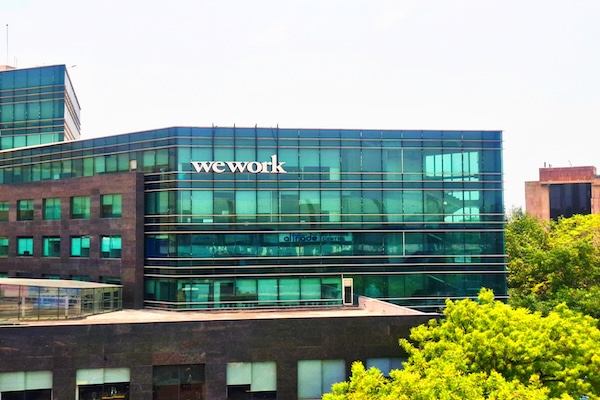
WeWork India’s glitzy branding suggests a business built for freelancers, start-ups and hot desks. That is the obvious reading, but the wrong one. The brand earns the attention, but the money increasingly comes from a different customer set altogether.
This is not the WeWork that imploded in the US. WeWork India is a separately run franchise, majority owned by Bengaluru-based Embassy Group, focused on Indian Grade-A office markets. It has built a more disciplined business around enterprise clients and managed office demand.
The numbers back that up. Revenue in 2025-26 rose 23% to about ₹24.77 billion, EBITDA, a rough measure of operating profit, grew at the same pace to roughly ₹4.99 billion, profit after tax more than doubled to around ₹1.80 billion, and return on capital employed came in at 28.3%, a level that looks more like a solid platform than a shaky start-up.
The March quarter was stronger still. Portfolio occupancy stood at 86.9%, mature centres reached 88.9%, EBITDA margin rose to 23.2%, RoCE touched 45.1%, and net debt turned slightly negative for the first time, leaving the company with a small net cash position instead of borrowings.
By April–June of 2026-27, revenue was up 28.5% year on year at around ₹6.98 billion, EBITDA had climbed 69.3% to about ₹1.38 billion with a 19.8% margin, and profit had risen to roughly ₹532 million, while RoCE held at 28.6%.
That does not look like the profile of a co-working company selling cappuccinos and community to freelancers. Roughly 77% of core revenue comes from enterprises, Fortune 500 companies contribute 29.1%, and non-enterprise customers account for just 22.7%. Around 65% of core revenue comes from global members headquartered outside India, with a tilt towards North America and Asia Pacific. Put differently, WeWork India is less a home for start-ups and more a service provider to multinational companies.
GCC Gravity
The company has made global capability centres the centre of its pitch, saying they account for about 40% of its existing member base and roughly half of new sales. It also says flexible offices have led Indian office leasing for three consecutive quarters, domestic firms now drive 46% of leasing, and more than half of occupiers already use flex in some form. Premium demand is shifting towards younger, green-certified, institutional-grade buildings, precisely the market where WeWork India operates.
AI will provide another tailwind. The company cites a study arguing that India’s AI workforce in GCCs could rise from about 181,000 to more than 700,000 by 2030, with a 55 million square foot leasing pipeline attached to that shift.
WeWork India has used this tailwind to lock in behaviour that looks anything but flexible. Average commitment terms have risen from 26 months to 28 months overall, and from 30 months to 33 months for large enterprises, while remaining locked-in core revenue stood at about ₹29.40 billion against rent commitments of ₹9.86 billion in March, rising to roughly ₹33.63 billion against ₹11.52 billion by June.
More than half of new desk sales in 2025-26 came from existing members expanding rather than new customers, and in the April–June quarter, 52% of new desk sales were also expansion. In effect, WeWork India offers flexibility to its customers while increasingly locking in predictable income for itself.
Capex Creep
Investors, though, could keep circling a few key questions. Will margins hold through a new capex cycle? Will higher rents and lease renewals in tight micro-markets squeeze spreads? How quickly can new centres fill? And will richer per‑desk capex on managed office deals still earn acceptable returns?
WeWork India believes this capex cycle should hurt less than the last because more of the new capacity is backed by demand through managed offices, which open with full occupancy from day one. Operational desks stood at roughly 133,600 in June, and management plans to lift that to about 155,300 by March and nearly 179,400 beyond that.
Capex in 2025-26 was around ₹4.56 billion, inflated in part by large managed office deals for clients such as JPMorgan and Amazon, and 2026-27 capex is guided in the ₹5-6 billion range. Here, WeWork India looks less like a flex operator merely adding seats and more like an outsourced campus builder for global companies.
At the same time, it wants to earn more from each tenant once they join the platform. The new Member Services offering, launched in the April–June quarter, bundles admin, IT, HR and GCC-oriented advisory services inside the WeWork app, ranging from employee transport and hardware rental to hiring, insurance and legal or accounting support. A customer that buys office space, staffing help, transport and back-office services from one place is harder to walk away from than one that simply rents desks.
But deeper relationships also reshape risk. Once the business depends not just on occupancy and rent spreads, but also on outside partners delivering transport, staffing and advisory services effectively, the model becomes broader and more complex. Investors may take comfort from the fact that WeWork India earns roughly ₹2.60 to ₹2.80 of revenue for every ₹1 of rent it pays, while its breakeven occupancy sits around the mid-50s.
Those revenue‑to‑rent multiples of around 2.6 to 2.8 times, combined with a steady-state business, may reassure investors about the company’s resilience. But they should also recognise that a business built around the “future of work” is increasingly anchored to large enterprises, making it a more concentrated corporate services provider tied to a relatively small group of clients and a heavy capex cycle.
While it is a better business than the old WeWork ever built, it is also not quite the simple flex story the branding suggests.
More From BasisPoint