.png)

Amitabh Tiwari, formerly a corporate and investment banker, now follows his passion for politics and elections, startups and education. He is Founding Partner at VoteVibe.
October 13, 2026 at 5:10 AM IST
With Punjab’s Assembly election due in early 2027, whether the Shiromani Akali Dal (SAD) and the BJP should reunite has become a central political question. The numbers support both sides of the argument.
The Arithmetic
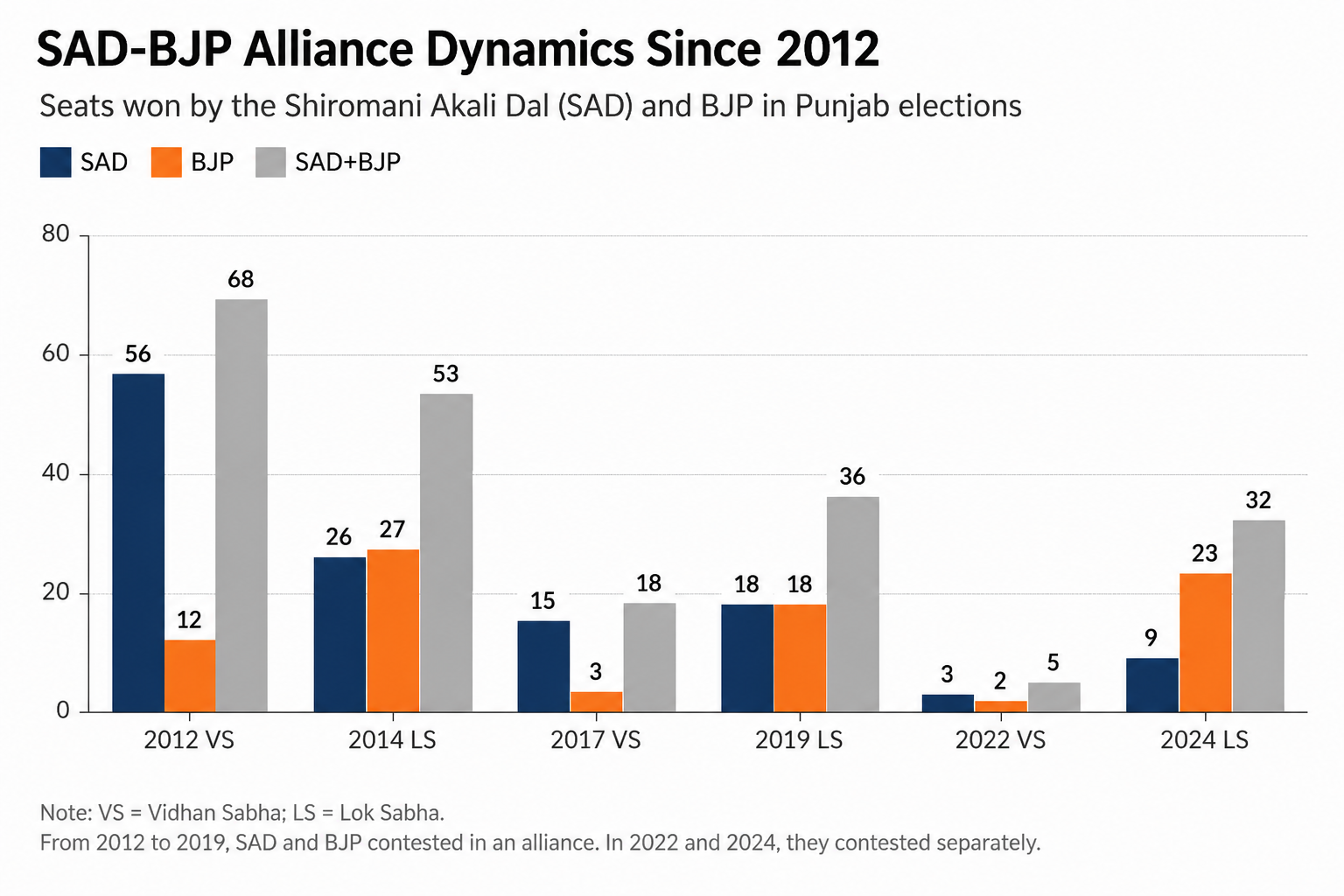
The alliance years were dominant. SAD and BJP won three Assembly elections together, in 1997, 2007 and 2012. Counting Assembly segments won or led, they stood at 68 in 2012 and 53 in the 2014 Lok Sabha polls. Their tally fell to 18 in 2017 amid an anti-incumbency collapse, before recovering to 36 in the 2019 Lok Sabha polls.
Separation proved costly. After splitting in 2020 over the farm laws, the parties managed just five segments between them in the 2022 Assembly election: SAD won three and BJP two. AAP swept the election, winning 92 of 117 seats. In the 2024 Lok Sabha polls, SAD and BJP led in 32 Assembly segments, but the recovery was driven largely by BJP, which led in 23 against SAD’s nine. The old balance of power had reversed.
The 2024 counterfactual is striking. The parties’ separate tallies were SAD nine, BJP 23, AAP 37, Congress 33 and others 15.
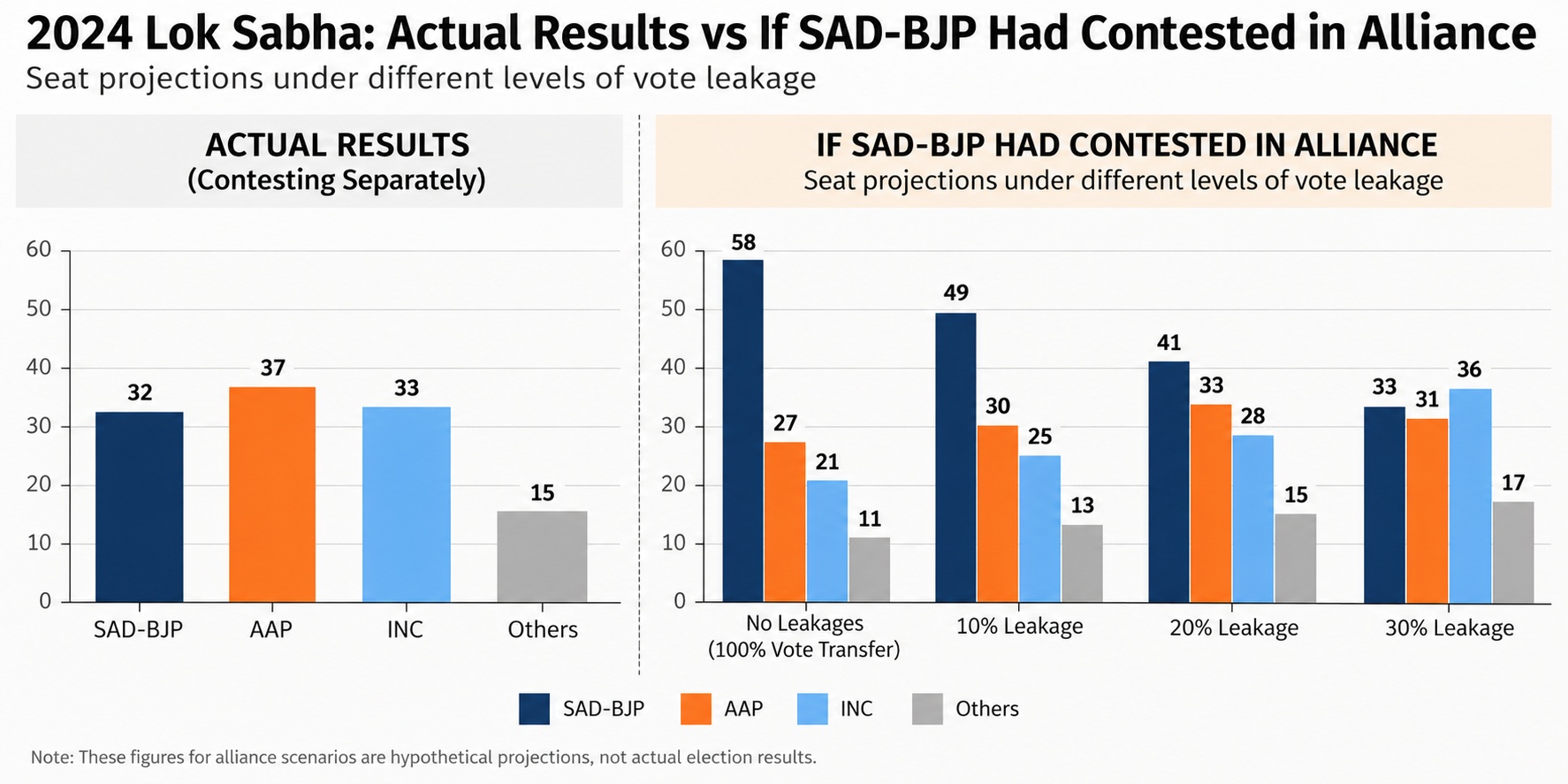
With perfect vote transfer and no leakage, the alliance would have led in 58 segments, just one short of the 59 needed for a majority. It would remain ahead with leakage of up to 20%, but at 30% leakage, its tally would fall to 33, barely above the separate 2024 result, with Congress moving ahead.
The alliance could therefore become competitive, but a decisive victory would require a favourable transfer of votes. BJP may hope to win 41 seats with SAD and then explore post-poll possibilities involving a split in AAP or Congress, or support from others.
The case for reunion rests on six arguments. First, the parties have traditionally complemented each other: SAD draws strength from rural Sikh Punjab, while BJP has a stronger base in urban Hindu Punjab. Second, their alliance governed the state for a decade across the 1997–2002 and 2007–2017 periods, winning comfortably in 1997, 2007 and 2012.
Third, both parties have struggled independently. Their combined tally of five Assembly segments in 2022 was a rout, while the 2024 recovery suggests BJP has a substantial base but may struggle to convert it into seats without support in Sikh-majority constituencies. Fourth, AAP has drawn support from both Hindu and Sikh voters, making a united opposition potentially more competitive.
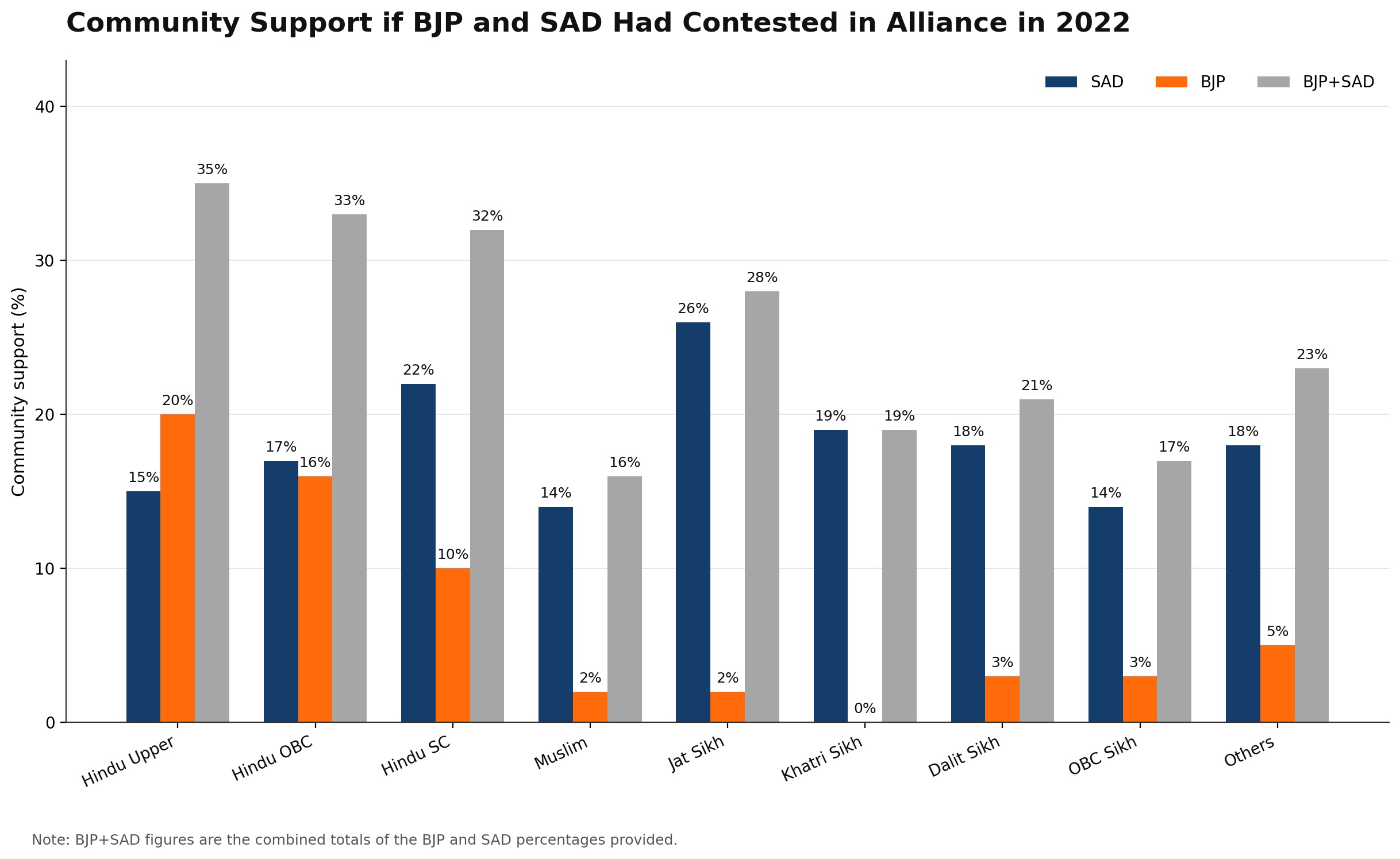
Fifth, SAD faces an existential challenge. Pressure from panthic formations, including groups linked to Waris Punjab De, is eroding its Sikh base. SAD’s share of Jat Sikh support was just 26% in the 2022 Assembly election, well below its historical dominance. An alliance could offer the party a route to political recovery.
Finally, BJP’s limited support among Sikh voters remains a structural weakness. Its reported support of 0–3% among Sikh communities in 2022 underscores the difficulty of winning Sikh-majority seats without a partner with credibility in those constituencies.
The case against reunion is equally significant. The parties split over the farm laws, with SAD leaving the NDA during a major farmers’ agitation. Reuniting before an election could look opportunistic, particularly to rural Sikh voters who remember the rupture.
Vote transfer is another risk. Hindu voters may move towards SAD, but Sikh voters angered by the farm laws may resist voting for BJP candidates. The 30% leakage scenario, in which the alliance gains little over the status quo, cannot be dismissed.
SAD’s weakened position also raises questions about seat-sharing. Its segment leads fell from 56 in 2012 to three in 2022 and nine in 2024. BJP’s 23 leads in 2024, against SAD’s nine, show which partner is now stronger. Would SAD accept a junior role in a state where it once dominated?
The BJP would also inherit SAD’s baggage, including corruption and governance allegations associated with their previous government. Drugs present a further political risk. The issue has emerged as a major concern in Punjab and is hurting AAP. BJP has pledged to make the state drug-free by 2029, but SAD leader Bikram Singh Majithia has faced allegations in a drug case. Although the allegations are contested, an alliance could complicate BJP’s ability to attack AAP on the issue.
The Wider Contest
AAP faces anti-incumbency, dissatisfaction with its MLAs and growing concern over drugs. Yet the opposition remains divided, potentially giving AAP its biggest advantage. Congress, BJP, SAD and panthic formations such as Waris Punjab De are competing for sections of the anti-AAP vote.
This leaves BJP with a strategic dilemma. Without an alliance, the main contest could remain between AAP and Congress, despite the latter’s internal differences. If Congress manages to resolve those divisions, it could emerge as a stronger single challenger.
On a combined basis, the alliance tops out at 35% among upper-caste Hindus and 33% among Hindu OBCs. It reaches 28% among Jat Sikhs. Among Dalit Sikhs it gets 21%, OBC Sikhs 17%, Khatri Sikhs 19%. No community gives the alliance anything close to a consolidated base.
The numbers make a strong case that separation has been costly for both SAD and BJP. A reunion offers their clearest route to a competitive combined tally, but not a guaranteed path to power. Its success depends on three factors: how effectively votes transfer, particularly from Sikh voters to BJP candidates; whether voters accept reconciliation after the farm-law rupture; and whether the combined baggage of the two parties outweighs AAP’s anti-incumbency.
For SAD, the question is survival. For BJP, it is whether Punjab can become electorally competitive without stronger Sikh support. An alliance may be necessary for both parties, but necessity does not guarantee success.
More From BasisPoint