.png)


Ganga Narayan Rath is a former central banker and a contributor to leading financial publications.

Chirayu Sharma is an independent researcher.
November 21, 2026 at 5:25 AM IST
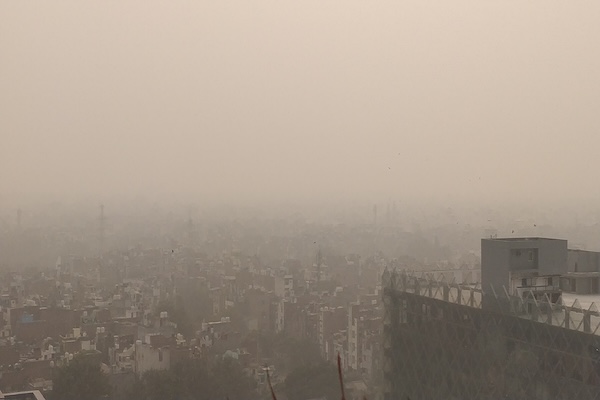
October 2026 was a record month for Indian carmakers. Industry estimates put domestic passenger vehicle sales at 525,000 to 530,000 units, up 13-14% year on year and well above the previous October peak of 465,000 in 2025. Maruti Suzuki, Tata Motors, Hyundai Motor and Kia all reported their best figures. At the same time, the Supreme Court was hearing a case on Delhi’s air quality, with the Air Quality Index touching 400 and the capital moving into GRAP III restrictions.
The two stories appeared side by side but were rarely considered together. They should have been. Car ownership is not the problem. The problem is celebrating rising sales without accounting for the wider costs of putting more vehicles on already congested, polluted roads.
The auto industry’s contribution to the economy is undeniable. A NITI Aayog report puts it at 7.1% of India’s GDP and 49% of manufacturing GDP. The sector supports millions of jobs, an extensive supplier base, exports and tax revenues. But an industry of this scale deserves scrutiny not just for how much it produces, but also for the quality and wider consequences of that growth.
Start with what is being sold. Not every vehicle contributes to the economy in the same way. Trucks, buses and goods carriers are productive assets: they move people and freight, supporting economic activity every day. Private cars, by contrast, are primarily consumption goods. They contribute to GDP when manufactured and purchased, but their subsequent use also adds to congestion, fuel imports and emissions.
The sales mix is revealing. India sold a record 28.3 million vehicles in 2025-26, including 4.64 million passenger vehicles and 21.7 million two wheelers. Commercial vehicle sales stood at about 1.08 million. Two wheelers accounted for roughly 77% of sales, passenger vehicles 16% and commercial vehicles just 4%. Around nine in ten vehicles sold were therefore cars and two wheelers, largely for personal use. Rising vehicle sales tell us as much about household consumption as they do about productive capacity.
There is a second parameter that must enter this calculation: the cost of pollution. A study published in The Lancet Planetary Health estimated that air pollution caused 1.67 million deaths in India in 2019. Lost output from premature deaths and illness cost the economy about $36.8 billion, or 1.36% of GDP. The study also found that deaths from outdoor particulate pollution had risen 115% since 1990. Delhi recorded the highest per capita economic loss among Indian states.
These estimates cover all sources of pollution, not vehicles alone. But they expose a fundamental accounting problem. GDP captures the value of cars sold while leaving out much of the cost of ill health, lost working days and premature deaths. A measure of growth that ignores these costs is gross, not net. Once pollution is factored in, the benefits of the car boom look less impressive.
At the World Economic Forum in Davos in January 2026, former IMF chief economist and Harvard professor Gita Gopinath warned that unchecked pollution posed a far greater threat to India's economy than trade tariffs. The warning deserves to be taken seriously.
The Mobility Shift
Available data point to a gradual shift towards private transport in several Indian cities over the past 15 years, alongside a decline in public transport use. In Delhi, private transport’s modal share rose from 19% in 2007 to 23% in 2022-23, while public transport’s share fell from 43% to 31%. Hyderabad saw a sharper reversal: private transport’s share increased from 38% to 55%, while public transport’s share dropped from 32% to just 16%.
Private cars, however, are not the sole source of urban pollution. Studies of Delhi’s air identify different contributions from road dust, transport and other sources. An IIT Kanpur study in 2015 found road dust to be the largest contributor to PM2.5, followed by vehicles. A 2016 TERI study attributed 28% of winter PM2.5 to transport, with trucks and two wheelers accounting for the largest shares within that category. The Centre for Science and Environment estimated that vehicles contributed nearly 17% of Delhi’s total PM2.5 during a week in late October 2022, but around half of the pollution from the city’s own sources.
The estimates vary, but the broad conclusion does not: vehicles are a significant and controllable source of local pollution. Their contribution will become harder to manage as their numbers grow.
The Supreme Court’s recent remarks reflect this concern. The bench led by Chief Justice Surya Kant described vehicle bans and construction curbs as “old, tried and failed tools” and asked the Centre and the Commission for Air Quality Management whether they had a more effective scientific approach. Justice Bagchi pointed out that vehicles can enter Delhi without authorities being able to monitor their fuel or condition. The government, meanwhile, argued that emergency measures are not entirely ineffective and that human activity has expanded faster than the capacity to manage it.
Both positions have merit. Emergency restrictions can help contain an immediate crisis, but they cannot fix a system in which vehicle numbers keep rising faster than the capacity to regulate emissions and provide alternatives.
Beijing offers a useful, though imperfect, comparison. Its annual PM2.5 concentration fell from 89.5 micrograms per cubic metre in 2013 to 32 in 2023, a decline of 64.2%. This followed a sustained programme targeting coal use, vehicle emissions, industrial pollution and dust. More than three million highly polluting vehicles were phased out. Beijing’s early gains were driven substantially by reductions in coal pollution, and its controls operated across a wider region with strong central direction. Temporary measures such as odd even restrictions also produced only short-lived improvements, with pollution rebounding once they were lifted. China’s PM2.5 levels rose again in 2023 after a decade of decline.
The lesson for Delhi is not to replicate Beijing mechanically, but to adopt its longer-term approach: scientific source tracking, sustained targets and the systematic retirement of the dirtiest vehicles, rather than relying on seasonal emergency orders.
Beyond Sales
What should the government do? First, pollution must be reflected more directly in the cost of vehicle ownership. Registration fees, road taxes and parking charges could be linked to emissions and vehicle size, making cleaner choices more affordable and discouraging more polluting ones.
Second, the retirement of old and heavily polluting vehicles must accelerate, backed by strict and verifiable emissions testing. This is particularly important given the enforcement gaps highlighted by the Supreme Court.
Third, electrification should prioritise vehicles that travel the greatest distances, particularly buses, taxis, delivery fleets and trucks. Electric car sales nearly doubled in October to 35,777, taking their market penetration to about 7%, from 3.2%. That is encouraging, but most new cars still run on fossil fuels.
Fourth, public transport must become good enough to make owning a second or third car a choice rather than a necessity. Fifth, the National Capital Region must be treated as a single airshed, with coordinated action across state boundaries. Finally, the government should publish pollution adjusted assessments of the auto sector alongside sales figures, so that its contribution is judged by net economic benefit rather than volumes alone.
India does not need to sell fewer cars to achieve sustainable growth. It needs to ask what kinds of vehicles are being sold, where they are driven and what alternatives are available. A record sales month is good news for manufacturers’ balance sheets. Whether it is good news for the country depends on the quality of the air that comes with it.
*Views are personal.
More From BasisPoint