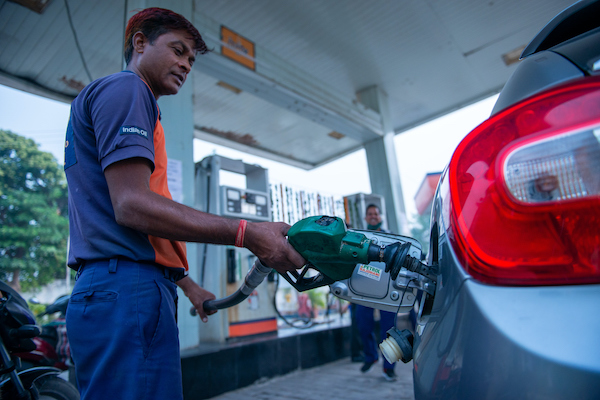
In February 2026, when tensions at the Strait of Hormuz cut off close to 60% of India’s liquefied petroleum gas, and severely hit crude oil imports almost overnight, the country reached for a toolkit that had been built years earlier, and in an unlikely place. Not a military option and not emergency diplomacy, but something assembled in the sugarcane fields of Uttar Pradesh and the maize belts of Maharashtra.
India’s ethanol programme began as an agricultural intervention, a second market for surplus cane and other agricultural produce such as maize, rice, and corn. From there, it has now become one of the more consequential instruments of the country’s energy and foreign policy, and the distance travelled is not best measured in years. It is measured in what the programme absorbed when it was tested.
The vulnerability
India imports 88.7% of the crude oil it consumes. That dependence stopped being an abstraction in February. Yet, the country recorded no fuel shortages, helped by a ramp up in domestic LPG production from 32,000 metric tonnes a day to nearly 52,000, and a Rs 10 per litre cut in central excise duty on petrol and diesel.
Ethanol is the structural part of that resilience rather than the emergency part. Blending has replaced more than 31 million metric tonnes of crude since 2014-15, and saved more than ₹1.9 trillion in foreign exchange. This itself contributes 4% to Maharashtra’s and 5% to Uttar Pradesh’s state GDPs, respectively—two of the country’s major sugarcane-growing regions. Blending itself climbed from under 1.5% in 2013-14 to 20% in 2025-26, five years ahead of the original timetable. Every percentage point of ethanol in the national fuel mix is a percentage point of Hormuz exposure removed permanently.
From Domestic Policy to Diplomatic Platform
The shift from a farm scheme to a diplomatic asset happened at the G20 summit in 2023, when India launched the Global Biofuels Alliance and positioned itself not as a large ethanol consumer but as a convenor and standard setter.
That was a genuine break with how India had behaved for decades. Indian energy diplomacy had been almost entirely defensive: securing crude supply contracts, managing relationships with producer groups, hedging against price shocks. The Alliance was the first significant instance of India converting an energy policy success into outward facing coalition leadership, and it placed the country alongside Brazil and the United States as a co-architect of global biofuel trade and technology standards.
The industrial ambition behind it runs past road fuel. India has set Sustainable Aviation Fuel blending targets for international flights of 1% by 2027, rising to 5% by 2030, aligned with the CORSIA framework. Indian carriers have already flown trials blending SAF with conventional jet fuel. More than ₹18 billion has been earmarked for a dozen integrated second generation bioethanol projects producing from crop residues and biomass rather than food crops. If that technology matures, India exports not only the fuel but the method, to other biomass rich developing economies.
Lessons From Brazil
India’s approach borrows openly from Brazil, which mandates E27 nationwide, is moving toward roughly 35%, and sells over 80% of new cars as flex fuel vehicles. The country also has the capability to operate on 100% ethanol blended cars. Brazil built that capability across four decades and used its ethanol leadership as an instrument of soft power and trade diplomacy across Latin America and beyond. India can take a cue from Brazil and emerge as a leader in ethanol-blending technology across Asia.
Brazil also settles the argument that India is still having. Brazilian drivers have run high ethanol blends for decades without the systemic mileage collapse or engine degradation. The United States runs E10 nationwide with E15 expanding across states, powering hundreds of millions of vehicles without a national mileage crisis. Japan, more conservative in regulatory temperament than either, has taken a phased approach centred on E10, which tells you that even cautious regulators who studied the science found no reason to stay away.
What India is Actually Offering
India is positioning itself to play Brazil’s role for a different constituency. There is a large bloc of import dependent, agriculture rich economies for whom the Indian model, which pairs farm income support with energy security, is more directly replicable than a sugarcane dominant approach requiring Brazil’s land and climate.
And there is a domestic dividend that travels well as an argument. Cumulative additional farmer earnings since 2014-15 have crossed ₹1.60 trillion. Ethanol production also yields Dried Distillers Grain with Solubles, a protein rich by-product now widely used as cattle feed, which quietly links ethanol producers to livestock farmers. The government should ensure that a significant share of the benefits currently accruing to millers and refiners is passed on to farmers through pre-specified prices, with timely payments and minimal arrears. A timely audit of the big refiners and millers would be a step in the right direction.
None of this argues for uncritical expansion. India has already surfaced real friction, including reports of a mid-sized eastern distillery shutting down when oil marketing companies did not lift contracted volumes, and genuine feedstock competition with poultry, which consumes close to 60% of India’s maize, facing price pressure as ethanol demand has grown. These are management problems and they deserve to be treated as such rather than argued away.
But the underlying proposition has held up. A developing, import dependent economy has shrunk a strategic vulnerability while building a new rural income stream, and it can now export that model to countries facing the same bind. At a moment when energy security is once again a matter of national urgency, ethanol has become India’s most exportable idea.
.png)