.png)

Rajesh Mahapatra, ex-Editor of PTI, has deep experience in political and economic journalism, shaping media coverage of key events.
November 28, 2026 at 5:35 AM IST
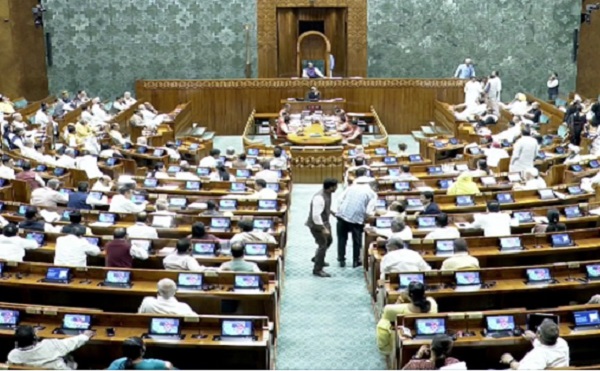
In April, the DMK’s 22 MPs helped defeat the Modi government’s plan to expand the Lok Sabha. When the House reconvenes on Monday, those same MPs could help revive it. The Union Cabinet has now put in writing a concession that matters to Tamil Nadu, a proposal to give every state 50% more seats in the Lok Sabha.
That offer changes the politics of implementing the one-third reservation for women that Parliament approved in 2023. The government wants the quota in place for the 2029 Lok Sabha election, after constituencies have been redrawn. For the BJP-led National Democratic Alliance, the gamble is whether protecting each state’s relative weight in Parliament will win over enough of the parties that opposed the April amendment.
If the Delimitation Bill is passed, the ruling coalition will be encouraged to push its other plan of holding simultaneous elections to Parliament and state assemblies – One Nation, One Election.
A constitutional amendment of this kind requires a two-thirds majority of members present and voting in both houses of Parliament. It must also be passed with a simple majority in the assemblies of at least two-thirds of India’s states.
The government’s earlier attempt, in April this year, fell short in the Lok Sabha. The constitutional amendment received 298 votes in favour and 230 against, leaving it 54 short of the required number. Much has since changed in politics and parliamentary arithmetic.
Changed Arithmetic
In West Bengal, Trinamool Congress, whose 28 MPs had voted against the bill last time, is now reduced to a party of seven MPs after 20 MPs walked out following its defeat in the West Bengal assembly elections held in April-May. They have joined a new, little-known party that is now part of the NDA. One MP has been suspended.
In Maharashtra, six out of nine MPs of the Uddhav Thackeray-led Shiv Sena defected in July and joined the rival Eknath Shinde-led Shiv Sena, which is part of the NDA. Sharad Pawar, whose Nationalist Congress Party-SP has eight MPs in Lok Sabha, too has more or less decided to drop its earlier reservation regarding the bill and support.
The Delimitation Bill now appears to have the support of more than 360 members in Lok Sabha. That’s the two-thirds majority mark in the lower house, whose current strength now stands at 540.
On Friday, the Union Cabinet reportedly approved a revised draft of the delimitation bill, which sweetens the deal for some of the parties that had earlier opposed it. The bill now proposes a uniform increase of 50% in seats across all the states. This ratio will hold for 25 years, until the Census of 1951. It also proposes to raise the current ceiling on seats in a state assembly to 650, so that no state is constrained to expand its assembly in line with the increase in the strength of the Lok Sabha. The women’s reservation bill will come into effect along with Delimitation.
Currently, seat allocation is based on the 1971 Census. The use of the 2026 Census, as proposed earlier, would have meant northern states like Uttar Pradesh and Bihar, which have experienced higher demographic growth, gained disproportionately more seats in the Lok Sabha. Conversely, the southern states, where fertility rates dropped alongside economic development and social progress, stood to lose the most.
The DMK, historically a fierce opponent of northern demographic dominance, had advocated for a uniform 50% seat expansion formula across all states rather than a pure population-based adjustment. News reports say the Cabinet-cleared revised draft incorporates that demand.
If Uttar Pradesh’s 80 Lok Sabha seats expand by 50% to 120, Tamil Nadu’s seats would similarly increase by 50%, maintaining equitable relative strength and preserving Tamil Nadu’s overall parliamentary share at a guaranteed minimum of 7.2%. The same goes for every other state that was earlier losing its share in Parliament.
Opposition to Delimitation
Opponents fear that a Delimitation Commission, dominated by the government’s appointees, could arbitrarily reconfigure constituency boundaries to disadvantage opposition strongholds.
The commission would comprise a state’s chief electoral officer or his/her nominee, one of three Election Commissioners and a retired Supreme Court judge of the government’s choice as its chairman. It is to be noted that the NDA is in power in an overwhelming number of states – 20 out of 28.
A similar exercise in Assam last year offers a possible example. Critics of the delimitation process have argued that Muslim-majority areas were grouped together, in some cases allegedly disregarding geographical contiguity, potentially concentrating the community’s electoral influence in fewer constituencies. Some have also suggested that the changes may have influenced the outcome of the assembly elections held earlier this year, although the extent of any such impact remains difficult to establish.
More importantly, if the bill is passed, a short interval between the final notification of constituency boundaries and the 2029 Lok Sabha elections could leave opposition parties with little time to prepare and may work to the ruling coalition’s advantage.
Imagine a constituency that has been a pocket borough of a well-known male opposition leader is notified as reserved for women barely months before the elections. There is every chance that he may not readily find an alternative winnable constituency and make it again to Parliament.
There is no clarity yet on the timeline that the Delimitation Commission will follow. It is also not known how constituencies will be earmarked as reserved for women – whether it will be a draw of lots, or the Commission will exercise its discretion.
Opposition parties have also raised questions over the timing and urgency of the legislation. Why could it not wait for the Winter Session of Parliament, set to start in a few days? A plausible explanation is that the surprise move and a notice of just about 48 hours were to pre-empt any attempt by opposition parties to consolidate, or a change of mood on the part of constituents like DMK and NCP-SP.
The other reason is that Modi-Shah don’t want to take any chances. Seven states go to polls in 2027, starting with Uttar Pradesh, Uttarakhand, Punjab, Goa and Manipur in February-March. Gujarat and Himachal Pradesh poll later, in December. Other than Punjab and Himachal, BJP is in power in the remaining five states. What if a couple of these states flip? The NDA will then lose its two-thirds majority among states.
Long View
The late prime minister Indira Gandhi learnt it the hard way. She lost the post-Emergency elections in 1977 to a hurriedly put-together rag-tag coalition of non-Congress parties. More recently, US President Donald Trump and his Republican Party met with a similar fate in Texas redistricting. They lost the southern oil-rich state that had never let them down since 1988.
The Delimitation Bill may pass the House test next week, but the future of Indian democracy hinges on whether federal fairness is preserved or sacrificed in the pursuit of electoral hegemony.
More From BasisPoint