.png)


Datametricx is a veteran journalist tallying the macro game, keeping score of the numbers that shape India’s economy and policy.
November 15, 2026 at 11:32 AM IST
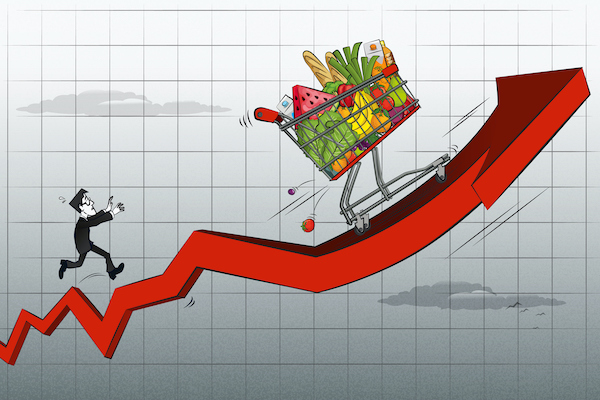
India’s retail inflation rose to a two-year high of 6.09% in October, driven primarily by higher food prices, particularly those of cereals, meat and vegetables. Retail inflation was 5.54% in September and 0.04% a year earlier.
This was the first time in two years that CPI inflation had breached the upper limit of the Reserve Bank of India’s medium-term target of 2-6%.
The overall CPI rose 0.5% month-on-month, driven by a 0.9% increase in food prices. Food inflation accelerated to 8.94% in October from 7.74% a month earlier. The increase was led by cereals, meat, oils, and vegetables, whose prices rose 1.7%, 2.4%, 1.1%, and 1.7%, respectively, on a month-on-month basis.
Annual inflation in the restaurants and accommodation segment and the personal care, social protection and miscellaneous goods and services segment was in double-digit territory at 10.06% and 10.14%, respectively.
Core inflation edged up to 4.5% in October from 4.3% a month earlier. ‘Super core’ inflation (core inflation excluding precious metals) rose to 3.8% in October from 3.2% a month earlier, indicating a broadening of price pressures. With the West Asia conflict showing no signs of abating and deficient monsoon rainfall posing risks to food prices, inflationary pressures are likely to persist.
The Reserve Bank of India has projected inflation to rise to 6.0% in the October-December quarter before easing in subsequent quarters. This is the first time since December 2023 that the RBI has projected quarterly inflation at 6.0%, the upper bound of its tolerance band.
The RBI’s Monetary Policy Committee, which raised the policy repo rate for the first time in three-and-a-half years, said there was some evidence that elevated inflation expectations were becoming generalised. With inflation breaching 6% and price pressures remaining firm, the committee is likely to increase the repo rate again in December.
India’s merchandise trade deficit widened to $39.88 billion in October from $30.21 billion a month earlier. However, the deficit narrowed from $42.58 billion a year earlier, as export growth outpaced import growth. The trade deficit in October was the second-highest on record.
Exports rose 45.1% year-on-year to $49.47 billion in October, driven by strong growth in petroleum product and electronic goods exports. Exports of petroleum products increased 140.2% to $8.89 billion, while those of electronic goods rose 62.7% to $6.64 billion. Exports of engineering goods, the largest component of India’s export basket, rose 36.0% to $12.74 billion. Export growth was the fastest in 62 months. In value terms, exports were the highest ever in a month.
Imports rose 16.5% year-on-year to $89.35 billion, the highest monthly level on record. Imports of petroleum products and crude oil increased 54.3% to $22.82 billion, while those of electronic goods rose 50.0% to $14.86 billion. Imports of gold and silver declined 57.2% to $7.46 billion in October, restraining overall import growth.
India’s current account deficit widened to $7.4 billion in September from $5.2 billion a month earlier, mainly due to a wider merchandise trade deficit and lower net transfers. The deficit in September last year was also $5.2 billion. The merchandise trade deficit widened to $30.0 billion from $26.6 billion a month earlier, while the services trade surplus increased to $19.2 billion from $16.5 billion. Net transfers declined to $10.9 billion in September from $12.8 billion a month earlier.
The capital account recorded a surplus of $16.2 billion in September, down from $50.6 billion a month earlier. The lower surplus reflected net foreign direct investment and foreign portfolio investment outflows, as well as lower inflows into banking capital. The capital account had recorded a deficit of $0.4 billion in September last year.
Net foreign direct investment outflows of $4.9 billion and foreign portfolio investment outflows of $6.7 billion weighed on the capital account surplus. Banking capital inflows declined to $22.2 billion from $64.7 billion a month earlier. This reflected the end in August of inflows into the special deposit schemes for non-resident Indians announced by the RBI to attract foreign exchange.
The current account recorded a deficit of $25.8 billion in the first half of 2026-27, up from $18.0 billion a year earlier. The capital account recorded a surplus of $92.6 billion in April-September, sharply higher than $11.6 billion a year earlier.
Unlike retail automobile sales, wholesale automobile dispatches continued to be strong in October. Growth in automobile dispatches accelerated to 15.8% year-on-year in October, with total dispatches rising to 3.20 million units, the highest monthly level on record. Growth remained in double digits for the 12th consecutive month and was marginally higher than the 14.8% recorded in September.
Retail automobile sales had contracted 23.8% year-on-year to 3.17 million units in October, primarily because of a high base. Retail automobile sales had risen sharply in October last year following cuts in goods and services tax rates. However, the sharp pickup in wholesale dispatches following the GST cuts began only in November last year. Growth in wholesale dispatches is likely to moderate in November because of the high-base effect.
Growth in passenger vehicle dispatches slowed to 12.4% in October from 21.8% in September. Passenger vehicle dispatches rose to 519,060 units, a monthly record. Growth in two-wheeler dispatches accelerated to 16.1% in October from 13.5% a month earlier, with dispatches reaching 2.58 million units, also a monthly record. Motorcycle dispatches remained relatively subdued, rising 6.6% year-on-year to 1.42 million units. Scooter dispatches, however, continued their strong growth, increasing 36.1% to 1.10 million in October. This was the first time scooter dispatches had crossed the one-million mark.
The country’s unemployment rate eased to 5.1% in July-September from 5.4% a quarter earlier. The decline was primarily driven by lower unemployment among both rural men and women, even as the urban unemployment rate edged up. Rural unemployment declined to 4.3% in July-September from 4.8% a quarter earlier, with the rate among rural women falling to 4.1% from 4.7% and that among rural men declining to 4.4% from 4.8%.
Unemployment in urban areas, however, increased to 6.8% from 6.7% a quarter earlier. Unemployment among youth (those aged 15-29 years) fell to 15.3% in July-September from 15.9% a quarter earlier. While unemployment among urban youth increased to 18.9% from 18.2%, the rate among rural youth declined to 13.6% from 14.7%.
Inflows into gold exchange-traded funds moderated to ₹35 billion in October from ₹45 billion a month earlier, as several mutual funds paused fresh investments in their gold ETF fund-of-funds following an unofficial directive from the Securities and Exchange Board of India.
The mutual fund industry’s net assets under management rose to ₹83.39 trillion at the end of October from ₹82.64 trillion a month earlier, primarily reflecting mark-to-market gains and inflows into schemes.
Growth in e-way bill generation rose to a 10-month high of 23.1% year-on-year in October from 7.2% a month earlier. In absolute terms, the number of e-way bills generated in October hit an all-time high of 156.21 million, surpassing the previous record by 10.4%. The record generation may partly reflect traders stocking up ahead of the festival season. An e-way bill is a document under the goods and services tax system for transporting goods worth more than ₹50,000 and serves as a leading indicator of economic activity.
Petroleum product consumption rose 2.7% year-on-year to 20.49 million tonnes in October, marking a 10-month high in growth, driven by double-digit growth in diesel consumption. Consumption had contracted in six of the previous 10 months amid disruptions caused by the war in West Asia. Diesel, which accounts for roughly 40% of the country’s total petroleum product consumption, recorded a 12.0% increase to 8.53 million tonnes. Petrol, the second-largest component of the basket, rose 3.5% to 3.80 million tonnes. Liquefied petroleum gas consumption fell for the eighth consecutive month, declining 12.3% to 2.52 million tonnes in October.
New business premiums of life insurers rose 26.2% year-on-year to ₹429 billion in October, led by a sharp rise in premium income of state-owned Life Insurance Corporation of India. LIC’s premium income rose 31.3% to ₹253 billion, while that of private life insurers increased 19.5% to ₹176 billion. In April-October, new business premiums grew 21.4% to ₹2.885 trillion, with private insurers’ premium income rising 22.0% and LIC's premium income increasing 20.9%. LIC sold 8.27 million policies in April-October compared with 5.30 million by private insurers.
Gross direct premiums underwritten by non-life insurers rose 10.5% year-on-year to ₹328 billion in October. Premiums underwritten by the four state-owned general insurers rose 7.3% to ₹104 billion, while those underwritten by private general insurers increased 11.9% to ₹176 billion. Premiums underwritten by standalone health insurers rose 21.3% to ₹45 billion, while those of specialised insurers declined 63.8% to ₹2 billion.
India’s foreign exchange reserves ended an eight-week declining streak in the week ended November 6, primarily driven by a rise in gold prices. Reserves rose by $2.49 billion to $719.55 billion. Foreign currency assets increased by $232 million to $591.35 billion, while gold reserves rose by $2.21 billion to $104.80 billion during the week.
Reservoir storage declined sharply, widening the gap with historical levels. As of November 12, live storage in the country’s 178 reservoirs stood at 116.85 billion cubic metres, or 63% of their total capacity. Storage was 30% lower than a year earlier and 20% below the 10-year average. Deficient southwest monsoon rainfall and the low reservoir storage are likely to adversely affect rabi crops, which rely heavily on irrigation in many regions.
After a deficient southwest monsoon, the northeast monsoon also appears headed for a shortfall. Also known as the winter monsoon, it has so far been deficient across the core region, comprising five subdivisions of the southern peninsula: Coastal Andhra Pradesh, Rayalaseema, Tamil Nadu and Puducherry, South Interior Karnataka and Kerala. As of November 13, cumulative rainfall in the core region was 211.4 millimetres, 89% of the long-period average. For the country as a whole, rainfall was even lower at 68% of the long-period average, indicating a 32% deficit.
Rabi sowing continued to lag amid deficient rainfall and lower reservoir levels. The total area under rabi crops was 17.83 million hectares as of November 13, down 11.3% from a year ago. The area under wheat, the main rabi crop, declined 15.3% year-on-year to 5.01 million hectares, while the area under rice fell 4.2% to 0.79 million hectares. The area under pulses declined 14.3% to 4.70 million hectares, while the area under oilseeds fell 7.4% year-on-year to 6.17 million hectares. The area sown so far accounted for 27.6% of the normal rabi area of 64.52 million hectares.
Coming up:
- November 16: WPI inflation for October
- November 20: Index of Nine Core Industries for October
- November 21: Annual Survey of Unincorporated Sector Enterprises for July-September
Tailpiece
Is there a southern skew in retail inflation? Four of the five southern states – Andhra Pradesh, Karnataka, Tamil Nadu, and Telangana – recorded CPI inflation above 7% in October. Interestingly, Keralam was the only southern state where inflation remained below 7%, at 6.22%, despite having recorded the highest inflation in the country until about a year ago.
More From BasisPoint