.png)


Lt Gen Syed Ata Hasnain is Governor, the State of Bihar, and Former Commander of India's Srinagar-based Chinar Corps.
October 27, 2026 at 4:55 AM IST
There is a paradox in the improving security environment of J&K. As violence occupies less space in everyday conversation, the dates that once reminded us of sacrifice and survival risk losing their significance. October 27 is one such date. Observed as Infantry Day, it commemorates the landing of Indian troops at Srinagar in 1947 but that label effectively restricts the date to an Army event. Yet its meaning extends beyond the infantry, the Army and military remembrance. It belongs within India’s national security consciousness.
During the worst years of terrorism, reminders of Kashmir’s vulnerability were unavoidable. Today, a new generation understandably seeks opportunities, mobility and normal lives. That aspiration deserves encouragement. But peace should create the space to understand history more clearly. If remembrance depends upon continuing violence, we would have failed to give it a permanent place in national life. October 27 reminds us how close India came to losing J&K, who initiated the aggression and how soldiers and civilians together resisted it.
The sequence of events matters and must be embedded in our security related memory. Pakistan had accepted a Standstill Agreement intended to preserve existing arrangements with J&K while its ruler considered accession. It subsequently violated that understanding. On October 22, 1947, armed tribal columns entered the area from Pakistan, supported by elements of its military establishment. The invasion carried looting, killing and terror towards Srinagar. Pakistan’s claim to be acting for Kashmir’s people was exposed by the suffering inflicted upon them.
This was an early demonstration of a method India would repeatedly encounter in later years. Armed irregulars advancing political objectives while their sponsors sought distance from responsibility. Operation Gibraltar in 1965 and then the triggering of terror-based militancy in 1989 were manifestations of the strategy.
Maharaja Hari Singh signed the Instrument of Accession on October 26, 1947. Indian troops began arriving the following morning. Between the invasion and that intervention stood a small body of men whose resistance bought time that could never have been recovered once lost.
Brigadier Rajinder Singh, Chief of Staff of the J&K State Forces, led the delaying battle along the invasion route. With a small force, he contested the advance and demolished the bridge at Uri. Against overwhelming numbers, his task was to make the enemy lose time. He and his men paid for those hours with their lives. His posthumous Maha Vir Chakra recognised leadership whose consequences reached far beyond the battlefield.
Civilian courage belongs equally within this history. Maqbool Sherwani of Baramulla resisted the invaders and was brutally killed. Remembered for misleading their advance and defying their demands, he represents something Pakistan’s narrative has always struggled to accommodate: a Kashmiri Muslim narrative rejecting aggression conducted ostensibly in his name. This sacrifice must remain part of Kashmir’s own inheritance, taught and remembered alongside its military defenders.
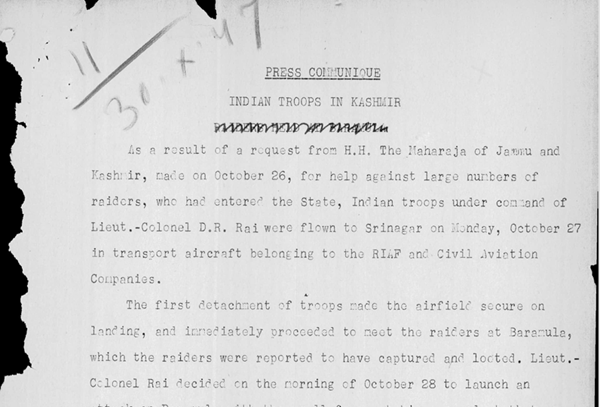
On October 27 1947, troops of 1 Sikh, commanded by Lt Col Dewan Ranjit Rai, landed at Srinagar. The uncertainty was extraordinary. Information about the enemy was incomplete; the security of the airfield itself could not be taken for granted. Aircraft, aircrew, soldiers and those organising the airlift together created a lifeline upon which the campaign depended.
Rai understood that protecting the airfield required confronting the invaders farther west. He pushed troops towards Baramulla, taking the battle away from the landing ground through which reinforcements had to arrive. He was killed during the fighting and awarded the Maha Vir Chakra posthumously. His decisions illustrate the value of initiative when instructions cannot anticipate every circumstance.
The defence subsequently demanded leadership that could turn arriving detachments into a coherent fighting force. Brig Harbaksh Singh, later among India’s most distinguished generals, was an important figure in this campaign. Alongside brigade-level leadership and battalion commanders, officers such as him helped translate desperate resistance into organised military action. The campaign deserves remembrance as an achievement of command, coordination and adaptation, as well as individual gallantry.
On November 3, Major Somnath Sharma’s company of 4 Kumaon fought at Shelateng (Badgam), close to Srinagar’s vital airfield. With his arm in plaster, Sharma led his heavily outnumbered men against attackers approaching from three sides. He moved under fire, directed the defence and sustained resistance until he was killed by a mortar explosion.
His men continued fighting after his death. Their stand helped frustrate the enemy’s designs upon the airfield. Sharma became the first recipient of the Param Vir Chakra or PVC. The significance of Badgam lies in that relationship between a company’s sacrifice and the survival of the entire military effort of a nation.
These events also help explain why India must retain a long view of Pakistan’s exploitation of J&K. Methods changed across subsequent decades, but the use of infiltration, armed proxies and intimidation repeatedly returned. Historical understanding requires us to recognise that continuity.
The targeted killings and intimidation that drove Kashmiri Pandits from their homes constitute another indispensable part of this memory. January 19, 1990, has become the community’s defining date of remembrance, although the exodus unfolded over months. Its human consequences endure in displaced families, abandoned homes and a fractured cultural inheritance. Any understanding of Kashmir’s recovery must include their security, dignity and belonging.
As someone who commanded troops in Kashmir, I believe remembrance carries an obligation to explain. A wreath honours sacrifice; explaining what that sacrifice prevented gives it meaning for another generation. October 27 should therefore reach beyond cantonments and ceremonial gatherings into schools, universities, public broadcasting and accessible accounts of local history.
Kashmiri voices must be central to that effort. Sherwani’s resistance, the suffering of civilians and the assistance extended to soldiers reveal a history in which local people exercised courage and agency. Young Kashmiris should encounter these lives as part of their own story. The way the people of Uri and the villages around it responded should also be remembered.
This requires accuracy and restraint. Exaggeration makes even a just account easier to challenge. Responsible remembrance establishes the sequence, honours the individuals and draws lessons that citizens can understand.
India should welcome every advance towards a secure, confident and prosperous J&K. Those advances increase our responsibility to preserve the memory of how its future was protected.
October 27 should remain important even when circumstances no longer make it necessary to remember. That will be the measure of a nation which understands the price of its peace.
More From BasisPoint