.png)

Review of the MPC Decision: The Fine Print on Outperformance
Behind the policy pause, easing inflation, stronger external buffers and broader investment point to a more resilient economy.

Dr. Ashima Goyal is Emeritus Professor of Economics in the Indira Gandhi Institute for Development Research. She was a member of the RBI Monetary Policy Committee.
August 5, 2026 at 2:27 PM IST
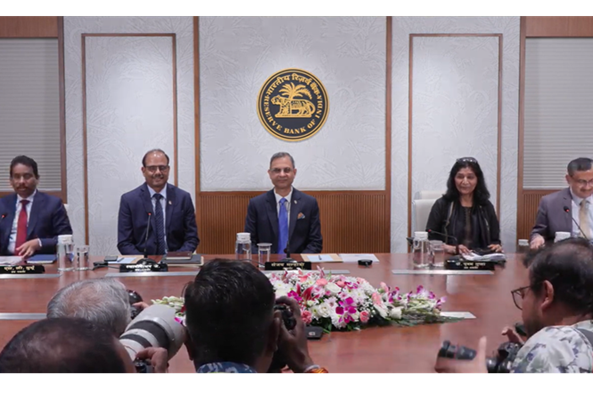
The Monetary Policy Committee's decisions were as widely anticipated, but there are a number of issues to note in the communications and in the data fine print.
Communication
The dharma of inflation targeting requires a hawkish tone, data-based guidance and mention of the target to offset the absence of action, however. This helps sustain the credibility of inflation targeting.
The MPC assures us it will act if inflation persistently exceeds the target. It has forecast headline inflation staying above 5% into the first quarter of 2027-28, but seems to expect to be wrong again in its forecasts. Uncertainty is emphasised, as well as the absence of broad-based secondary pressures, so that headline inflation is likely to approach core, whose projections remain near target.
Second, there is the prominence given to core, or trend, inflation and the fact that volatile headline inflation tends to converge towards the more stable trend. Turning attention to the much lower trend helps inflation expectations remain anchored.
The forecasts show headline inflation rising and then falling by the first quarter of 2027-28. This supply-shock transience supports the status quo in repo rates and softens the guidance. The real repo rate may be below unity for a few months, but it has far exceeded unity for many months in the past.
Third, a noteworthy feature of the Governor’s statement was that, while emphasising continuity of a market-determined exchange rate policy, the explicit mention of intervention to ‘ensure that it is not out of sync with fundamentals’.
As daily movements rose, markets had interpreted the new regime as being hands-off. But actual RBI buying and selling were higher than in the past so-called ‘interventionist regime’. While initially markets enjoyed the volatility and freedom, they did not enjoy the panic and one-way movements that followed repeated external shocks.
So a clearer commitment to intervening in a narrower band against further depreciation is likely to build confidence amid continuing geopolitical uncertainty and oil price fluctuations.
Data
Large inflows from the special schemes announced last time will add to this confidence. But some of the data highlighted in the Governor’s statement are even more important because they suggest that the long-term strategy to reduce balance of payments pressures is working.
Market nervousness over a two-year overall balance of payments deficit and dependence on inflows for financing was clearly overdone because the actual current account deficit was only a tiny 0.6% of GDP in 2025-26, as in the year before that ($25.4 billion and $23.1 billion, respectively). Such amounts can easily be financed.
The often-expressed concerns about low net FDI flows should also be mitigated, since net FDI inflows rose to $7.9 billion during April-June this year, while India was third in global greenfield FDI project announcements with $33 billion during first half of 2026. Exports had fallen in first quarter of 2025-26, but they grew at an annual rate of 15.9% in the same quarter this year, despite tariff and global volatility. Petroleum products, engineering goods and electronic goods did well. Policies to diversify Indian exports and attract global green and AI-related investment, as well as multiple sources of finance, seem to be delivering. These will help prevent the rupee from being at the mercy of global crises and volatile FPI sentiment in future.
External diversity will complement domestic diversity as a source of resilience for the Indian economy.
Concern about lagging corporate investment should also dissipate as a wide range of data shows industry and investment parameters picking up. There are signs that corporate investment is becoming broad-based beyond a few sectors. Credit growth to industry has finally picked up. These real sector responses to monetary policy are its real rationale, although market participants dominate the discussion.
A worry that these participants often voice is about fluctuations in liquidity. Since 2025, however, durable liquidity has credibly remained in surplus despite large outflows of foreign capital. Domestic liquidity shrinks as the RBI sells USD spot.
But new tools, such as FX derivatives used more frequently since 2014, have cut the close link between capital flows and domestic liquidity. The problem was that earlier the RBI was not committed to maintaining durable liquidity in surplus, although it had the tools to do so. Recent outcomes should convince markets of the latter.
Some are concerned about the opposite problem. They fear large inflows under the new schemes will create excess liquidity. But the tools can be used in reverse. Some have worried about the $100 billion short dollar forward book. This will shrink and absorb some liquidity.
Transmission of monetary policy through bank interest rates has averaged about 60% for deposits and 85% for loans. But transmission through long G-Secs had stalled from June last year and should resume with more diverse participants and a fall in risk premia as confidence in the economy builds up.
The MPC is to be congratulated for steering the economy smoothly through rough waters. But there are many dimensions and contributors to this outperformance. They have yet to be fully understood and acted on. This policy continues the good work of smoothing volatility and countering fear rather than adding to it, unlike the under-confidence and over-strictness that characterised policy in the past.
More From BasisPoint