The Reserve Bank of India’s (RBI) October monetary policy decision marked a significant shift. The Monetary Policy Committee (MPC) unanimously voted to raise the repo rate by 25 basis points to 5.50%, while a 4–2 majority voted to change its stance from neutral to calibrated tightening, ruling out near-term rate cuts and leaving a hike or pause as the possible options. The decision came amid mounting inflationary pressures and resilient domestic growth. However, the minutes released on October 21 reveal a more nuanced picture, highlighting members’ differing assessments of inflation risks and their reasons for disagreeing over the policy stance.
October 2026 also marks a decade since India adopted its flexible inflation-targeting framework. Beyond the 4% inflation target, a key institutional contribution has been greater transparency through published voting records and individual MPC statements. The anniversary, coinciding with a significant policy shift, offers an opportunity to examine how members’ preferences have evolved.
I used a large language model (LLM) to analyse individual statements across 13 MPC meetings from October 2024 to October 2026, assigning scores from −3 (strongly dovish, favouring easier monetary conditions) to +3 (strongly hawkish, favouring tighter conditions). The scores reflect the policy path advocated by each member, rather than their preferred policy rates. The methodology is adapted from the Fedspeak Tracker, recently launched by Harvard economist Jason Furman.
Hawkish Shift
The analysis reveals a striking transformation from predominantly dovish assessments in 2025 to uniformly hawkish positions in October 2026. The committee’s average score was close to zero in late 2024 before turning decisively negative in February 2025. Dovish preferences persisted through June 2026. By August, however, the average had turned positive, although two external members remained neutral.
Poonam Gupta wrote in August that “a case for a hike may emerge”, while Governor Sanjay Malhotra spoke of “recalibration of the policy rate”. The hawkish shift in communication thus preceded the October hike, suggesting that individual statements can signal changing risk assessments before they translate into policy action. In October, all six members became more hawkish than in August, although the magnitude of the shift varied.
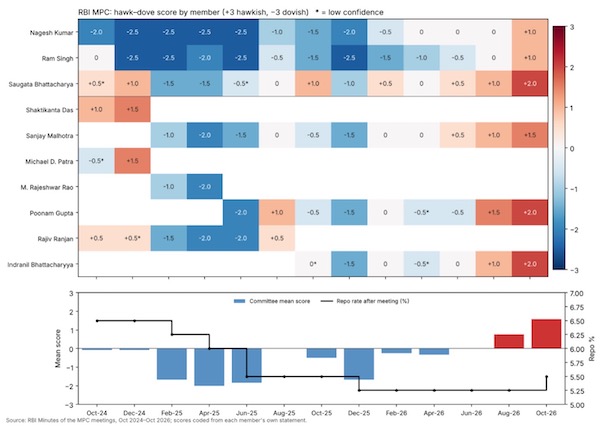
The analysis also reveals persistent differences in individual preferences. Two of the three external members, Nagesh Kumar and Ram Singh, were consistently among the most dovish. Over the past year, during which the MPC’s composition remained unchanged, Singh’s average score was −0.86 and Kumar’s −0.43. Both cast every pro-cut dissent and pushed for an accommodative stance three times after the committee had returned to neutral.
External members, however, were far from a homogeneous group. Saugata Bhattacharya emerged as the most hawkish member, averaging +0.57 over the same period, compared with +0.14 for the most hawkish internal members, Indranil Bhattacharyya and Governor Malhotra.
Bhattacharya’s hawkishness was evident well before the committee’s broader shift. He favoured a smaller cut in June 2025, argued in October 2025 that “I do not see the need for a policy easing”, and warned in February 2026 that inflation “risks… are accumulating”. His early hawkishness illustrates why the distribution of individual preferences matters as much as the committee average: concerns about inflation may first emerge among a few members before gaining wider acceptance.
Rising inflation and its increasingly broad-based nature strengthened the case for tightening in October. Headline CPI inflation reached 4.8% in August 2026, with the RBI projecting inflation of 6% in Q3 and 5.7% in Q4 of 2026–27. The share of CPI items experiencing inflation above 4% rose from 20% in March to 37% in August.
Yet evidence of inflation persistence remains mixed. Core inflation excluding precious metals was just 2.9% in August. A broadening of price pressures does not necessarily imply persistence, particularly when supply shocks drive increases across sectors. The MPC acknowledged limited evidence of demand pressures and uncertainty over whether cost pass-through represented genuine second-round effects.
This creates the central policy dilemma: should the RBI act pre-emptively against the risk of persistent inflation or wait for clearer evidence that temporary supply shocks are generating sustained price pressures?
The October minutes show that members assess this trade-off differently. Indranil Bhattacharyya highlighted broadening price pressures and the risk of waiting too long to tighten. Saugata Bhattacharya pointed to input-cost pressures and evidence of pass-through to prices. Poonam Gupta, dovish as recently as June 2026, acknowledged that inflation was substantially supply-driven, with limited evidence of entrenchment, but supported pre-emptive action because monetary policy operates with a lag.
The concern about the consequences of doing too little has gained ground across the committee. Supporting a hike, however, does not require believing that inflation is already entrenched.
Agreement on direction, not duration
The disagreement over the policy stance reveals the limits of this convergence. Nagesh Kumar and Ram Singh supported the rate hike but opposed calibrated tightening. Their dissent reflects different assessments of two possible policy errors.
The dissenters appear more concerned about over-tightening, which could unnecessarily weaken demand, investment and growth if inflation remains predominantly supply-driven. The four members supporting calibrated tightening place greater weight on the risk of under-tightening: delayed action could allow inflation expectations and second-round effects to become entrenched, requiring more aggressive tightening later.
The disagreement also concerns communication. While a repo rate hike directly affects monetary conditions, a change in stance influences expectations about future rates. Kumar and Singh were not necessarily opposing another hike; they were reluctant to signal a prolonged tightening path.
The committee has therefore converged on the direction of policy without reaching consensus on its intensity or duration. This distinction underlines the value of reading individual statements alongside formal voting records.
The October minutes suggest that another rate hike in December is a distinct possibility. Uniformly hawkish sentiment scores, broader price pressures and the RBI’s inflation projections strengthen the case for further tightening. However, the split over the policy stance suggests that an extended cycle is not assured.
The 4–2 vote reveals reservations about committing to a prolonged sequence of hikes, reflecting differing assessments of the risks of acting too late and tightening too much. A pause would remain consistent with calibrated tightening if incoming data showed inflation moderating or suggested that the effects of earlier tightening needed more time to emerge.
A decade into India’s inflation-targeting regime, the latest MPC deliberations illustrate both the value of transparent policymaking and the difficulty of calibrating monetary policy under uncertainty. The committee has turned hawkish, but differences remain over the path ahead. Its challenge will be to prevent supply-driven inflation from becoming entrenched without unnecessarily constraining economic activity.
*Views expressed here are personal.
.png)