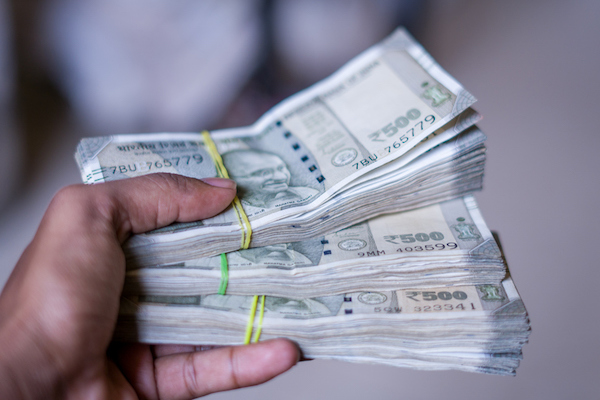
Indians working abroad sent home $42.9 billion between April and June 2026, which is $9.7 billion more than in the same quarter of 2025, a rise of 29%, according to Reserve Bank of India balance of payments data released on September 1. This followed $43.5 billion in January-March. Quarterly receipts had never crossed $40 billion before 2026. They have now done so twice in succession.
In rupee terms, the increase was sharper. Private transfer receipts, a slightly broader RBI measure, reached ₹4.14 trillion, against ₹2.91 trillion a year earlier, according to the September 2026 RBI Bulletin. That represents a 42% increase in rupee terms, compared with 29% in dollars, reflecting the rupee’s depreciation.
Both quarters came after the West Asia conflict began on February 28. The 29% increase in remittances is striking in a period of regional disruption. The government’s April 20 briefing reported that Kuwait’s airspace was closed and flights from the UAE were operating on limited non-scheduled services. One possible explanation is that workers transferred savings home because they feared losing their jobs. But aggregate remittance figures cannot establish that motive, or show how much of the increase originated in the Gulf. India is recording a surge in money received, but some of it may represent workers drawing down savings rather than a durable increase in earnings.
The Numbers
The Ministry of External Affairs lists 9.93 million non-resident Indians in the six Gulf Cooperation Council countries as of January 2026, representing 56% of the 17.76 million NRIs worldwide.
The RBI’s latest remittance survey, covering 2023-24, found that the GCC countries accounted for 38% of India’s remittances. The UAE was the second-largest source, contributing 19.2%, after the US at 27.7%. The survey also found that Indian migrants in the UAE worked mainly in blue-collar jobs, led by construction, followed by healthcare, hospitality and tourism. These sectors are particularly exposed when projects stall, travel is disrupted and employers cut back.
Yet the RBI publishes remittances by source country only through periodic surveys, six of which have been conducted since 2006. India therefore does not yet know how much of the 2026 surge came from the Gulf, making it difficult to distinguish a broad-based increase in overseas earnings from a temporary transfer of savings.
The April-June quarter was weak on almost every other major line of the balance of payments. The merchandise trade deficit widened to $86.1 billion from $68.9 billion. Foreign portfolio investors withdrew a net $9.6 billion, compared with an inflow of $1.6 billion a year earlier.
Despite these pressures, the current account deficit remained at $4.2 billion, or 0.5% of GDP. The increase in remittances provided a substantial cushion. The $9.7 billion rise in personal transfers almost matched the $9.6 billion withdrawn by portfolio investors. Had personal transfers remained at their year-earlier level, and all other items stayed unchanged, the current account deficit would have been about $13.9 billion, more than three times the reported figure.
Net private transfers of $41.0 billion covered 48% of the quarter’s merchandise trade deficit, according to the RBI Bulletin. The RBI estimates that net remittances financed about 42% of the trade deficit, on average, between 2010-11 and 2023-24, excluding the pandemic year. RBI economists describe remittances as “an important absorber of external shocks”. In 2026, they absorbed more than their usual share. But the strength of the inflow should not be confused with proof that the workers generating it are secure.
The experience of the last Gulf shock offers a warning. Remittances contracted by 3.6% in 2020-21, with the RBI linking the fall in Gulf inflows to the mass return of contractual migrant workers. Kerala’s share of India’s remittances fell from 19.0% in 2016-17 to 10.2% in 2020-21. Karnataka’s share dropped from 15.0% to 5.2%.
Migration also collapsed. Emigration clearances for workers travelling to the 18 Emigration Check Required (ECR) countries fell from 368,049 in 2019 to 94,145 in 2020, a decline of 74%, according to information provided by the Ministry of External Affairs to the Lok Sabha. Kerala eventually recovered. Its share of remittances rose to 19.7% in the 2023-24 survey, second only to Maharashtra at 20.5%.
The 2026 figures may capture the first stage of another shock. Workers can transfer accumulated savings home before their employment situation deteriorates. The loss of wages, by contrast, unfolds over time and may not show up in quarterly remittance data until later. That distinction matters because a one-off transfer of savings cannot indefinitely replace a lost income stream.
The Blind Spot
The government’s inter-ministerial briefing of April 20, issued through the Press Information Bureau, quoted a Ministry of External Affairs update: “Since 28 February, around 11,30,000 passengers have travelled from the region to India.”
That is a passenger count, not a count of displaced workers. Tourists, students, transit travellers and workers returning on leave are included alongside people who may have lost their jobs. No official series separates these groups.
The eMigrate system records departures by workers holding ECR passports for 18 countries. In 2023, it issued 398,317 clearances, 95% of them for the six Gulf states. But there is no equivalent published count of workers returning home. In August 2024, the Ministry told the Lok Sabha that workers who had not obtained the required clearances were not reflected in its database.
The gap is stark: the government knows how much money arrived in a quarter, but not how many Indian workers stopped earning in the Gulf. This is a policy failure, not merely a statistical inconvenience. A worker who returns without a job must draw on household savings, local credit and, eventually, possibly state welfare support. Such pressures are harder to anticipate when the number of returning workers and the reasons for their return remain unknown.
Two changes would help close this gap. The first is a return module in eMigrate, recording the date and reason for a worker’s return against the original departure record. The second is for the RBI to publish quarterly remittance data by source country, rather than relying on surveys conducted only every few years.
There is, however, a strong counter-argument to the warning. India’s remittances are no longer as dependent on the Gulf as they once were. Advanced economies accounted for more than half of India’s remittances in 2023-24, according to the RBI survey. The US share rose to 27.7%, from 22.9% in 2016-17, while the UK share climbed to 10.8%, from 3.0%. A Gulf slowdown would therefore affect a smaller proportion of the national total than it did in 2020.
That is true at the aggregate level, but it obscures the uneven distribution of the risk. The RBI survey draws a clear distinction between Indian migrants in the US, who work mainly in white-collar jobs, and those in the UAE, who are concentrated in blue-collar employment. Higher salary transfers from the US do little for a household in Kerala that has lost the wages of a construction worker in Dubai.
There is another uncertainty that tempers the argument: remittances were rising before the conflict. Personal transfers grew by 11% in July-September 2025 and 5% in October-December 2025. Growth then accelerated to 28% in January-March 2026, a quarter with only one month inside the conflict period. The surge cannot therefore be attributed entirely to the war.
Even so, the scale of the latest increase stands out. If April-June receipts had grown at the pre-war high of 11%, they would have reached about $36.9 billion. The remaining $6 billion is the portion that the earlier growth trend does not explain. It is not proof of precautionary transfers, but it is a reason to investigate whether the conflict changed how much money workers sent home.
The RBI’s balance of payments data for July-September 2026 will provide the next test. If personal transfers remain close to $43 billion while workers continue to return, the surge may reflect durable earnings, and the warning offered here will need to be reconsidered. If transfers fall towards pre-conflict levels, India could lose an inflow that helped offset portfolio outflows in the first quarter.
India’s record remittances are a source of resilience, but they are not an unqualified windfall. Some of the money may be the savings of workers who fear losing the jobs that generated it. A country that counts the money but not the people behind it risks recognising the second stage of the shock only after it has arrived.
.png)