.png)


Sharmila Chavaly, a former civil servant who held key roles in the railways and finance ministries, specialises in infrastructure, project finance, and PPPs.
September 18, 2026 at 6:32 AM IST
Anil Kakodkar, the man who helped build India’s nuclear programme, has recently reiterated what he’s said before: don’t wait for fast breeders to scale before you start using thorium. Don’t treat it as a distant Stage 3 goal that depends on fast breeders maturing first.
The occasion for his intervention: India had reached a key milestone on April 6, 2026, when the 500 MWe Prototype Fast Breeder Reactor at Kalpakkam achieved first criticality — a controlled, self-sustaining nuclear chain reaction. It marked India’s entry into the second stage of its three-stage nuclear programme, the bridge to a thorium-powered future that Homi Bhabha had envisioned in the 1950s.
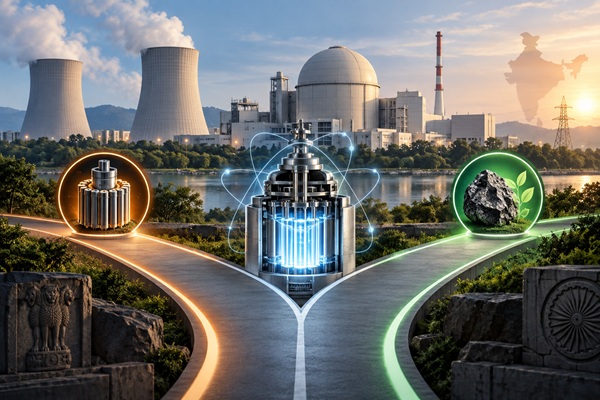
Kakodkar has advocated introducing thorium-based fuel into India’s existing fleet of pressurised heavy water reactors to accelerate the use of the country’s abundant thorium reserves, while continuing in parallel with the three-stage nuclear programme.
His reasoning is blunt: the answer is not to wait for the three-stage thorium programme to mature. Globally, planned nuclear energy capacity by 2050 is roughly double what known uranium resources can sustain in once-through mode, and India, as a late and price-sensitive buyer, will feel the strain within 10–15 years. His proposal is to introduce thorium into PHWRs now, reducing uranium consumption per unit of electricity rather than increasing it.
His proposed fix: HALEU-thorium fuel. HALEU - high-assay low-enriched uranium -can be blended with thorium and dropped into existing PHWRs with “no significant design changes.” The thorium converts to U-233, a fissile material, while uranium consumption falls.
And that is the trigger for this piece. Not the PFBR milestone alone, but the question his argument raises: is India sequencing its thorium future correctly?
The Global Race
The global fast reactor race is no longer hypothetical. Russia’s BREST-OD-300 is under construction. China’s CFR-600 came online in 2023. Japan’s government is weighing in on a new fast breeder reactor, with a decision expected in 2028 . After decades of stagnation, the technology that once defined nuclear ambition is back on the agenda. India joined this group without fanfare, but the hard part is just beginning.
The gap between a reactor that works and a reactor that powers a nation is measured in years of operation, fuel cycle infrastructure, and political will.
This article argues that the PFBR’s real significance lies not in what it proves technically, but in what it obliges India to do next. And Kakodkar’s intervention suggests the answer may not be the one the programme has assumed for seventy years.
Why India Took the FBR Path
For India, the fast breeder reactor is not about being a superior power plant. It serves one unique strategic function: making fuel.
The logic begins with geology. India holds about 25% of the world’s thorium reserves, roughly 846,000 tonnes, making it the largest holder globally. These reserves are concentrated in monazite-rich beach sands along the coasts of Andhra Pradesh, Tamil Nadu, Odisha, Kerala, West Bengal, and in Jharkhand.
By contrast, India holds less than 2% of global uranium reserves and imports over 70% of its uranium.
The three-stage programme was designed to overcome this asymmetry. Stage 1 heavy water reactors produce plutonium. Stage 2 fast reactors use that plutonium as fuel while a blanket of thorium-232 or uranium-238 surrounds the core. Fast neutrons transmute that blanket into fissile uranium-233 or plutonium-239. Only then can Stage 3 run thorium-based reactors at scale.
Without the fast reactor, India’s vast thorium reserves remain a geological fact rather than a fuel source. In thermal-spectrum reactors, thorium breeding has a doubling time far too long to support national-scale expansion. Only a fast spectrum can multiply uranium utilisation by over 60 times, enabling a truly sustainable nuclear system from limited domestic uranium.
And that is why India chose the FBR path. The alternative, of importing uranium and running an open fuel cycle would mean abandoning energy autonomy, which is both difficult and imprudent.
Kakodkar’s argument does not reject this logic. It challenges its sequencing. The FBR remains necessary for the long run. But if thorium can be introduced into PHWRs now - with HALEU as the driver - India need not wait for the fast breeder ecosystem to mature before it begins converting its thorium into usable fuel. The two tracks can run in parallel.
That parallel track is not uncontested: in January 2026, three BARC scientists published a study concluding that HALEU-thorium fuel is "far from a drop-in option." Their concern was safety: thorium, they found, interferes with the rods used to shut a reactor down, making them roughly a quarter less effective. The fuel also produces far less plutonium - the material Stage 2 depends on to breed more fuel.
Kakodkar rejected the findings as misleading. And the US firm behind ANEEL (Advanced Nuclear Energy for Enriched Life), a thorium-HALEU fuel designed as a drop-in replacement for natural uranium in PHWRs, published a peer-reviewed rebuttal arguing that the BARC analysis modelled a generic fuel rather than its proprietary design, and safety margins remain adequate.
Neither side has irradiated ANEEL in an Indian PHWR. The debate has stayed unresolved.
What Deserves Credit
The PFBR is indigenously designed and built: designed by the Indira Gandhi Centre for Atomic Research, with construction by the public-sector BHAVINI. Domestic manufacturing content is nearly 90%.
From reactor physics and sodium technology to materials and fuel handling, India has built a complete capability set. That is no small thing, as very few countries can design and build a commercial-scale sodium-cooled fast reactor.
The achievement is real. But so are the sixteen years of delay, and what they say about what comes next.
What Demands Caution
The time and cost overruns have been severe. Construction began in 2004 with a 2010 target. Criticality arrived at least 16 years late, in April 2026, and the reactor is still not generating electricity for the grid. Final cost exceeds ₹81.81 billion, more than double the original sanction.
Criticality is not electricity. The reactor must now undergo power ascension, turbine synchronisation, and full-power operation. Official information indicates power ascension and grid connection are expected to begin around December 2026, with full commercial operation possibly by late 2026 or early 2027.
The Fast Reactor Fuel Cycle Facility, the real bottleneck, is over a decade late. Originally scheduled for 2014, it is now projected for December 2029. Without it, the fast reactor’s closed fuel cycle remains theoretical.
This is where the argument for speeding up the use of thorium gains force. If the FBR path is this slow - and the FRFCF is the binding constraint - then waiting for Stage 2 to mature before touching thorium means waiting decades. India’s uranium supply strain, on this timeline, arrives sooner.
A Regulatory Weakness That Keeps Being Flagged
Alongside, if the fuel cycle is the physical bottleneck, the regulatory structure is an institutional one. India’s nuclear regulator is not independent of the body it regulates. The Atomic Energy Regulatory Board sits under the Department of Atomic Energy, which also runs the nuclear programme. The same institutional chain that pushes reactors forward also houses the body meant to hold them back when safety demands it.
This complaint has been raised in Parliament, in academic literature, and by former regulators. A regulator dependent on the promoter for budget, staffing, and administrative existence is structurally compromised, even if the individuals involved are professionally impeccable.
The problem sharpens now. The PFBR is entering a phase where operational safety decisions - power ascension rates, sodium leak response, fuel handling - will have real consequences. At the same time, the government is opening the sector to private participation and pushing Small Modular Reactors. New players, new designs, new supply chains, all of which demand a regulator with genuine autonomy. Until that changes, PFBR’s success will rest more on individual competence than on a system designed to catch failures before they become accidents.
The Comparative Picture
Russia is currently the only country operating commercial-scale fast reactors. The BN-600 has run for decades; the BN-800 is burning MOX fuel; the BN-1200M is planned.
China is moving quickly. The CFR-600 fast reactor was connected to the grid in 2023, with a design thermal efficiency of 41% and breeding ratio of about 1.1. China also has a separate thorium molten salt reactor experiment underway.
India’s PFBR has a breeding ratio of only 1.03–1.05 and a doubling time approaching 30 years. Even if everything goes smoothly, the scale-up of fast reactors will be very slow.
A 30-year doubling time is not a sprint. It is a generational commitment. Kakodkar’s proposal offers a way to hedge against that slowness - by starting thorium irradiation in PHWRs now, rather than waiting for the FBR fleet to produce enough surplus fissile material to seed Stage 3.
Milestone Status Since April
No publicly announced operational milestone has been missed in the months since criticality. But that is not the same as smooth sailing - it means the hard milestones are still ahead.
One positive signal: in May 2026, BHAVINI requested that Tamil Nadu expedite commissioning of two 230 kV transmission lines, needed to meet nuclear safety requirements for redundant offsite power. Grid preparation is moving (though the state load dispatch centre delayed line charging on “commercial issues,” prompting the Southern Regional Power Committee member-secretary to note that commercial matters should not be tied to operational needs, given the PFBR’s national importance).
One detail worth noting: every other nuclear programme announces power ascension schedules (the step-by-step timelines). India has not. That silence is evidence enough.
Ideal Milestones
Drawing on what experts have suggested, if India wants the three-stage plan to become real, these milestones would need to be met:
- December 2026: PFBR begins phased power injection to the grid
- Early 2027: Full-power commercial operation
- 2029: FRFCF commissioned, closing the fuel cycle
- Early 2030s: FBR-1 and FBR-2 construction begins
- Before 2035: At least one fast reactor completes a full fuel cycle, demonstrating breeding
- 2040s: Thorium blanket validated in a fast reactor, producing U-233 for Stage 3
Kakodkar’s argument suggests a parallel set of milestones, running alongside these:
- Near-term: HALEU-thorium fuel qualification for existing PHWRs
- Within 10–15 years: Thorium irradiation begins in the PHWR fleet, producing U-233 while stretching uranium supplies
- Continuous: FBR ecosystem matures in parallel, rather than as a precondition
Without these milestones, criticality remains a scientific event, not an energy event.
The Bottom Line
The PFBR criticality is a hard-won engineering milestone which proves India can build a fast reactor but it does not yet prove India can run a fast reactor economy.
Kakodkar’s intervention asks a harder question. India has spent seventy years assuming that thorium must wait until fast breeders scale. What if that assumption is now the obstacle? The FBR remains necessary for the long run. But if thorium can be introduced into PHWRs now with HALEU as the driver, then the real issue is not whether India can build a fast reactor, but whether it can afford to wait for one before touching the fuel it has in abundance.
So while the physics has been demonstrated, the industrial system - reprocessing, fuel fabrication, regulatory independence, scale - remains the real test, with telling silence on power ascension schedules. The man who helped build the programme is now asking whether its sequencing still makes sense - a question which may matter more than the milestone that prompted it.
More From BasisPoint