The 2014 general election was historic in more ways than one. It did not merely mark another change of government through the ballot box. It also signalled a palpable demographic awakening.
For decades, India’s electoral landscape had been shaped by entrenched loyalties, caste fault lines and regional identities. The 2014 election opened a new front. A surge in participation among first-time and under-25 voters rewired political calculations, setting a trend that later found expression in several state elections.
It was a generational vote for the promise of better governance, economic mobility and institutional integrity. It represented unprecedented faith in the ballot box as the ultimate lever of change.
The data reflected that enthusiasm. During the 2014 Lok Sabha election, Lokniti-CSDS studies recorded turnout among voters in the 18–22 age group at an impressive 68%. For the first time, this exceeded the national average of 66.4%.
It was also a jump of nearly 10 percentage points from 2009, when youth participation was estimated at around 58%. India’s young voters had arrived at the polling booth, signalling a robust willingness to participate in nation-building.
Creeping cynicism
Politics has often been described as the theatre of the absurd. The description increasingly fits the recurring paralysis gripping both Houses of Parliament. The larger concern is that the political ecosystem may be betraying the very demographic that every political party so energetically claims to court.
Citizens are repeatedly made to witness legislative gridlock being sold as political triumph. The Congress and other opposition parties claim a tactical victory whenever a session is washed out, arguing that disruption is sometimes necessary to prevent the government from bulldozing legislation without adequate scrutiny.
The ruling dispensation, for its part, laments the obstruction and argues that the opposition’s refusal to allow Parliament to function denies the country legitimate debate, wastes taxpayers’ money and impedes national progress.
Both sides claim to be fighting for the soul of democracy. But in this high-stakes game of political brinkmanship, it is the voter, especially the young and aspirational voter, who is left disappointed.
The trust, hope and expectations that young people invested in the political class a decade ago are receding. There are signs of growing anger, anguish and cynicism, from recurring student protests to weak first-time voter registration ahead of the 2024 Lok Sabha election.
Election Commission of India data showed that only about 38% of eligible first-time voters in the 18–19 age group had registered. Roughly 18 million out of an estimated 49 million eligible young citizens enrolled to vote.
A closer look at state-level registration paints an even grimmer picture in politically critical and youth-heavy regions. In Bihar, only 17% of these young voters registered. In Delhi, the figure stood at 21%, while Uttar Pradesh and Maharashtra recorded 23% and 27%, respectively.
This cannot be dismissed as mere laziness. At the least, it signals a deeper estrangement from political institutions among a demographic that CSDS-Lokniti surveys have repeatedly shown to prioritise tangible economic outcomes and institutional integrity over inherited partisan loyalties.
Institutional retreat
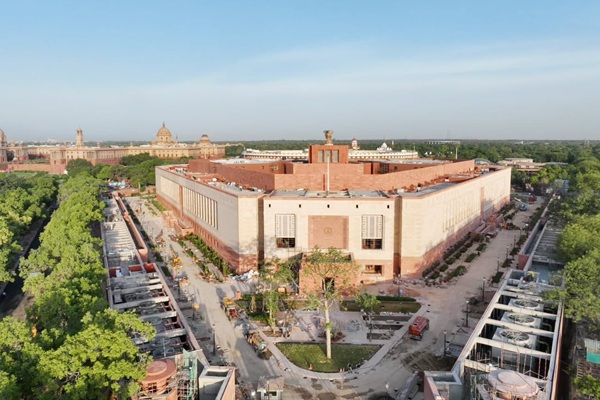
To understand the depth of this crisis, one must examine the blurring of lines between two indispensable arenas of Indian democracy, the Sansad, or Parliament, and the Sadak, or street.
Parliamentarians have increasingly imported the methods of street protest into the country’s highest legislative institution, making the Sansad resemble the Sadak. Yet the two cannot substitute for each other because both perform distinct and indispensable democratic functions.
The street represents the voice of public dissent, exercised peacefully and within constitutional bounds. It is the arena to which unheard citizens turn when other institutional channels appear exhausted. It allows people to aggregate, articulate grievances and demand that those in power listen.
Parliament, by contrast, is the arena of reasoned debate, deliberation and dialogue over policies that can make or break a nation. Parliament is not merely a scorecard where numerical strength decides every question. It is supposed to be a forum where nuance, scrutiny and persuasion prevail.
A healthy democracy requires the Sadak and the Sansad to remain in balance, with each serving the Constitution in its own way. The perilous shift occurs when the Sansad becomes the Sadak while Parliament is in session.
Over recent Lok Sabha terms, legislative productivity has frequently plummeted during critical monsoon and winter sessions because of persistent disruptions. Several sessions have recorded less than 45% of their scheduled working time, while critical Bills have been passed with minimal or entirely absent floor debate.
When the floors of Parliament are reduced to arenas for sloganeering, placard-waving and rushing into the Well of the House, the legislative process is fundamentally subverted. It is one thing to protest against a contentious Bill. It is quite another to institutionalise disruption as a daily substitute for debate.
This institutionalisation of disruption is reinforced by a problematic intellectual tendency to romanticise street politics. Activists and political commentators, including Yogendra Yadav, have argued in different contexts that when institutions fail, politics must return to the street.
Mass movements certainly have a historic place in correcting the course of democracies. But normalising the street as the primary arena of everyday politics risks replacing democratic contestation with permanent mobilisation.
The street can expose a grievance, but it cannot draft a nuanced economic policy. It cannot construct a complex national-security framework or legislate delicate social reform. Those tasks require negotiation, expertise, compromise and sustained parliamentary scrutiny.
For young Indian voters, this deliberate blurring of institutional roles is profoundly disillusioning. They operate in a hyperconnected and brutally competitive global environment in which outcomes matter. When they look to their elected representatives to formulate the laws that will shape their futures, they expect statecraft. They do not expect a localised street brawl dressed up in parliamentary privilege.
The danger is not merely that a session is washed out or that a handful of Bills are delayed. The larger danger is the systemic, perhaps irreversible, alienation of the electorate.
Should this disillusionment continue to fester, the under-25 demographic, which forms the backbone of India’s much-touted demographic dividend, may increasingly turn away from the electoral process. The risk is the emergence of a generation indifferent to voting as a democratic instrument, and of a large cohort that views the political class as self-serving rather than citizen-centred.
A democracy cannot survive on the fumes of past electoral enthusiasm. It requires the continuous, active and hopeful participation of its citizens. The political establishment, across the partisan divide, must recognise that its current zero-sum game is Pyrrhic.
A victory claimed over a paralysed Parliament is a defeat for the Republic. It is time to restore the sanctity of the Sansad and allow the Sadak to remain what it should be, a legitimate constitutional outlet for citizens, not a substitute for legislative work.
The young Indian voter is watching, but that voter’s patience is not infinite. Unless political leaders course-correct and return to the hard, unglamorous work of parliamentary debate, they may soon find themselves presiding over an electorate that has quietly and tragically walked away.
.png)