.png)

Anatomy of an Upset in a Bastion: Top 10 Reasons Why BJP Lost Bankipur
How Prashant Kishor breached a BJP stronghold held for three decades, turning voter fatigue, local grievances and a weak candidate into one of Bihar’s biggest political upsets yet.
Amitabh Tiwari, formerly a corporate and investment banker, now follows his passion for politics and elections, startups and education. He is Founding Partner at VoteVibe.
August 4, 2026 at 12:16 PM IST
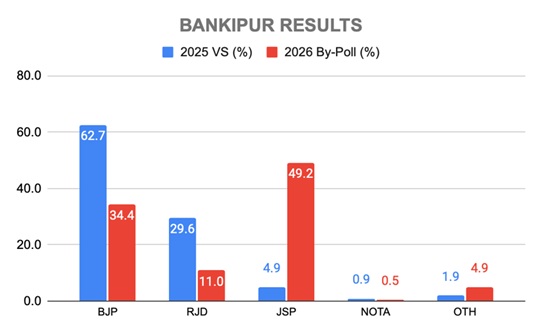
For three decades, Bankipur was a safe seat for the BJP in Bihar. The party had held it uninterrupted since 1995, and Nitin Nabin had turned it into a personal fortress, winning it four times in a row — most recently in the November 2025 Bihar Assembly election with a thumping margin of more than 51,000 votes and a 63% vote share.
So, when the seat fell vacant after Nabin's elevation to the Rajya Sabha, few gave Jan Suraaj founder Prashant Kishor — contesting his first-ever election — a realistic shot at breaking the BJP's grip. Yet on August 3, 2026, Kishor won by close to 19,000 votes, defeating the BJP's Neeraj Kumar Sinha, with the RJD's candidate trailing in a distant third. The result has been read as one of the most symbolically important upsets in recent Bihar politics.
Here is why it happened.
1. The fatigue factor
Bankipur voters had elected the same party, and largely members of the same family — Nitin Nabin and, earlier, his father — for thirty straight years. Even loyal constituencies eventually crave a change of face. The low turnout also suggests that a large chunk of habitual BJP voters simply didn't feel compelled to show up to defend a seat they had never seen slip.
2. Civic issues at the wrong moment
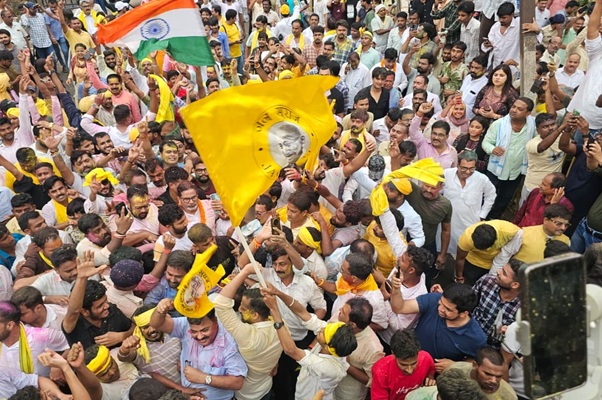
Bankipur is a dense, urban central Patna seat, and municipal-level irritants — waterlogging, garbage, traffic and drainage — tend to be felt acutely by voters here. These everyday civic complaints surfaced just as the BJP-led NDA was trying to project its "double engine sarkar" narrative. Civic failure in the state capital's own backyard — and in the constituency previously represented by the BJP national president — undercut the double-engine pitch.
3. The quality of the candidate
The BJP's ticket saga did it no favours. Its original nominee, Abhishek Kumar "Bunty" Sinha, withdrew abruptly, citing family reasons, forcing the party to field 32-year-old grassroots worker Neeraj Kumar Sinha at the eleventh hour. Sinha was a committed organisational hand — having served as booth president, mandal general secretary and Yuva Morcha district president — but he was a first-time candidate with a comparatively low public profile, up against Prashant Kishor, arguably India's most recognisable political strategist, making his personal electoral debut. The contrast in name recognition and campaign command was stark.
4. Discontent among the youth
Bankipur's urban, aspirational, often first-time-voter demographic has long been a constituency Kishor has specifically courted with his talk of employment, migration and education reform. These themes dominated his Jan Suraaj campaign even in its unsuccessful 2025 statewide debut. In the aftermath of the CJP protests in Delhi, which also resonated in Bihar, young voters appeared increasingly dissatisfied with the NDA governments at the Centre and in the state and opted for a change. Almost 28% of voters in the constituency were in the 18-29 age group, and more than 60% seem to have backed JSP, according to local reports, cutting across caste and religious lines.
5. Unease among upper-caste voters over policy issues
Sections of the upper-caste electorate — a significant bloc, accounting for around 36% of voters in Bankipur — have reportedly expressed disquiet over how certain policy debates and controversies, including UGC norms, the encounter of Bharat Tiwari and paper leaks, have been handled. Even a section of the Kurmi community expressed displeasure over the removal of Nitish Kumar from the CM post.
6. Brahmins eyeing a route back to relevance through PK
Prashant Kishor himself is a Brahmin, and analysts have suggested that sections of the community — which have often felt under-represented in the top leadership calculus of both the NDA and the Mahagathbandhan in Bihar — saw his candidacy as an opportunity to back one of their own with a plausible shot at greater political relevance.
7. A "low-stakes" seat, ideal for sending a message
Bypolls don't decide governments. That makes them a relatively safe venue for otherwise loyal BJP voters to register dissatisfaction — over ticket distribution, local governance, or anything else — without risking the party's actual hold on power in Patna. A single-seat protest vote carries none of the consequences of a general election verdict. Bankipur may have functioned as exactly that kind of pressure valve. More so after the government relented to student demands following the CJP protests, loyal supporters may have felt that a Bankipur bypoll defeat would send a message without threatening the NDA government's survival.
8. The failure to counter a damaging "taking voters for granted" narrative
JSP pushed a narrative that the BJP had become arrogant and believed it could field virtually anyone and still win. That helped create the impression that the party was treating both the contest and its voters casually. The narrative appears to have gained traction during the campaign: that Bankipur was being taken for granted rather than fought for.
9. Muslim-Yadav consolidation shifting toward Jan Suraaj
Some of the MY (Muslim-Yadav) vote that would traditionally anchor the RJD appears to have moved toward Jan Suraaj in this particular contest — plausibly a tactical choice to back whichever non-BJP candidate looked most capable of winning, given the RJD's own organisational weakness in this specific urban seat. That the RJD finished a distant third, well behind both Kishor and the BJP, supports the idea of an anti-incumbent vote consolidating around Jan Suraaj rather than splitting.
Muslim voters have often shown a willingness to consolidate behind the candidate seen as best placed to defeat the BJP. Sections of Yadav voters may also have taken the risk of moving away from the RJD, though to a lesser extent, despite the party facing an increasingly difficult political moment.
10. A leadership vacuum in the post-Nitish-Lalu era
Finally, Bankipur played out against the backdrop of Bihar's slow generational transition away from the Nitish Kumar-Lalu Prasad duopoly that has defined state politics for two decades. With both stalwarts aging and succession questions unresolved on both sides, voters — especially in politically engaged urban seats — appear more willing to experiment with alternatives like Jan Suraaj, testing whether a credible third force can fill the space opening up. BJP’s Samrat Chaudhary and RJD’s Tejashwi Yadav have not yet established themselves as bearers of the Nitish-Lalu legacy. Prashant Kishor has thrown his hat into the ring in a state staring at a leadership vacuum.
No single factor fully explains the loss of a seat the BJP had never lost in thirty years. It was a convergence: local grievances, a compromised candidate-selection process, caste-specific unease, a formidable and highly visible opponent, and the peculiar dynamics of a low-turnout bypoll that made protest voting relatively cost-free. For the BJP, Bankipur is a warning sign rather than a structural threat — but warning signs in a party's own bastion can’t be ignored.
A few claims would also benefit from strong sourcing before publication, particularly the 28% youth share, “more than 60%” youth support for JSP, 36% upper-caste share, caste-wise movement to Jan Suraaj, and assertions about the CJP protests influencing Bankipur voters. Those are stronger empirical claims than the rest of the political analysis.
More From BasisPoint