There are people who are impressively organised. Their bills are paid before they are due, their investments are monitored, their calendars are colour-coded and their children’s schedules are known with the precision of an air-traffic controller. They remember car servicing, school deadlines, passport renewals and the birthdays of people they haven’t spoken to in twelve years. At work, a document placed in the wrong folder can produce a level of distress normally reserved for a national emergency. Then they come home, read the newspaper and spend the next several hours quietly dismantling it across the house.
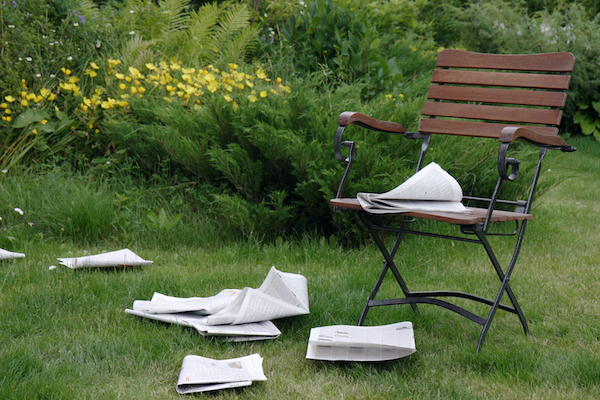
The front page remains on the sofa. The business pages migrate to the dining table. The sports section turns up near the bed. A supplement disappears altogether, usually to be discovered inside another newspaper three days later. The neatly folded object delivered by the newspaper boy has been reduced to a collection of loose sheets living independent lives. Nobody has consciously made this mess. That is the beauty of it. It has happened without anyone being responsible.
The breeze is often given the job.
This is convenient because the breeze cannot defend itself.
It is also a remarkably selective breeze. It never seems to scatter the important papers. Bank statements remain where we put them. Property documents are safely filed. The child’s school report is unlikely to be found under a cushion. Only the newspaper is apparently vulnerable to atmospheric conditions.
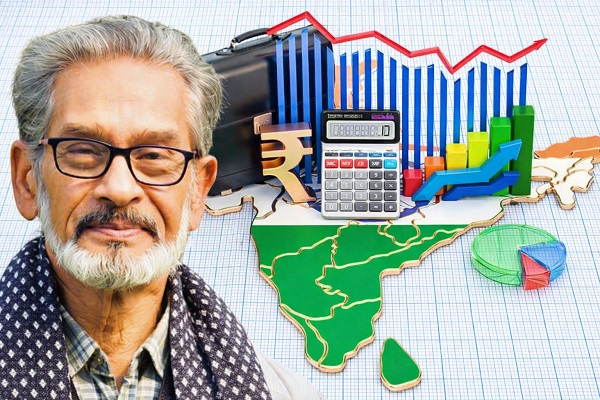
The amusing part is that the person responsible may be extraordinarily disciplined. He will notice a discrepancy of ₹700 in an expense account. He will complain if the driver arrives eight minutes late. He will know exactly when the car needs servicing and precisely how much the mutual fund has gained this quarter. He may spend ten minutes adjusting the cushions before guests arrive. Yet a newspaper page lying beside his chair for an entire afternoon will acquire the invisibility of a wall.
This is because we are not really untidy people. We are selectively attentive people. We notice what has consequences. We notice what costs money, threatens reputation, interrupts plans or might be mentioned by somebody else. The newspaper does none of these things. It is therefore granted the rare privilege of being completely ignored.
Modern life has made us extraordinarily good at responding to things that can be measured. We count money, steps, calories, followers, meetings and screen time. We track deliveries to the minute. We become irritated when a cab is two minutes away instead of one. Yet the small evidence of our own disorder can sit within arm’s reach for six hours without generating a single internal alert.
There is a whole domestic economy built around things we intend to put away later. The charger remains in the socket because it will be needed again. The empty bottle stays on the bedside table because someone might want it. The chair becomes a wardrobe because putting clothes into a cupboard requires a level of commitment that the chair does not demand. A cupboard door remains slightly open for years. Nothing is broken enough to repair and nothing is inconvenient enough to fix.
The newspaper belongs perfectly to this world.
For many middle-aged Indians, this is also a relic from a time when newspapers mattered differently. The paper arrived in the morning with the seriousness of a household institution. Someone opened it first. Someone claimed the business pages. Someone wanted sport. Someone else wanted the matrimonial pages, where entire families once conducted demographic research over breakfast. The paper travelled through the house in a recognisable sequence and eventually became useful for wrapping something, lining a shelf or protecting the floor during painting.
It had a lifecycle.
Now the news arrives on our phones before the newspaper reaches the gate. We know what happened in the markets, in Parliament, in Washington and on Instagram before we have finished our first cup of tea. Artificial intelligence can summarise the day’s events before we have unfolded the first page. Yet the physical newspaper survives in many middle-aged homes because habits have longer lives than technology.
And perhaps that explains the casualness with which we treat it. The newspaper is no longer important enough to protect and not useless enough to discard. It occupies the domestic category of things that are permanently “there”. Like the old remote, the extra key, the mysterious cable nobody knows the purpose of but nobody dares throw away.
We are collections of priorities, blind spots and temporary arrangements.
And the things we stop noticing can tell us as much about ourselves as the things we carefully manage. We have become obsessed with efficiency, yet much of a life consists of insignificant things that do not reward efficiency. A conversation that goes nowhere. A cup of tea that takes too long. A newspaper read slowly. A friend who calls without having anything particular to say. A page left open because something on it made us think.
Tomorrow morning, the newspaper will arrive neatly folded. We will open it over tea, read what interests us, put one page on the sofa and carry another to the dining table. By evening, the sports section will have vanished and somebody will ask who left the newspaper lying around.
Nobody will know.
.png)