.png)

Gurumurthy, ex-central banker and a Wharton alum, managed the rupee and forex reserves, government debt and played a key role in drafting India's Financial Stability Reports.
April 30, 2026 at 10:26 AM IST
There are moments in public life when policy ceases to be about numbers and becomes something far more primitive: character.
Jerome Powell’s latest post-FOMC press conference was ostensibly about rates, inflation, labour markets, and the calibrated monotony of central banking.
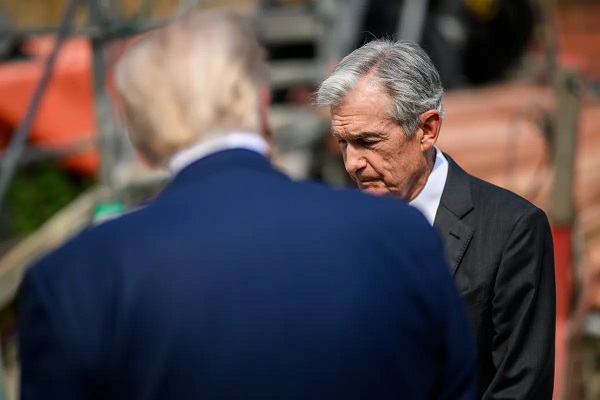
Beneath the spreadsheets and institutional caution, however, lay something deeper: a central banker navigating an increasingly personalised political gauntlet shaped by Donald Trump’s peculiar style of pressure, public ridicule, personal attacks, insinuations of incompetence, and the constant suggestion that institutional independence is merely an inconvenience to political appetite.
Powell’s burden, therefore, is no longer simply inflation. It is the preservation of institutional credibility in a politicised environment.
That burden has now acquired a sharper edge. In what is expected to be his final press conference as chair, Powell indicated that he intends to remain on the Federal Reserve’s Board of Governors until a pending investigation reaches a clear and transparent conclusion. While officials have suggested the matter may not be reopened without internal recommendation, the possibility has not been entirely ruled out. The pressure, in other words, is no longer confined to rhetoric or policy disagreement as it now carries legal and institutional overtones, further raising the stakes of his decision to hold the line.
For years, Donald Trump’s idiosyncratic assaults on Jerome Powell went beyond disagreements over rates, becoming stress tests of institutional dignity. Powell was branded “bonehead”, criticised for not cutting rates fast enough, and cast as a political obstacle rather than a constitutional steward. Yet in his public posture, he chose something increasingly rare in modern governance: restraint without surrender.
That distinction matters because courage is often misunderstood. It is rarely the roaring defiance or theatrical rebellion we tend to imagine, nor is it martyrdom in broad daylight. Institutional courage is frequently quieter as it lies in the discipline to remain within one’s mandate when provoked beyond it, and in the refusal to convert office into ego. Powell’s composure reflects a central banker’s version of stoicism, not reacting emotionally when political theatre demands spectacle.
This is where the real dilemma begins, not in economics but in ethics. Every individual entrusted with constitutional, fiduciary, or moral duty eventually confronts the same temptation, to surrender principle for comfort, to bend rules to preserve position, to please power in order to remain relevant, and to trade integrity for survival.
History is crowded with such bargains. Thomas More chose execution over endorsing what he believed violated conscience and law under Henry VIII; Martin Luther King Jr., writing from Birmingham Jail, argued that moral responsibility transcends obedience to unjust pressure; and Vaclav Havel articulated the idea of “living in truth” under authoritarian absurdity.
The pattern is enduring; worldly power offers safety in exchange for moral compromise. That is why Powell’s challenge, however less dramatic than prison cells or battlefields, remains symbolically resonant. In democracies, institutions rarely collapse through coups; they erode through corrosion as individuals within them begin to rationalise surrender. A central banker bullied into political submission may not appear tragic in cinematic terms, but the constitutional implications are profound; if monetary policy becomes hostage to personal vendetta or electoral urgency, inflation is not the only casualty, credibility is.
In the movie Society of the Snow, the survivors of the Andes disaster confront unbearable ethical dilemmas where survival itself demands choices that rupture conventional morality. The film’s brilliance lies not in sensationalising desperation but in exposing a universal truth: under extreme pressure, human beings discover whether principles are luxuries or anchors.
The mountain, in that sense, is metaphorical (in that movie, the Andes are literal: freezing cold, starvation, death, isolation, and impossible choices).
For some, it is a frozen wasteland.
For others, it is the Oval Office’s shadow.
For many, it is the boardroom, courtroom, newsroom, or regulator’s chair.
The survivors endure not because choices become easier, but because they accept the burden of choosing at all.
Powell’s “mountain” may be institutional rather than physical, but the psychology rhymes. Public humiliation, threats to stature, whispers of replacement, and now the prospect of formal scrutiny, along with the ever-present temptation to appease power for temporary peace, are all softer forms of avalanches. The snow here is political rather than meteorological, yet burial remains possible.
So how does one endure?
First, clarity of mandate. Duty becomes survivable when one remembers the role one actually occupies. Powell is not there to secure applause from presidents or markets, but to preserve monetary stability, and anyone facing moral conflict must similarly define a non-negotiable purpose, because ambiguity is where compromise breeds.
Second, emotional discipline. Trumpian politics thrives on reaction, and personal attack seeks emotional destabilisation, yet Powell’s measured tone suggests that dignity can itself be resistance, not every battle is won by counterattack, some are won by refusing degradation.
Third, acceptance of loss. This is often the hardest lesson, because ethical courage begins with recognising that doing the right thing may carry a cost in position, status, or safety. As Society of the Snow suggests, survival can demand the surrender of comfort and certainty, and in civic life, preserving principle may require risking career advancement.
Fourth, institutional memory. Offices outlast occupants, and institutions such as the Federal Reserve, the judiciary, or the civil services are not personal brands but inherited trusts, which means one acts not merely for oneself, but for precedent.
This is perhaps the greatest antidote to worldly temptation: understanding that surrender today may weaken generations tomorrow.
Modern society often celebrates winners rather than custodians, rewarding those who acquire, dominate, and monetise. Yet the more essential figures are often those who simply refuse to bend at the wrong moment; they rarely trend or become myth quickly, but they preserve the architecture others inhabit.
In the end, the gravest threat to moral or constitutional duty is rarely outright evil, but exhaustion and weariness, along with the seductive whisper that a single compromise will do no lasting harm.
But institutions are not usually destroyed in one dramatic collapse.
They erode through accumulated exceptions.
Powell’s significance, therefore, may not lie in whether he cut or held rates. It may lie in whether, amid noise, he demonstrated that the office can still retain seriousness when politics becomes spectacle.
And perhaps that is the larger lesson for all of us.
Whether stranded on an icy mountain, cornered by political intimidation, or facing threats to livelihood, dignity often begins with a single stubborn act, refusing to betray what one is there to protect. The world may promise comfort in exchange for compliance, power may mock restraint, and fear may argue for surrender, yet grit is not the absence of fear but duty persisting despite it, and courage, in its highest form, lies not in victory over others but in resisting the temptation to abandon oneself.
A change in leadership may alter the Federal Reserve’s posture, but it could do so at the cost of its institutional standing, and if nothing fundamental is at stake, the question is whether such a trade-off is worth making.
More From BasisPoint