.png)


Chandrashekhar is an economist, journalist and policy commentator renowned for his expertise in agriculture, commodity markets and economic policy.
March 16, 2026 at 2:50 AM IST
The government’s second advance estimate of crop production for 2025-26, released last week by the agriculture ministry, projects a record Rabi harvest led by wheat, rapeseed and mustard, and sugarcane. On paper, the numbers appear reassuring. Wheat production is placed at 120 million tonnes, rapeseed and mustard at 13.3 million tonnes, and sugarcane at 500.2 million tonnes.
For observers who have tracked Indian agriculture for decades, however, some of these projections appear optimistic when viewed against ground conditions, recent weather patterns and realistic yield assumptions.
It would be best to treat the numbers with caution until firmer evidence emerges.
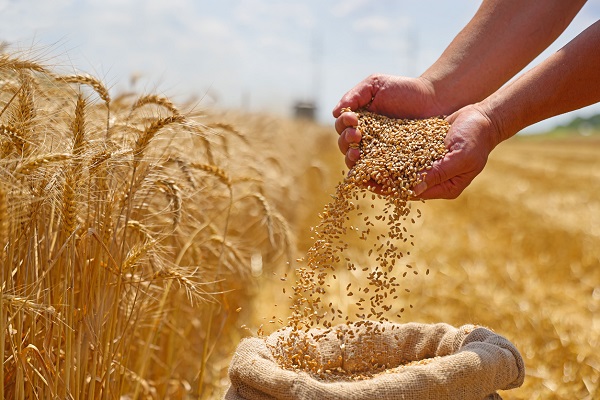
The wheat crop illustrates the problem. Sown area has indeed reached a new high of about 33.4 million hectares compared with 32.8 million hectares a year earlier. Area expansion normally supports higher production. Yet yields ultimately determine harvest size, and the crop has faced less than ideal conditions in recent weeks.
Major wheat growing regions across Uttar Pradesh, Bihar, Madhya Pradesh and Rajasthan have experienced rising day temperatures during the past month. Wheat in India already operates close to the upper threshold of heat tolerance. Agronomic studies suggest that sustained temperatures above about 22°C during critical growth stages can reduce grain filling and affect yields.
Recent temperature trends have therefore been far from conducive to crops.
Equally important, large parts of northern India have seen a noticeable absence of winter rainfall. Moisture availability in the soil plays an important role during the grain formation stage, and weak winter precipitation can leave the crop vulnerable precisely when it needs support. The impact is particularly visible in states such as Uttar Pradesh and Bihar.
Against this background, the official projection of 120 million tonnes appears difficult to reconcile with prevailing field conditions. The government’s own production target for wheat this season had been set at 119 million tonnes. A harvest significantly above that level would normally require both favourable weather and strong yield performance. Current evidence suggests that such optimism may be premature. A downward revision later in the season cannot be ruled out.
Yield Reality
Yet the arithmetic of yield and acreage raises doubts. If one assumes an average yield of roughly 1,200 kilograms per hectare, production would be around 10.8 million tonnes. Even under a more optimistic scenario of 1,300 kilograms per hectare, output would be closer to 11.7 million tonnes. Both calculations fall well short of the official estimate.
To its credit, the government has acknowledged that the advance estimates rely on a combination of crop-cutting experiments, historical trends, and other contributing factors. It has also indicated that the figures are provisional and subject to revision as more reliable yield data become available. That caveat is important. Successive estimates often change as the season progresses and better information emerges from the field.
For commodity markets, however, the implication is clear. Traders and processors who take positions based purely on early official projections risk being misled if the estimates later prove overly optimistic. The second advance estimate should therefore be treated as an evolving benchmark rather than a definitive measure of production.
A broader look at the 2025-26 agricultural season, combining both Kharif and Rabi crops, also highlights the gap that can exist between targets and outcomes. Cotton, for instance, had a production target of 33.5 million bales of 170 kilograms each. The latest estimate places output at about 29.1 million bales, more than 10% below the target and also lower than last year’s 29.7 million bales.
Soybean tells a similar story. While the production target had been fixed at 16.2 million tonnes, the current estimate is closer to 12.7 million tonnes. Even last year’s official figure of 15.3 million tonnes was widely viewed within the trade as overstated.
Pulses have faced comparable challenges. Production of tur, or pigeon pea, continues to show signs of structural weakness. The output target for 2025-26 was 3.8 million tonnes, yet the latest estimate places production at around 3.45 million tonnes, below last year’s 3.62 million tonnes.
Taken together, these numbers underline the pressures confronting Indian agriculture. Land availability is increasingly constrained, water resources are under stress, and climate variability is becoming more pronounced. Weather shocks that were once occasional are now appearing with greater frequency.
Looking ahead, the risks may not end with the current Rabi season. Several climatologists have warned that El Niño conditions could develop during the second half of 2026, coinciding with India’s Kharif planting cycle. If that scenario materialises, rainfall patterns could become less favourable, adding another layer of uncertainty to agricultural output.
For policymakers, the message is straightforward. Agricultural production estimates are indispensable for planning procurement, trade policy and price management. But early projections should always be interpreted in the context of evolving weather conditions and realistic yield assumptions.
For markets, caution may be the wiser course. The Rabi crop story is still unfolding.
More From BasisPoint