.png)

Chandrashekhar is an economist, journalist and policy commentator renowned for his expertise in agriculture, commodity markets and economic policy.
April 28, 2026 at 5:29 AM IST
India ranks 130th on the Human Development Index, 102nd on the Global Hunger Index, and 145th in GDP per capita. That’s barely $3,000 per head. Some 234 million of its citizens live in extreme poverty, the highest in any nation. About 800 million depend on monthly free rations of wheat or rice just to eat.
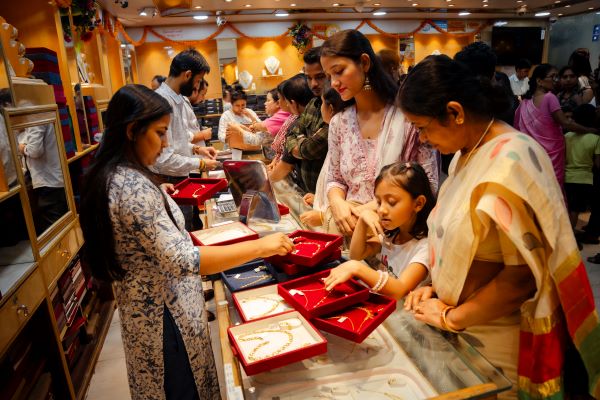
Against this backdrop, the country spent roughly $480 billion on gold imports and $38.5 billion on silver imports over the decade between 2014–15 and 2024–25. Factor in the current year, and total foreign exchange expended on these two metals crosses $600 billion in twelve years.
Alongside crude oil, gold is among the principal drivers of India's goods trade deficit. At a moment when overseas remittances are slowing and foreign direct investment outflows are outpacing inflows, a swelling trade deficit exerts downward pressure on the rupee, which in turn inflates the cost of imports and stokes inflationary pressures across the economy. The feedback loop is well understood. What is less understood is why successive administrations have declined to interrupt it.
Demerit Goods
The government has not been entirely passive. The Gold Monetisation Scheme, Sovereign Gold Bonds, and Exchange Traded Funds were designed to reduce appetite for physical gold and channel idle domestic stocks back into productive circulation. In principle, these instruments would reduce dependence on fresh imports and limit external vulnerability.
In practice, the data show no meaningful movement in that direction. Physical demand has barely shifted, and the schemes have attracted only marginal uptake relative to the scale of the problem.
More puzzling still was the decision, in July 2024, to slash customs duty on gold from 15% to 6%. The official justification framed this as relief for consumers. The evidence does not support that framing.
Retail demand has not expanded. If anything, price-sensitive buyers are simply trading down to lighter, lower-carat jewellery, which suggests demand destruction rather than stimulus. Domestic prices have not fallen in any sustained or meaningful way. What has demonstrably occurred is a sharp reduction in customs revenue, with the exchequer absorbing a loss that is difficult to justify on economic grounds. Who benefits from this revenue sacrifice warrants closer scrutiny than it has received.
One argument frequently advanced against tightening gold import policy is the spectre of smuggling — the suggestion that curbing legal imports merely diverts demand underground. This is largely a red herring.
Modern surveillance infrastructure, satellite tracking, and coordinated border enforcement make large-scale illegal gold import a high-risk, low-reward proposition. The risk-reward calculus simply does not favour it. The smuggling argument is most vigorously articulated by industry bodies with commercial ties to overseas suppliers, who have an obvious interest in maintaining access to one of the world's largest gold markets. India's liberal import regime transfers purchasing power in dollars abroad; the primary beneficiaries are not Indian consumers but the nations doing the selling.
What India's policymakers need is a coherent, enforceable framework, one that maximises customs revenue, mandates full supply-chain transparency, and requires an audit trail on the source of funds financing large gold transactions. The current approach delivers none of these. It sustains an arrangement in which rupee wealth is converted into bullion imports at scale, year after year, with no commensurate public benefit.
For the vast majority of middle-class households, the rising market value of gold jewellery remains entirely notional. Price appreciation means little unless the gold is liquidated, and family jewellery, barring distress, is rarely sold. The wealth is not real in any liquid sense. Yet the foreign exchange cost of acquiring it is very real indeed.
India is the world's fourth-largest by some metrics and its fastest-growing major economy by others. It is a country where hundreds of millions cannot meet basic nutritional needs. Yet over twelve years, it has spent $600 billion importing non-essentials.
Who says India is a poor country?
More From BasisPoint