.png)

Does the Market Fall Mean the Budget Was a Big Disappointment?
Despite a sharp post-Budget market fall, the government stayed fiscally prudent, raised capex targets, and stuck to deficit goals—signals markets may soon reassess.

Chokkalingam, Founder of Equinomics Research, has over 40 years of experience in economics and markets, leading research teams at top financial firms.
February 2, 2026 at 5:07 AM IST
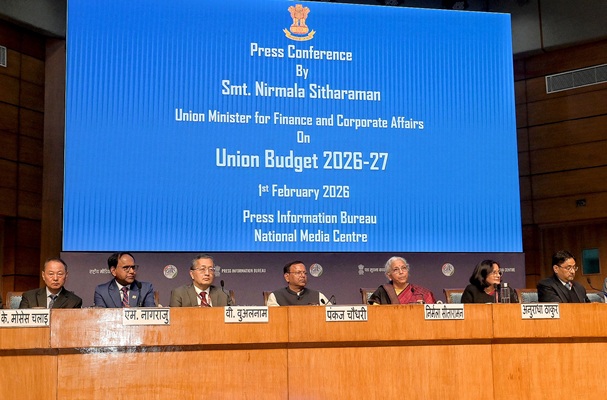
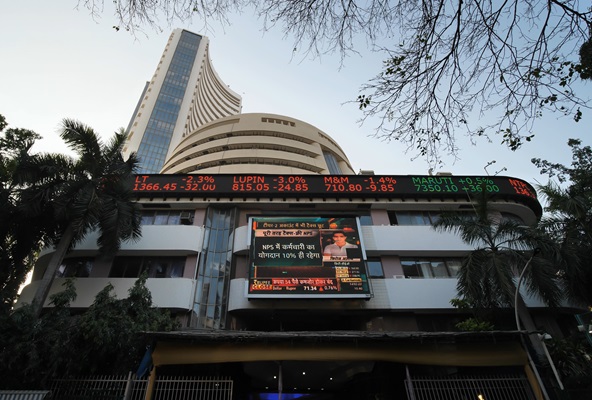
Major equity indices fell nearly 2% post Budget presentation. Does the market's perception and its reaction indicate that the Budget was a disappointment? Not really.
Budget deliveries are fair when we consider major constraints on mobilisation of tax revenues, which have been under severe pressures – they grew by just 7% year-on-year in 2025-26. Despite the single-digit growth in tax revenues, the government managed to contain the fiscal deficit at 4.4% of GDP in 2025-26 as originally estimated. Similarly, it stuck to target for revenue deficit as well at 1.4%.
The government also managed to freeze the capital receipts, which invariably creates liabilities proportionately, at the same level in absolute terms on a year-on-year basis in 2025-26. It managed to control growth in both total expenditures as well as revenue expenditures at single-digit levels of 6.7% and 7.4%, respectively. Of course, the government was forced to be content with growth in capital expenditures also at just 6% for 2025-26.
This is where the proposals for 2026-27 score over the previous budget achievements. Next financial year is also expected to continue to face significant pressures on mobilisation of tax revenues, which are expected to grow again at poor single digit of 7.2% year-on-year. Even non-tax revenues are estimated to be stagnant in a year-on-year basis in 2026-27.
Despite such a difficult environment envisaged for the next fiscal year, the government didn’t compromise on fiscal prudence. It budgets borrowings to grow only by 8.8% in 2026-27. It targets fiscal deficit to fall from 4.4% in 2025-26 to 4.3% in 2026-27. The government aims to maintain the revenue deficit to remain at the same level of 1.5% in 2026-27.
While it projects revenue expenditures to grow only at 6.6%, the government is optimistic of growing effective capital expenditures by a whopping 22% year on year to ₹17.15 trillion in 2026-27 as against ₹14.04 trillion in 2025-26. Budget hasn’t compromised on two core objectives — fiscal prudence and economic growth. But the capital market has failed to recognize the severe constraints the government is facing on mobilisation of its own resources, credible achievements on budget deficit targets, and solid growth in capital expenditures envisaged for next fiscal year.
Capital gain tax on buyback is also a positive development – it is quite possible for many cash-rich companies to come out with buyback proposals, giving boost to the market, which has lost nearly ₹50 trillion in market capitalisation from the record high. Higher buyback tax for the promoters as compared to public investors may not be a major discouraging factor for announcing the buybacks as they tend to increase promoters’ equity stakes in their companies without spending their own money.
Still, the market is disappointed, perhaps on account of nearly 10% shortfall in effective capital expenditures in the revised estimate of 2025-26 as compared to the original estimate. However, it is quite difficult to miss the capital expenditure target in the next fiscal when the economy is facing the threat from the tariff war and the rupee is weakening quite substantially. The government has announced several initiatives to boost production of import substitutes and also to promote exports through a successfully proven model of PLI schemes for electronics manufacturing.
Of course, the Budget banks on other capital receipts, which is projected to grow 136% year-on-year in 2026-27. Other capital receipts largely consist of proceeds from disinvestments and asset monetisation. The government has limited options to compromise on the target of capital expenditures for a second year in a row, considering constraints on goods exports and rupee weakness. Hence, this time, the central government would be under tremendous pressures to reach the disinvestment target. Equity market would soon realise fair deliveries of Budget and also necessity of achieving the capex target in next fiscal year. Stock market is expected to recover quite significantly soon on realising these realities.
More From BasisPoint