.png)


Krishnadevan is Consulting Editor at BasisPoint Insight. He has worked in the equity markets, and been a journalist at ET, AFX News, Reuters TV and Cogencis.
December 2, 2025 at 11:11 AM IST
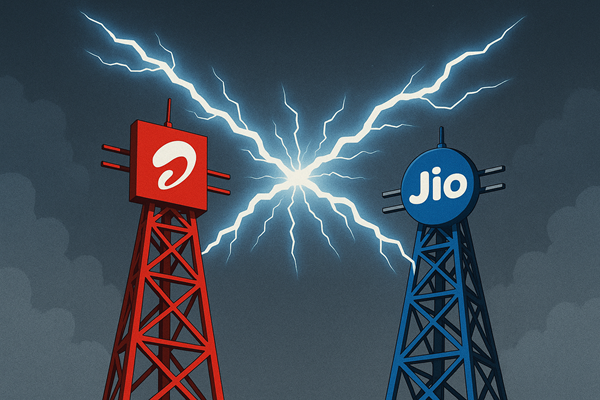
India’s telecom story appeared to be slowing down, but the numbers keep contradicting the script. October delivered 5.7 million new active users, bringing the total to roughly 1.09 billion — the strongest monthly addition in five months. Reliance Industries subsidiary Jio Infocomm bagged 3.9 million of them, Bharti Airtel 2.7 million, while Vodafone Idea lost another 0.4 million and BSNL lost 0.6 million.
The number that matters now is not how many SIMs exist, but how many are actually used. Jio’s active-to-total ratio is at 98%, Airtel’s is at 99.6%, and Vodafone’s is around 85%. The industry saw about 15 million number-portability requests, a reminder that users are not chained to legacy choices.
The growth spurt is coming from outside the obvious centres. Tele-density in urban areas stands at 134.7%, and rural at 59.7%. The battleground has moved. It is no longer about squeezing incremental share out of an over-data-saturated Mumbai; it’s about capturing first-time households in Moradabad and Madhepura.
On share metrics, Mukesh Ambani's Jio leads with just over 43.5% share of active users, and around 41% of total wireless users. Airtel holds around 35.8% active share. Vodafone Idea is in the mid-teens, around 15.6%. The relative positioning has not changed much. Jio is still climbing. Airtel is holding and expanding selectively. Vodafone is leaking.
Also Read: Bharti Airtel Keeps Scoring but Parries Questions on Capex Intensity
The more interesting shift is in what form connectivity reaches the home. India’s home broadband momentum is increasingly wireless. The interesting development is in Unlicensed Broadband Radio Fixed Wireless Access. TRAI data indicates nearly 10 million 5G FWA users in October, excluding UBR connections. Separately, Jio has an additional 2.84 million users on its UBR-FWA network. UBR FWA, in plain speak, is broadband access via fixed wireless equipment that primarily uses outdoor radios or customer-premise equipment instead of laying fibre or relying only on licensed 4G/5G spectrum. Reliance’s JioAirFiber now touches almost 5,900 towns. Bharti Airtel, which once doubted the economics, is now aggressively building presence as customer premise equipment costs fall and returns improve. In markets where fibre trenching faces local bureaucratic delay or hurdles, radios win.
Focussing on broadband matters because households generate higher ARPUs and more stable data-consumption patterns than prepaid SIM holders. Volume shows scale, but household connectivity drives monetisation. Airtel sees the opportunity too — its home services have quietly clocked double-digit growth across recent quarters — but it is starting from further behind.
There is also the machine-to-machine layer that rarely grabs headlines but deeply influences operator economics. India now has around 98.9 million M2M cellular lines. Airtel controls roughly 60% of them. While this is a low-ARPU, low-churn business, it is strategic. From logistics sensors to smart meters to connected payments, M2M is becoming the invisible inventory of the digitised economy.
What does all this mean for pricing? The consensus is that subscriber momentum and rising data penetration justify tariff hikes. If higher prices were truly biting, active subscribers would not be rising at the fastest clip in years. It appears the price elasticity is intact, with gains, prima facie, disproportionately coming from those who can least afford it. But this can change.
So, the question to not ask is “Who added the most SIMs this month?”, but rather “Who owns the pipes that matter?” The ones that go into homes, enterprise devices, machines and places that were once off-grid. The churn statistics show that Indian users have finally stopped treating telecom operators like utility providers and are now evaluating them on performance. It is not about airwaves but connections that stick.
More From BasisPoint