.png)

A Little Help for Japan and the Return of Managed Currencies
Reported US support for the yen is more than a market operation. It signals the return of coordinated currency management as economic statecraft.
Gurumurthy, ex-central banker and a Wharton alum, managed the rupee and forex reserves, government debt and played a key role in drafting India's Financial Stability Reports.
August 5, 2026 at 3:36 AM IST
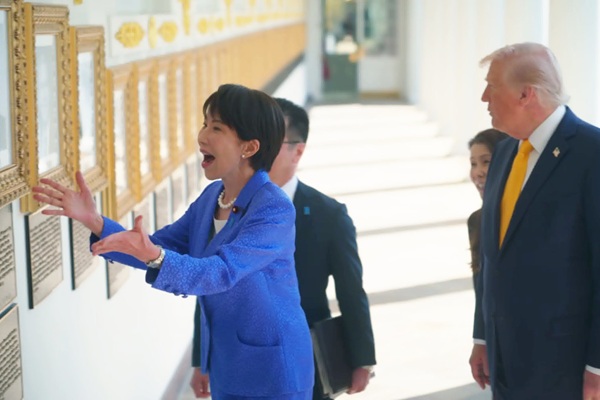
Donald Trump described the episode with characteristic casualness: "We have a good relationship with Japan ... They have a weakening yen, and they wanted a little bit of help." It sounded like a neighbour offering a jump-start for a dead car battery. Yet behind the quip lies a potentially significant shift in international finance.
If reports of US participation are accurate, Washington joined Tokyo in coordinated action to support the yen. Such cooperation is rare. This would not be just another instance of central banks buying and selling currencies, but a reminder that exchange rates, despite decades of free-market rhetoric, remain instruments of statecraft.
Plaza Echoes
The agreement succeeded in moving the currency. The dollar depreciated sharply against the yen and the Deutsche Mark. Its consequences, however, were far less straightforward.
The yen's rapid appreciation hurt Japan's export competitiveness. The Bank of Japan responded with prolonged monetary accommodation, which helped fuel an extraordinary asset boom. When the bubble burst, Japan entered its "Lost Decades" of weak growth, persistent deflation and repeated policy experimentation.
Also Read
Yen Intervention Raises Spectre of a Plaza Accord Remake
Whether the Plaza Accord caused Japan's subsequent malaise remains debated. The broader lesson is less contentious: currency management can generate effects far beyond its immediate objective.
Today's circumstances are almost the mirror image of 1985. Four decades ago, Washington wanted a weaker dollar. Now, it appears to want to prevent an excessively weak yen. The motive is no less self-interested.
Japan remains one of the largest foreign holders of US Treasury securities. A disorderly yen depreciation could prompt Japanese investors to repatriate capital or sell US bonds, pushing Treasury yields higher when the US is already grappling with elevated borrowing costs.
Helping Japan, then, is less an act of charity than prudent financial self-preservation. In international finance, friendship usually comes with a balance sheet.
Reports also suggest that part of the intervention may have occurred through the euro-yen market rather than directly through dollar-yen. If so, the route matters less for the economics than for the signalling. It could support the yen without making it appear that Washington was explicitly targeting the dollar, an awkward perception for an administration that publicly favours a strong dollar.
The choreography illustrates how modern currency operations seek to manage not only exchange rates, but also market psychology.
Statecraft Returns
Trump merely makes the claim more openly than most. The strengthening yen might as well carry an invisible sticker reading: "I did that."
Yet dismissing the episode as political theatre would miss its wider significance. For nearly three decades, advanced economies championed market-determined exchange rates while accusing others of currency manipulation. Treasury reports monitored trading partners for excessive intervention, while multilateral institutions extolled the discipline of floating currencies.
Practice has always been more pragmatic. When financial stability is at risk, official intervention tends to override doctrine.
The episode therefore says less about Japan than about the evolving international monetary system. The prevailing orthodoxy of globalisation treated markets primarily as mechanisms of price discovery, with limited official interference. The emerging order increasingly treats them as strategic infrastructure to be managed when national interests demand it.
Currencies are regaining their role as geopolitical tools.
The Plaza Accord sought to reshape global trade through exchange rates. The recent intervention appears aimed instead at preserving financial stability amid large fiscal deficits, volatile capital flows, and heightened geopolitical rivalry. Both episodes show that governments can move currencies decisively. They also show that the consequences can extend well beyond the immediate target.
The operation should therefore not be judged solely by whether the yen strengthens over the next few weeks. Its more durable significance may be that it marks the return of coordinated currency management as an accepted policy instrument in an increasingly fragmented world economy.
Trump's remark may deserve to be remembered, not because it explains the yen's move, but because it inadvertently captures the scale concealed by casual language. In international finance, a "little bit of help" can involve billions of dollars, multiple central banks, delicate diplomacy, and calculations stretching from Tokyo to Washington.
That is rather more complicated than the phrase suggests. Understatement, however, has rarely defined either politics or currency markets.
Also read:
The Importance of Fiscal Prudence: Lessons from the Yen’s Depreciation
More From BasisPoint