.png)


Vivek Kaul is a writer and an economic commentator.
June 23, 2026 at 3:11 AM IST
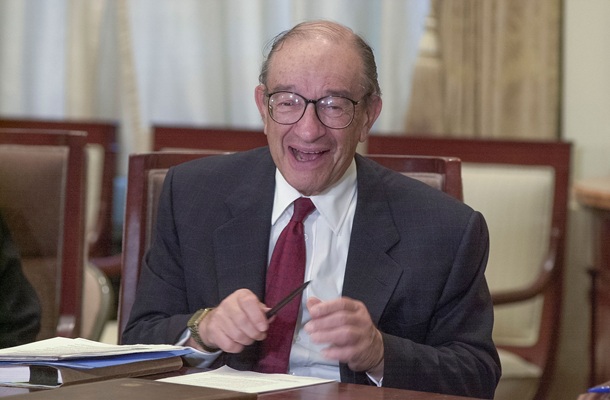
Alan Greenspan — the most famous central banker the world has ever seen — has died. He was 100.
This writer had the pleasure of being in the same room as him in January 2017, in Baltimore, United States. And there are two memories from that day.
One Greenspan wasn’t as tall as this writer thought he would be. At 90, he was stooping and physically, his best days were behind him.
Two, mentally he was as sharp as ever and his central banker’s way of speaking still hadn’t left him. Or as a quote often (mis)attributed to him goes: “I know you think you understand what you thought I said, but I'm not sure you realize that what you heard is not what I meant.”
Greenspan took over as the Chairperson of the Federal Reserve of the United States, in August 1987. He was the second longest serving Chairperson and hung his boots in January 2006.
He succeeded the great Paul Volcker who had managed to tame the double-digit inflation that had prevailed in the US through the late 1970s and the early 1980s.
Volcker was famous but Greenspan became a global celebrity. They called him the “Maestro”.
He was so famous that Senator John McCain once quipped: “If Mr Greenspan should happen to die… I would prop him up and put a pair of dark glasses on him and keep him as long as we could.”
McCain was probably giving the press a good sound bite.
Nonetheless, the dark glasses would have gone well with Greenspan’s preference for wearing dark suits, which led the philosopher Ayn Rand to call him “the Undertaker”. And this Undertaker — unlike his WWE namesake — was the real deal. Or at least that’s what the world thought of him.
The previously prepared obituaries, which have been unleashed on us as soon as Greenspan’s journalist wife Andrea Mitchell announced his death, remember Greenspan as the man who presided over nearly two decades of American prosperity.
During his tenure, inflation remained largely under control. The American economy expanded. Productivity surged. Unemployment fell. The Soviet Union collapsed and with it collapsed communism. Capitalism was the only ism in town. And not surprisingly, globalisation flourished. The internet transformed the way the world worked.
All this is true. But Greenspan also gave the world what came to be known as the Greenspan put — something that changed how the global financial system operates.
As soon as he landed, he inquired about the state of the stock market and was told: “It was down ‘five oh eight’.” Greenspan thought that the market was down 5.08 points.
But the stock market had fallen 508 points or 22.6% from its previous close. The lazy business press labelled it, the ‘Black Monday’.
It was natural this crash was compared to the stock market crash of October 1929, which led to the Great Depression.
By October 1987, the prevailing view was that the Great Depression had been caused because the Fed failed to ensure there was enough money flowing through the financial system. The Fed couldn’t be seen making that mistake again.
The next day, October 20, 1987, the Federal Reserve issued a single-sentence statement before the stock market opened, declaring it stood ready “to serve as a source of liquidity to support the economic and financial system”.
The question on the top of the mind of all the stock market wallahs was: “Is 1929 coming back?” Thanks to Greenspan it wasn’t.
He flooded the financial system with money and reassured markets that the Fed stood ready to help. The crisis passed and turned Greenspan into a media darling.
In the years to come, this pattern repeated itself with remarkable consistency.
The savings-and-loan crisis. The Mexican peso crisis.
The First Gulf War. The Asian financial crisis.
The 1998 collapse of the heavily leveraged hedge fund Long-Term Capital Management.
The aftermath of the dot-com crash.
Every time markets stumbled, monetary policy became easier. Interest rates were cut and the financial system was flooded with more money.
This came to be referred to as the Greenspan put. A "put option" is a financial derivative which can protect investors from losses.
In simple English, the Greenspan put was an unwritten guarantee to Wall Street. It made the financial world believe that come what may, if the stock market fell significantly, Greenspan would ride to the rescue by cutting interest rates and bailing out investors.
It was the ultimate socialisation of risk. If Wall Street's aggressive bets paid off, the bankers/financiers/investors/hedge funds kept the huge profits.
If the bets failed, the Fed would lower borrowing costs and cushion the fall, and try pushing the market up again.
Bubbles, Greenspan argued, could only be identified with certainty after they burst. Since central bankers could not reliably recognise them in real time, it was better to clean up after the crash than try to prevent one.
That argument justified intervention after every major market setback. Each rescue seemed justified in isolation. But together they created what economists term as ‘moral hazard’.
The Moral Hazard
Forest fires provide a useful metaphor. Small fires clear away dead wood and prevent larger disasters. Extinguish every small fire, and eventually enough fuel accumulates for a catastrophic blaze.
By repeatedly putting out smaller financial fires, policymakers created incentives for investors to take greater risks, the very definition of moral hazard.
Moral hazard is a situation where investors and financial firms believe that, come what may, the central bank and the government will come to their rescue at the slightest sign of trouble. This encourages them to take on more risks in the quest for higher returns.
Greenspan's defenders point out that he was responding to genuine crises. They are right. No central banker can simply stand by doing nothing when there is trouble.
But there is a difference between putting out large fires and putting out every fire, thereby convincing everyone that fires are impossible. That distinction became the defining feature of the Greenspan era and the years that followed.
Indeed, the Greenspan put became the defining philosophy of modern central banking and eventually it ended up creating even bigger bubbles.
The dotcom boom gave way to the housing boom. Homes became investment vehicles. Banks stopped worrying about whether borrowers could repay. Investors stopped worrying about risk. Wall Street transformed home loans into financial securities and sold them around the world.
Everyone believed home prices would keep rising. Everyone was wrong. The bill for two decades of easy rescues finally arrived.
The financial crisis of 2008 erupted after Greenspan had left office. So, it would be unfair to blame him alone. The crisis was the result of many forces acting together: securitisation, global imbalances, rating-agency failures, political incentives, financial innovation and regulatory failures.
But Greenspan helped create the intellectual climate in which risk-taking flourished and caution appeared unnecessary.
Indeed, the Greenspan put survived Greenspan. Under Ben Bernanke and Janet Yellen, it simply acquired new names.
During Greenspan’s tenure, investors learned that whenever markets stumbled or the economy weakened, the Federal Reserve would ride to the rescue with lower interest rates and abundant liquidity.
After the 2008 financial crisis, under Bernanke, this logic culminated in quantitative easing — the large-scale creation of digital money out of thin air to buy bonds and flood the financial system with money, so as to drive down long-term interest rates in the hope that people would borrow and spend, and firms would borrow and expand.
If the Greenspan put was an implicit promise to support markets, QE was its industrial-scale version. The lesson remained unchanged: risk-taking would be rewarded, while the Fed would help cushion every downside.
The Irony
Alan Greenspan admired and was close friends with writer and philosopher Ayn Rand.
Rand through her books and thinking had championed the cause of what she called ‘objectivism’.
Among other things, one of the central points of objectivism is that the moral purpose of an individual’s life is the pursuit of their own happiness and the only social system that is consistent with this right is laissez-faire capitalism, that is, allowing the various markets to operate on their own without any government intervention in them.
But Greenspan did anything but that.
In fact, Nassim Nicholas Taleb explains Greenspan’s ability to operate in two different realms very well in his book Antifragile: “A main source of the economic crisis that started in 2007 lies in the … attempt by … Alan Greenspan … to iron out the ‘boom-bust cycle’ which caused risks to go hide under the carpet and accumulate there until they blew up the economy.”
As he further wrote: “The most depressing part of the Greenspan story is that the fellow was a libertarian and seemingly convinced of the idea of leaving systems to their own devices: people can fool themselves endlessly.”
In the end, Greenspan did realise that there was a chink in his thinking armour. He acknowledged in a newspaper article in 2007: “The 1% rate set in mid-2003 … lowered interest rates … and may have contributed to the rise in US home prices.”
He also admitted in October 2008 that: “I found a flaw in the model that I perceived is the critical functioning structure that defines how the world works.”
The trouble, as the economist Milton Friedman once said, is that when a crisis occurs “the actions that are taken depend on the ideas that are lying around”.
The Maestro is dead. The Greenspan put lives on.
More From BasisPoint