.png)

Why L&T’s Defence Business Feels Strategic but Not Profitable
L&T has built India’s broadest private defence platform, but slow procurement, falling margins and long gestation test whether patience can still pay investors.

Dev Chandrasekhar advises corporates on big picture narratives relating to strategy, markets, and policy.
January 8, 2026 at 9:10 AM IST
India's defence manufacturing revolution has markets chasing the usual suspects. Bharat Electronics, Bharat Dynamics, and Tata's aerospace ambitions dominate investor attention. But the stealth contender in this nationalist narrative might be hiding in plain sight—within Larsen & Toubro's sprawling engineering empire.
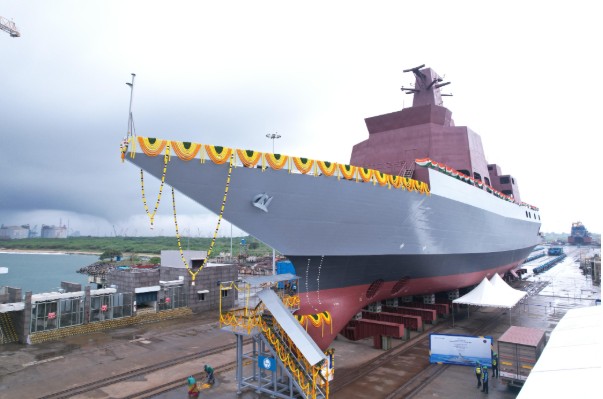
L&T's Precision Engineering & Systems division has quietly built what amounts to India's most diversified defence manufacturing footprint spanning armoured vehicles, warships, launch systems and aerospace components. The company has developed over 250 indigenous systems since the early 1980s, creating intellectual property and breadth no Indian pure-play defence manufacturer can match.
The financial performance, however, tells a story of promise and, in equal measure, of pain. PES revenue surged 53% year-on-year in the first half of fiscal 2026, reaching nearly ₹60 billion. The growth was driven by the ₹65 billion Vajra artillery repeat order and shipbuilding contracts. Yet EBITDA margins collapsed to 8.3% in the June-September 2025 quarter from 13.6% a year earlier. That represents a 530 basis point decline.
Management attributes the pressure to cost provisions on certain jobs, early-stage project concentration, and developmental costs. For comparison, Bharat Electronics posted 29.4% EBITDA margin in the same quarter.
This raises a fundamental question: are markets overvaluing BEL and BDL, undervaluing L&T’s defence optionality, or correctly discounting procurement execution risk? BEL trades at nearly 50x trailing earnings despite modest revenue growth prospects in a mature electronics business. BDL commands similar premiums for what is essentially a monopoly in guided missiles—a strong franchise but a narrow one. L&T’s defence capabilities, while demonstrably broader across naval systems, land platforms, and aerospace, carry the burden of lower margins and order unpredictability.
Markets may be pricing in not just current profitability gaps but skepticism about whether India’s procurement system will ever reward private sector scale and diversification. The mispricing, if it exists, hinges entirely on whether defence procurement reforms actually materialise.
L&T isn't positioning itself as just another defence contractor but as India's answer to integrated defence manufacturing. Think a mini-Lockheed Martin rather than a focused specialist. The September partnership with BEL for the Advanced Medium Combat Aircraft programme exemplifies this—a private-public consortium targeting India's next-generation fighter programme.
The Lakshya L31 strategy represents L&T's five-year roadmap, doubling down on defence electronics and expanding into electronic manufacturing services to capture the broader indigenization wave.
Yet near-term catalysts remain elusive. Order inflows plummeted 57% in the September quarter to just ₹9.5 billion, with near-term prospects limited. Defence procurement timelines in India are notoriously protracted. Programmes requiring development testing and multi-level government clearances can take years to translate into firm orders.
The timing mismatch between L&T's Lakshya L31 investment cycle and India's actual defence procurement cadence represents the core investment dilemma. The AMCA programme, for instance, won't see prototype delivery until fiscal 2028-29. Serial production sits eight to nine years away, well beyond L31's horizon.
Meanwhile, L&T must maintain expensive capabilities across multiple facilities while waiting for orders that may or may not materialise when expected. This dynamic risks creating a vendor-funded R&D trap: indigenisation mandates demand that private players develop complex systems domestically, absorbing substantial development costs and timeline risk, yet without guaranteed procurement commitments or cost recovery mechanisms.
The AMCA partnership exemplifies this. L&T invests heavily in platform integration capabilities today for production that may not commence until the mid-2030s, all while the government retains full discretion on final orders and pricing.
What makes L&T interesting isn't the defence business in isolation. Management acknowledges it will remain limited compared with faster-growing infrastructure segments. Rather, it's the optionality the division creates. At 30-35x consolidated earnings, L&T trades at a decent valuation—but given defence represents only 8-10% of revenue with depressed margins, that multiple likely reflects infrastructure growth expectations rather than material defence upside. Markets appear to treat L&T’s defence business as strategic positioning, not as a genuine earnings contributor worth separately valuing.
Investors eyeing India's defence renaissance face a choice: bet on focused specialists like BEL and BDL, or wager on L&T's patient capital approach. Asymmetric upside might be possible if India's defence procurement matures beyond the current stop-start rhythm.
But with margins under pressure and order flows uncertain, this dark horse might need several more miles before reaching the finish line.
More From BasisPoint