.png)

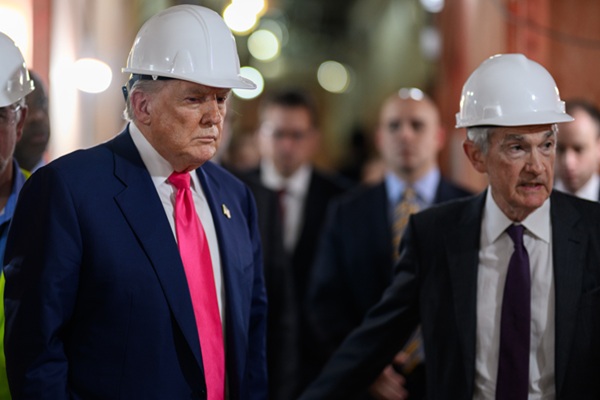
There is no direct precedent for the US Department of Justice’s threat of a criminal indictment of Federal Reserve Chair Jerome Powell, or Powell’s public rebuke of it. But as Mark Twain supposedly observed, though history doesn’t repeat itself, it often rhymes. In fact, two episodes offer insight into the current standoff and the future of Fed independence.
The first began 75 years ago this month. With annualized inflation on track to surpass 12% in the first quarter of 1951, the Fed was under pressure to raise interest rates. But the Korean War was underway, and the Treasury wanted lower interest rates to ease financing of the associated debt. That January, after a series of increasingly sharp exchanges, the Fed defied the Treasury by lowering the bond price, effectively raising rates.
Furious, President Harry Truman called the Federal Open Market Committee to the White House and accused its members of jeopardizing the fight against communism. The White House then announced to the press that the FOMC had agreed to “maintain the stability of Government securities,” and the Treasury issued a statement saying that the low-interest-rate peg on government bonds would be maintained.
Marriner S. Eccles, a member of the Fed’s Board of Governors, was defiant. He leaked the minutes of the White House meeting, which showed that the FOMC had done no such thing. A few more weeks of wrangling followed. But on March 4, the Treasury-Fed Accord was announced, granting the Fed full authority over monetary policy. Inflation quickly fell. Eccles became an icon of the Federal Reserve System, with the building that houses the Board of Governors’ main offices named after him.
The second episode occurred 20 years later. Fearing a weak economy while campaigning for reelection, President Richard Nixon attempted to coerce the Fed into monetary easing in the summer of 1971. His administration engineered a series of leaks suggesting that he and Fed Chair Arthur Burns were at loggerheads. The messages indicated that Nixon was considering either expanding the membership of the Fed Board or reducing its independence by bringing it under the executive branch, and that he had rejected Burns’ request for a salary increase – though Burns never requested one.
Unlike Eccles, however, Burns capitulated, pursuing unusually loose monetary policy in 1972. The resulting acceleration in price growth, together with commodity-price shocks, led to America’s worst bout of inflation since World War II.
These episodes hold important lessons. For starters, sometimes central bankers need to defend themselves publicly. Powell likely had the Eccles precedent in mind when he decided to release a statement disclosing the DOJ’s investigation into his testimony to the Senate Banking Committee about renovations to Fed headquarters (including, ironically, the Eccles Building). “The threat of criminal charges,” he stated bluntly, “is a consequence of the [Fed] setting interest rates based on our best assessment of what will serve the public, rather than following the preferences of the President.”
The second lesson, which Powell also seems to have internalized, is that letting politicians dictate monetary policy can have lasting consequences. The “start-stop” monetary policy of the 1970s – a direct result of Burns’ acquiescence to Nixon – allowed inflation expectations to drift upward. This trend was reversed only after Paul Volcker took over at the Fed and relied on prolonged high interest rates to re-establish policy credibility. The costs of that correction were high: the “Volcker Shock” contributed to the 1980-82 recession, during which unemployment reached double-digits.
By contrast, the anchoring of long-term inflation expectations at 2% in 2021-23 almost certainly tempered the surge in inflation and allowed disinflation to occur without a severe weakening of the labor market. With inflation still running mildly but stubbornly above the Fed’s 2% target, now is an especially precarious time to question Fed independence.
But further threats to that independence loom, and may require further action. Like Nixon, Trump may want to reduce unemployment to help his political prospects. If the public comes to believe that the central bank will tolerate somewhat higher inflation for political ends, firms will start raising prices in advance. The result will just be higher inflation. Breaking this political-monetary cycle is a key reason why Congress created an independent central bank.
Eccles, who played an important (if somewhat reluctant) role in drafting the 1935 Banking Act that established the modern Fed, recognized Congress’s vital role in asserting the central bank’s operational independence. As he put it in his 1951 address, acknowledging his role in leaking the minutes of the Truman meeting, the Fed has “not only the power but the responsibility” to fight inflation. “If Congress does not like what we are doing, then they can change the rules.”
This brings us to the third lesson: if a president takes aim at Fed independence, Congress must stand up in defense of it. Recent pledges by key US senators to oppose the confirmation of any of Trump’s nominees to replace Powell or other Fed Board members until the “legal matter” is fully resolved are a step in the right direction.
But Congress has a second job, illustrated by the 1951 clash. In that case, pressure to hold down interest rates was motivated not by politics, but by the need to finance large fiscal deficits. During WWII, the Fed kept rates low for that reason. While current federal spending as a share of GDP pales in comparison to what it was in WWII or the Korean War, the size of the federal debt is historically large and projected to continue to grow. Unless Congress takes action to reduce budget deficits, financing Treasury debt will become increasingly difficult, and challenges to Fed independence will intensify.
The DOJ investigation comes at a difficult moment for monetary policy. Missing data, a result of the prolonged 2025 government shutdown, will continue to muddle analysis of the economy’s performance. The Trump administration’s immigration crackdown distorts the picture further, as payroll-growth figures that would usually signal a recession may become the new normal. In challenging times, Fed policymakers should welcome genuine policy disagreement – and tolerate no incursion on the institution’s independence. They may need help.