.png)

Why India’s Fast Breeder Milestone is a Strategic Energy Shift
Going critical, PFBR advances India’s multi-stage nuclear roadmap, reducing reliance on uranium imports and bringing the thorium-based energy transition closer to reality.

T.K. Arun, ex-Economic Times editor, is a columnist known for incisive analysis of economic and policy matters.
April 13, 2026 at 11:07 AM IST
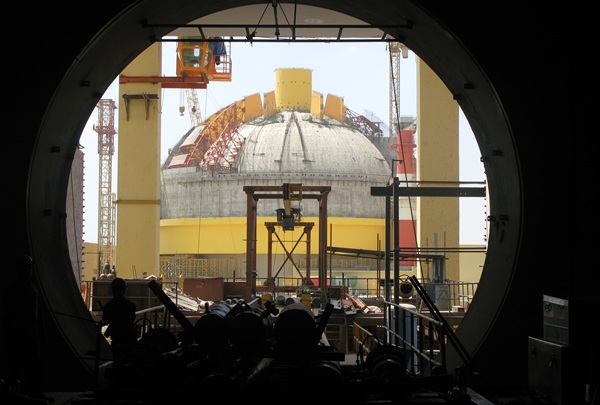
On April 6, India’s Prototype Fast Breeder Reactor went critical. This is a remarkable step forward for India’s energy security, towards the goal of relying on indigenously available thorium for power generation, and in the battle against climate change. It comes at the right time to defeat a major lobbying effort underway to persuade India to abandon its own technology for nuclear power generation and, instead, adopt a new, commercially unproven American technology to produce nuclear power.
No, the Prototype Fast Breeder Reactor, or PFBR, will not produce power from domestically available thorium. Rather, it will breed plutonium, making use, in part, of spent fuel from the conventional fission reactors. Once sufficient quantities of plutonium has been bred from breeder reactors, the stage would be set to use thorium inside the fission reactor to produce power, cutting off dependence on uranium imports for fuelling reactors.
The government of newly independent India, comprising Nehru and others like him, who had incorporated the need to develop the scientific temper into the Constitution’s Directive Principles of State Policy, were alive to the possibilities of tapping the power of atomic fission, devastatingly demonstrated in the bombing of Hiroshima and Nagasaki by the Americans in 1945. They moved early, as early as in August 1948, to set up an Atomic Energy Commission, with scientist Homi J Bhabha as secretary, and the prime minister as the chairman. The Department of Atomic Energy was constituted in 1954.
INCOSPAR, or the Indian National Committee for Space Research, was set up by the government in 1962 within the Department of Atomic Energy, to take over the functions of DAE in space research, with the Prime Minister Nehru as the chairman, and DAE secretary Dr Bhabha as secretary. Bhabha spotted Vikram Sarabhai as the right man to head space research. Indian Space Research Organisation was formally constituted only in 1969. INCOSPAR had, by then, already set up the Thumba Equatorial Rocket Launch Station, and launched rockets into space.
Thumba, a coastal fishing village in Thiruvananthapuram, was chosen for its proximity to the Equator. The spinning speed of our planet is, obviously, the maximum at the Equator, and a rocket launched from or near the equator gets the speed of earth’s rotation added to the speed generated by its engines, when it launches.
The resident fishing community, mostly Christian, was not too happy about being asked to vacate the village to make way for a rocket station. The parish priest persuaded them to relocate, given the national importance of the project, and handed over church buildings to function as project offices. Those who go around the country persecuting Christians as enemies of the nation would do well to recall this pre-history of ISRO.
Dr Bhabha conceptualised India’s nuclear energy programme as a three-stage project. The first one would be a conventional reactor making use of fissile Uranium. The second stage would utilise the plutonium recovered from the first stage reactors’ spent fuel, to breed yet more plutonium. When plutonium has been bred in sufficient quantities, that would be used to convert plentifully available local thorium into fissile uranium for the third stage of the nuclear programme, freeing India from external dependence for uranium supplies.
It was Vikram Sarabhai who set up the Fast Breeder Test Reactor, after Dr Bhabha’s untimely death in 1966 at the age of 57. Success of the FBTR, built with assistance from the French, who had built their own fast breeder reactor Rapsodie, paved the way for the Prototype Fast Breeder Reactor, which has now gone critical, with considerable delay but built on indigenous technology and fabrication.
Many in India see Canada as a country that matters because of its migration opportunities, and as a country that figures in the G7, thanks to US generosity to its neighbour. Canada was a major player in its own right in the post-World War II world. Canada was a significant exporter of nuclear reactors to several countries around the developing world, including India, Pakistan, China, South Korea, Argentina and Romania. It was the Canadian reactor design — Canada Deuterium Uranium or CANDU — that India adopted for its preferred Pressurised Heavy Water Reactors, heavy water being the oxide of a form of hydrogen, deuterium. India operates 18 of the world’s 45 or so PHWRs.
High-school chemistry has taught us that the number of protons in an atom (also equal to the number of electrons, in the normal state of electrical neutrality) defines its character as an element. The atomic mass represents the sum of protons and neutrons inside the atom. A neutron is a proton whose positive charge is neutralised by an electron. When a neutron undergoes beta decay, that is, loses an electron, it becomes a proton. This is key to understanding how thorium, with an atomic number 90, can transmute into uranium, whose atomic number 92, and how uranium can be induced to breed plutonium, with an atomic number of 94.
In the first stage reactors, non-fissile Uranium 238, mixed with a tiny proportion of fissile U 235, undergoes fission and produces energy, the fission fragments Barium and Krypton, and charging neutrons. Control rods introduced into the reactor absorb some neutrons, to ensure that the fission process stays critical, meaning, each fission, on average, creates another fission, sustaining the chain reaction. If each fission creates, on average, less than one other fission, that is, the reactor is sub-critical, the reaction chain will fizzle out. When each fission is permitted to create multiple other fissions, we have supercriticality or, in its material form, the makings of a nuclear bomb.
Some U238 atoms absorb a neutron to become unstable U239. That additional neutron loses an electron to become a proton, changing the atomic number of the element to 93, which is Neptunium. Neptunium is highly unstable, gains a proton to become the element with atomic number 94, that is, Plutonium. This plutonium, highly toxic and radioactive, is recovered from the spent fuel, and used to create the plutonium oxide part of the mixed oxide fuel for the second stage of the nuclear programme.
Plutonium oxide is mixed with Uranium oxide to form the fuel for the breeder reactor, in which liquid sodium is used as the coolant/moderator, in place of pressurised heavy water in PHWRs. While fissile Plutonium induces fission in the Uranium in the reactor core, neutrons from the reactor core bombard atoms in a blanket of U238 around the core. These uranium atoms gain protons to turn into plutonium. This is why this is called a breeder reactor: it breeds yet more fissile material. When lots of plutonium has been bred in this fashion, we are ready for the third stage of the nuclear programme.
In the third stage, the blanket of U238 around the core is replaced with a blanket of thorium. The thorium, bombarded with charging neutrons, gains two protons to become fissile Uranium 233. This uranium then becomes fuel for the PHWR of Stage 1. Once the breeder reactors work well, India can be self-reliant on uranium supplies.
In this era of rising importance of energy independence and freedom from imported hydrocarbons, technologies that make use of India’s natural endowments, such as coal gasification and the three-stage nuclear programme, become critical. This is why the success of the PFBR is welcome news for the Indian economy.
More From BasisPoint