.png)

Why India Keeps Paying the Psychological Price for the Fed’s Mixed Signals
India’s markets remain steady on fundamentals but still swing to every hint of Federal Reserve uncertainty, revealing how psychology now shapes price action.

December 7, 2025 at 5:35 AM IST
If Indian equity markets had a personality, it would resemble the dependable partner: steady, attentive to fundamentals, and committed to long-term building. Yet this partner finds itself frequently unsettled—not by its own choices but by the emotional ambiguity of a distant economic power. India’s macroeconomic foundation remains firm: stable GDP growth, resilient earnings, rising investment, and deepening domestic flows. None of this has meaningfully wavered. Still, confidence oscillates with a single hesitant phrase from the Federal Reserve chair. A cautious “we’re watching the data” or a mild pause can travel from Washington to Mumbai in seconds, triggering involuntary unease across trading desks and retail portfolios alike.
The reach of this anxiety is startling. A press briefing thousands of miles away can produce behavioural shifts in an otherwise steady market—proof that financial reactions are often emotional long before they are analytical.
Emotional Contagion
The numbers make this clear. In November, foreign portfolio investors pulled out ₹37.65 billion, even though not a single core indicator of India’s economic reality deteriorated. Only a month earlier, India saw inflows of ₹146 billion. Factories did not slow. Consumption did not contract. Corporate performance did not falter. What changed was the global emotional atmosphere drifting outward from the Federal Reserve: a spike in uncertainty that cascaded into risk-averse behaviour across continents.
Markets behave, in these moments, much like a calm airport terminal suddenly ruffled by an unverified rumour about weather somewhere else. Your own flight is fine; the conditions around you are stable. But the whisper of trouble in a far-off hub is enough to alter collective behaviour—shoulders tense, queues form prematurely, screens are refreshed obsessively. The response is psychological, not factual.
India’s markets now respond similarly: not as calculators of fundamentals, but as receivers of mood.
Finance likes to pretend it is math. It is not. Finance is biography, memory, and instinct disguised as numbers. It is the story investors tell themselves about tomorrow, and right now, the most powerful storyteller in that narrative is an anxious American named the Federal Reserve. Its caution becomes our emotional inheritance.
This inheritance sits deep in the brain. When the Fed signals uncertainty—pausing, hedging, refusing clarity—it activates primitive neural networks responsible for detecting social threat. Psychologists call this an abandonment micro-shock. It is the same circuitry that interprets a friend’s unread message or a partner’s indifferent tone as potential rejection. In markets, this micro-shock bypasses logic and dives straight into survival mode. Investors retreat not because India’s fundamentals are weak but because uncertainty itself feels unsafe.
This is what policymakers often sanitise as “volatility”. In truth, it is a rapid, near-biological reflex—a fear response coursing through global portfolios. At every hint of hesitation from the Fed, positions are trimmed, the rupee softens, yields shift. None of this reflects India’s intrinsic worth; it reflects decades of conditioning that has taught markets to flinch at American monetary ambiguity.
When clarity doesn’t arrive, the mind enters what can be described as an Ambiguity Fog: a hazy, disorienting state where investors compulsively seek patterns, refreshing data, rereading statements, searching for signals that may not exist. The market behaves like someone caught between text messages with an emotionally distant partner—checking, rechecking, interpreting silence, projecting meaning where none was intended. This is why we see sharp rallies followed by sudden pullbacks that make no fundamental sense. The market isn’t reacting to India’s reality—it’s buffering psychological suspense.
Soon comes the Anticipation Loop: a hyper-vigilant phase where every remark, data point, or tonal nuance from the Fed becomes a clue about tomorrow’s risk. At that point, markets are no longer trading economics; they are trading apprehension.
Yet something quieter and more constructive is unfolding beneath these emotional oscillations. India’s expanding economic and strategic partnership with the United States is beginning to function as an alternative anchor. Traditionally framed as a matter of diplomacy and trade, this partnership now carries psychological weight. Each step forward signals to investors that India is not merely a passive recipient of global capital, but an increasingly influential participant in shaping global stability.
This narrative functions as emotional insurance—softening the blows of Fed ambiguity and providing investors a more grounded storyline to hold onto when uncertainty spikes. It reframes India from being subject to the Fed’s mood to being a co-author in the global economic script.
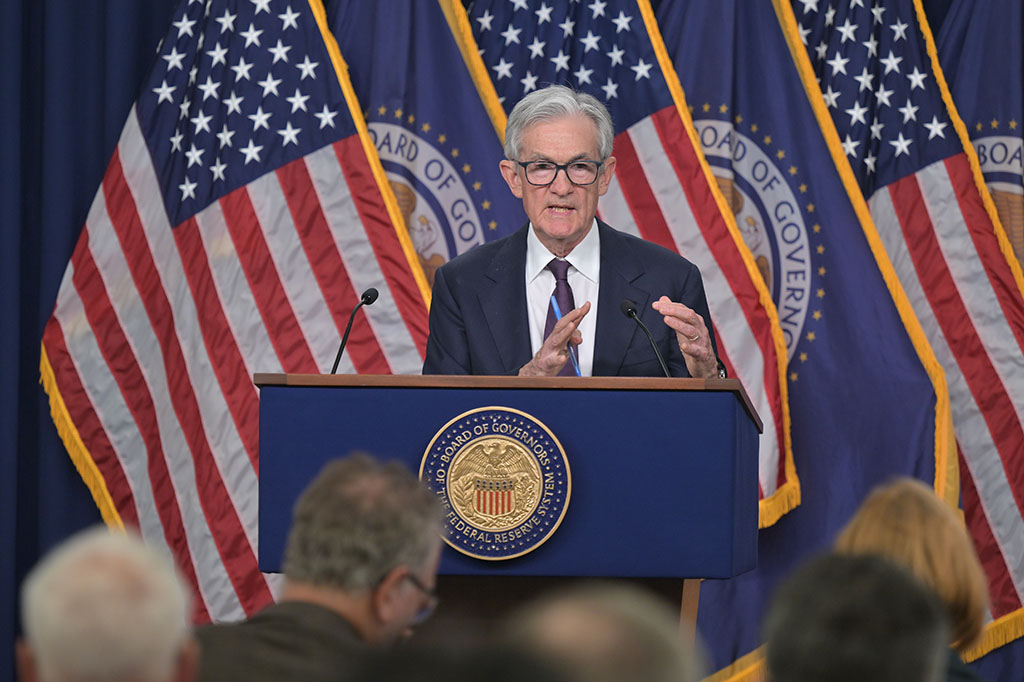
This brings us to December, the emotional crescendo of the year. This month is never decided by neat spreadsheets. It is shaped by fatigue, hope, anxiety, and anticipation converging all at once. The holiday slowdown, the year-end book closures, and the Fed’s final meeting create a psychological brew more potent than any policy move. One reassuring phrase from Jerome Powell could unleash a wave of relief-driven re-entry into Indian equities. One ambiguous hesitation could trigger another rapid pullback. These swings will not reflect fundamentals; they will reflect mood.
More From BasisPoint